Belt Drives
Pulley & Belt Ratio Calculator
Driven RPM, speed ratio, and open-belt length from pulley diameters — plus reverse mode to hit a target RPM.
Open Pulley & Belt Ratio ->TestTalkHQ • Machining & Fabrication Hub
Speeds, feeds, bending math, and tolerance checks for lathe, mill, drill, tap, press brake, and tube work — plus concrete volume for pads and footings. Built for shop setup and quoting, not textbook-only theory.
For most jobs, pick the operation first (turn, mill, drill, tap, bend, or stack tolerances), set SFM or chip load from material and tooling, then verify feed, depth, and machine limits before you cut air. Sheet metal and brake work usually flows from bend radius → allowance or deduction → flat length; hole work from drill → ream → tap in that order when precision matters.
Belt Drives
Driven RPM, speed ratio, and open-belt length from pulley diameters — plus reverse mode to hit a target RPM.
Open Pulley & Belt Ratio ->Lathe
Turning RPM, IPR feed, depth of cut, and MRR from diameter, material SFM, and insert limits.
Open Lathe Turning ->Milling
RPM, IPM, and chip load for end mills — slotting, profiling, and adaptive paths by flute count.
Open Milling Speed/Feed ->Drilling
Drill RPM and IPM from material, drill diameter, and practical peck or coolant assumptions.
Open Drill Speed ->General Cutting
Baseline SFM and feed targets across common materials when you need a quick speed sanity check.
Open Cutting Speed ->Speed & Feed
Combined SFM → RPM → feed workflow with chip load for milling and general machining operations.
Open Speed & Feed ->Milling
Feed per tooth (IPT) and table feed from spindle RPM, flute count, and target chip load.
Open Chip Load ->Boring
Boring RPM and feed with L/D and rigidity in mind — internal holes without chatter surprises.
Open Boring Bar ->Reaming
Reamer RPM, feed, and stock allowance for size and finish on pre-drilled holes.
Open Reaming Speed ->Tapping
Tap RPM and synchronized feed by thread pitch, material, and hole type (through vs blind).
Open Tapping Speed ->Lathe
Starting diameter and pitch for clean knurl patterns — avoid doubled or torn knurls on the first pass.
Open Knurling ->Lathe
Parting blade RPM and feed for stable cutoff without rub, chatter, or blade breakage.
Open Parting/Cutoff ->Hole Prep
Countersink depth for flush flat heads and counterbore depth for socket-cap and shoulder screws.
Open Countersink Depth ->Finish
Theoretical Ra from nose radius and feed — compare to print callouts before you chase the comparator.
Open Surface Finish Ra ->Tapping
Estimated threading torque by tap size and material — torque limits, tap breakage, and driver choice.
Open Tap Torque ->Threads
TPI, metric pitch, and major/minor/pitch diameters for standard inch and metric threads.
Open Thread Pitch ->Pipe Threads
ASME B1.20.1 tap drill, TPI, major/minor diameter, hand-tight L1 and wrench-makeup L2 for 1/8"–4" NPT.
Open NPT Pipe Thread ->Threads
Minimum engaged thread length by material and load — stripped threads vs adequate grip in tapped holes.
Open Thread Engagement ->Angle / Inspection
Convert target angle to gauge-block stack height (or reverse) for 5" and 10" sine bars — with 81/83-piece suggestions.
Open Sine Bar Angle ->Tolerance
Worst-case and RSS stack of part tolerances — will the assembly fit before you cut multiple setups?
Open Tolerance Stack-Up ->Press Brake
Air-bending tonnage from material thickness, width, die opening, and tensile strength.
Open Press Brake Tonnage ->DXF · Measure + Cleanup
Pan, zoom, measure, toggle layers, delete stray lines, and export a clean DXF — nothing uploaded. Sanity-check pierce count and cut length before nesting or quoting.
Open DXF Viewer ->Cutting · Estimating
Laser, plasma, or waterjet cut time and cost from manual length or DXF upload — PDF and CSV export for shop estimates.
Open Cut-Cost Estimator ->Cutting · CNC plasma
Gantry pierce height, pierce delay, cut height, and IPM starting range from material, thickness, and 40–105A — distinct from handheld torch amps.
Open CNC Plasma Calculator ->Sheet Nesting · Export
True-shape nesting for sheet metal and plate — rectangles, circles, and DXF/concave parts with kerf, multi-sheet overflow, and PDF/DXF/CSV export. Pairs with the 1D Cut List Optimizer for bar and tube.
Open 2D Sheet Nesting Optimizer ->Sheet Metal
Bend allowance, bend deduction, and flat blank length from angle, radius, and K-factor.
Open Bend Allowance ->Sheet Metal
Bend deduction and K-factor from inside radius and material thickness for flat-pattern layout.
Open Bend Deduction ->Sheet Metal
Minimum inside bend radius by gauge and material — cracks, coining, and grain direction limits.
Open Bend Radius ->Tube
CLR, arc length, bend deduction, and wall thinning estimates for round tube and pipe bends.
Open Tube Bending ->Project
Cubic yards, cubic feet, and bag counts for slabs, footings, and pads — shop floors and equipment bases.
Open Concrete Volume ->When the deliverable is a printable template or export file — not just a number — use the Interactive Tools Hub. Flat-pattern unfolders, tube notch wrap templates, cone/transition developments, cut-list optimizers, and pipe miter templates live there only: bend-allowance flat-pattern unfolder, tube notch template generator, cone/transition flat-pattern generator, square-to-round transition flat-pattern generator, cut list optimizer, and pipe miter template generator export PDF, DXF, CSV, or JSON.
Use the calculators above for speeds, feeds, tonnage, and dimensions; switch to /tools/ when you need a file you can print, nest, or hand to a customer.
No. Calculators and guides give validated starting points — always prove feed, depth, and tooling on scrap or a test pass before production.
SFM (via RPM) controls heat and tool life; feed and chip load control finish, engagement, and whether chips clear. One without the other misleads you.
Both describe the same flat-pattern correction from different reference faces. Pick the mode your print or CAM expects, then stay consistent through the job.
On the Interactive Tools Hub — not in the calculator grid above. Size bends and tube here; export templates there.
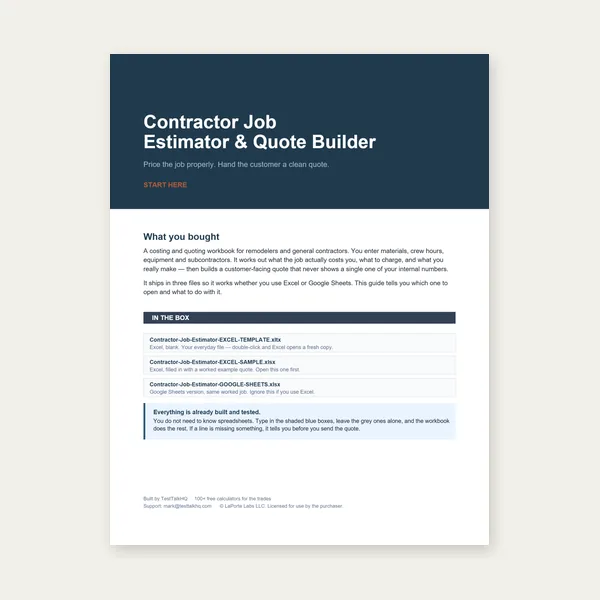
Price remodels and GC work, then send a quote with no internal numbers.
Excel or Google Sheets. Best on a computer.
$29.00
BuyCheckout opens in a new tab.