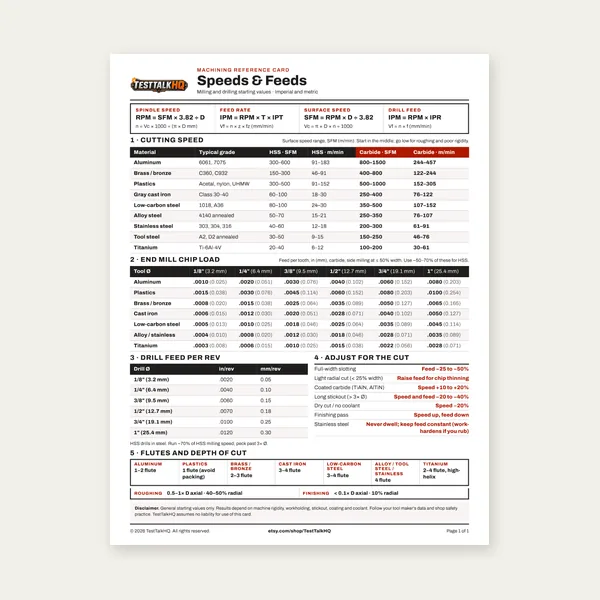
Machining Speeds & Feeds Card
One page. Speeds, chip load and drill feed, imperial and metric.
$3.99
BuyCommon shop diameters with speed ratios at 1725 and 3450 RPM motors
This chart is a planning reference for open V-belt drives using diameter ratio. It assumes negligible slip and uses outside/pitch diameter interchangeably as a shop approximation — for critical compressor or spindle limits, prefer catalog pitch diameter and verify with a tachometer.
Non-standard size?Any diameters, reverse sizing, and belt length.
Open Calculator →Each row pairs a driver (motor) pulley diameter with a driven pulley diameter. Ratio is driven÷driver. RPM @ 1725 and RPM @ 3450 are the driven-shaft speeds for those common single-phase motor nameplates using N₂ = N₁ × (D₁ / D₂).
Use the chart when you are standing in front of a shelf of cast sheaves and need a fast shortlist. Then confirm center distance, belt section, and horsepower rating before you buy. The interactive tool is better when one diameter is already fixed and you are solving for the other — that is reverse mode on the Pulley & Belt Ratio Calculator.
The diameters listed — roughly 2" through 12" — cover the majority of fractional-horsepower to ~5 HP shop drives: drill-press steps, compressor motor/pump sheaves, bench-lathe countershafts, and buffer/grinder conversions. Below ~2" on classical V-belts, bend stress climbs and belt life falls; above ~12" on small frames you often run out of guard clearance or center-distance adjustment.
Skipping identical driver/driven pairs keeps the table focused on actual ratio changes. A 1:1 pair is still valid mechanically (idler-like speed match) but it is rarely the answer when you opened a chart to change speed.
| Driver (in) | Driven (in) | Ratio D₂/D₁ | RPM @ 1725 | RPM @ 3450 |
|---|---|---|---|---|
| 2.0 | 2.5 | 1.250:1 | 1380 | 2760 |
| 2.0 | 3.0 | 1.500:1 | 1150 | 2300 |
| 2.0 | 4.0 | 2.000:1 | 862 | 1725 |
| 2.0 | 5.0 | 2.500:1 | 690 | 1380 |
| 2.0 | 6.0 | 3.000:1 | 575 | 1150 |
| 2.0 | 8.0 | 4.000:1 | 431 | 862 |
| 2.0 | 10.0 | 5.000:1 | 345 | 690 |
| 2.0 | 12.0 | 6.000:1 | 288 | 575 |
| 2.5 | 3.0 | 1.200:1 | 1438 | 2875 |
| 2.5 | 4.0 | 1.600:1 | 1078 | 2156 |
| 2.5 | 5.0 | 2.000:1 | 862 | 1725 |
| 2.5 | 6.0 | 2.400:1 | 719 | 1438 |
| 2.5 | 8.0 | 3.200:1 | 539 | 1078 |
| 2.5 | 10.0 | 4.000:1 | 431 | 862 |
| 2.5 | 12.0 | 4.800:1 | 359 | 719 |
| 3.0 | 2.5 | 0.833:1 | 2070 | 4140 |
| 3.0 | 4.0 | 1.333:1 | 1294 | 2588 |
| 3.0 | 5.0 | 1.667:1 | 1035 | 2070 |
| 3.0 | 6.0 | 2.000:1 | 862 | 1725 |
| 3.0 | 8.0 | 2.667:1 | 647 | 1294 |
| 3.0 | 10.0 | 3.333:1 | 518 | 1035 |
| 3.0 | 12.0 | 4.000:1 | 431 | 862 |
| 3.5 | 2.5 | 0.714:1 | 2415 | 4830 |
| 3.5 | 3.0 | 0.857:1 | 2013 | 4025 |
| 3.5 | 4.0 | 1.143:1 | 1509 | 3019 |
| 3.5 | 5.0 | 1.429:1 | 1208 | 2415 |
| 3.5 | 6.0 | 1.714:1 | 1006 | 2013 |
| 3.5 | 8.0 | 2.286:1 | 755 | 1509 |
| 3.5 | 10.0 | 2.857:1 | 604 | 1208 |
| 3.5 | 12.0 | 3.429:1 | 503 | 1006 |
| 4.0 | 2.5 | 0.625:1 | 2760 | 5520 |
| 4.0 | 3.0 | 0.750:1 | 2300 | 4600 |
| 4.0 | 5.0 | 1.250:1 | 1380 | 2760 |
| 4.0 | 6.0 | 1.500:1 | 1150 | 2300 |
| 4.0 | 8.0 | 2.000:1 | 862 | 1725 |
| 4.0 | 10.0 | 2.500:1 | 690 | 1380 |
| 4.0 | 12.0 | 3.000:1 | 575 | 1150 |
| 5.0 | 2.5 | 0.500:1 | 3450 | 6900 |
| 5.0 | 3.0 | 0.600:1 | 2875 | 5750 |
| 5.0 | 4.0 | 0.800:1 | 2156 | 4312 |
| 5.0 | 6.0 | 1.200:1 | 1438 | 2875 |
| 5.0 | 8.0 | 1.600:1 | 1078 | 2156 |
| 5.0 | 10.0 | 2.000:1 | 862 | 1725 |
| 5.0 | 12.0 | 2.400:1 | 719 | 1438 |
| 6.0 | 2.5 | 0.417:1 | 4140 | 8280 |
| 6.0 | 3.0 | 0.500:1 | 3450 | 6900 |
| 6.0 | 4.0 | 0.667:1 | 2588 | 5175 |
| 6.0 | 5.0 | 0.833:1 | 2070 | 4140 |
| 6.0 | 8.0 | 1.333:1 | 1294 | 2588 |
| 6.0 | 10.0 | 1.667:1 | 1035 | 2070 |
| 6.0 | 12.0 | 2.000:1 | 862 | 1725 |
Values rounded to the nearest RPM. Recalculate with exact measured diameters for final setup.
Catalog sheaves publish pitch diameter for a reason: the belt’s tensile cord line does not sit at the outside rim. Using OD in this chart slightly misstates ratio — usually by a few percent on classical A/B sections, more on deep narrow profiles. If your compressor pump has a hard RPM ceiling, that few percent matters.
Slip under load lowers real RPM further. A glazed belt on a polished groove can give up several percent before you smell it. If tach readings disagree with the chart, fix tension, alignment, and groove wear first — see Pulley and Belt Problems and Solutions — then remeasure diameters.
Multi-groove drives still follow the same diameter ratio per sheave set; horsepower capacity scales with the number of belts, not the RPM formula. Matched belt sets matter when grooves share load.
Full theory, belt-length formula, and reverse sizing walkthroughs are in the Pulley and Belt Ratio Guide. Belt-type selection is in V-Belt vs Flat Belt vs Timing Belt.
Treat every cell as a starting point. Measure, calculate, tach-verify, then lock the motor base.
One page. Speeds, chip load and drill feed, imperial and metric.
$3.99
Buy
27 pages. Milling, drilling, tapping, turning and CNC routing.
$12.99
Buy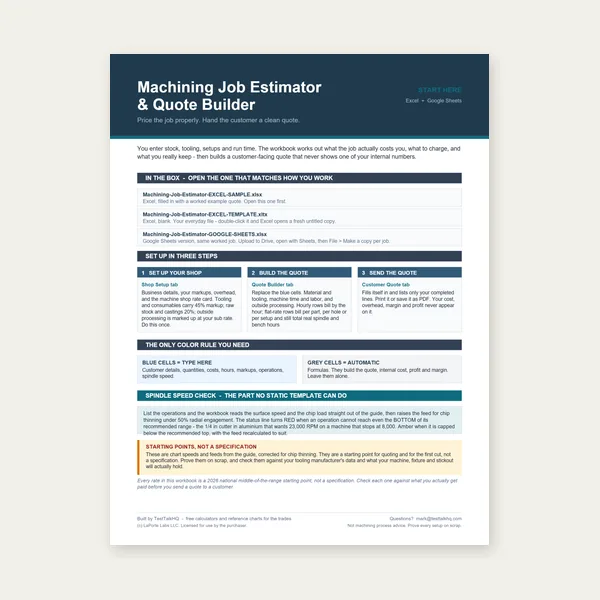
Quote shop work and check operations against your spindle's top speed.
Excel or Google Sheets. Best on a computer.
$29.00
Buy
Card, 27-page guide and the estimator workbook. All six files.
Excel or Google Sheets. Best on a computer.
$34.99
$45.98 if bought separately — save $10.99
BuyCheckout opens here — you stay on this page.
Dedicated V-belts, sheave sets, belt tension gauges, and laser tachometers are not in the current TestTalkHQ affiliate CSV — so they are not invented here. These are real catalog items you can use while sizing and checking a belt drive.
Measure driver and driven pulley outside diameters before you trust a stamped size. Pitch diameter may differ from OD on V-groove sheaves — confirm what the catalog calls out.
View on Amazon →Check pulley face runout and shaft end-play after a swap. A few thousandths of wobble will walk a belt off the groove and chew the sidewall.
View on Amazon →Confirm sheave faces are coplanar and shafts are parallel before you tension. Misalignment is the #1 cause of squeal that “needs more tension.”
View on Amazon →Probe V-groove wear and belt bottoming. If the belt rides on the groove floor instead of the flanks, ratio and belt life both go wrong.
View on Amazon →Torque taper-lock bushings and set screws to the sheave maker’s spec. Under-torque walks; over-torque cracks cast iron hubs.
View on Amazon →Common belt-driven shop compressor — the exact use case for a pulley swap when you need more CFM headroom or quieter lower RPM.
View on Amazon →As an Amazon Associate, TestTalkHQ earns from qualifying purchases.