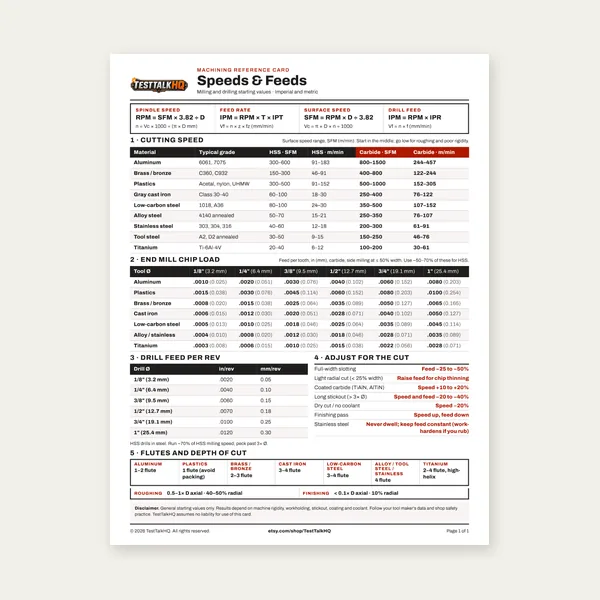
Machining Speeds & Feeds Card
One page. Speeds, chip load and drill feed, imperial and metric.
$3.99
BuyHow driver and driven diameter set speed on compressors, lathes, and drill presses
Most shop motors spin at a fixed nameplate speed — roughly 1725 or 3450 RPM on single-phase frames. Belt drives turn that fixed shaft into the RPM your compressor pump, lathe spindle, or drill-press quill actually needs. The lever is pulley diameter: bigger driven sheave means slower, higher-torque output; smaller driven sheave means faster output.
Need the numbers now? Open the Pulley & Belt Ratio Calculator.
Need RPM, not the lecture?Forward ratio, reverse sizing, and open-belt length in one tool.
Open Calculator →In an open belt drive with negligible slip, peripheral speed of both pulleys matches. That gives the classic shop formulas:
Where N₁ and D₁ are driver (motor) RPM and diameter, and N₂ and D₂ are driven RPM and diameter. Ratio greater than 1 is a reduction — the driven shaft turns slower than the motor. Ratio less than 1 is an increase — the driven shaft turns faster.
Torque scales roughly with the inverse of speed (ignoring losses). Halving RPM roughly doubles available torque at the driven shaft — which is why you never just “throw a smaller motor pulley on” without checking belt wrap, bearing loads, and the OEM RPM ceiling.
Start from the RPM you want on the driven machine, not from a random sheave sitting on the shelf.
The calculator’s reverse mode does that algebra. After you pick a standard size, confirm center distance still allows adequate wrap, then re-estimate belt length. If the machine is an air compressor, re-check capacity with the Air Compressor CFM Calculator — pump RPM changes SCFM. On a lathe, feed the new spindle RPM into the Lathe Turning Calculator.
Two-stage pumps usually want a lower RPM than a 3450 motor. The belt set is how the maker hits that pump speed. Swap pulleys to “get more CFM” and you may overspeed the pump, starve oiling, or trip the motor on overload. Always stay inside the pump’s rated RPM band, then size CFM at the new speed.
Older belt-head lathes and many mini-lathes use step pulleys or a countershaft. Changing the motor or countershaft sheave shifts the entire speed chart. Before you chase SFM with a carbide insert, confirm the spindle is actually turning the RPM you think — a mismatched swap is a classic chatter/finish mystery.
Step-pulley drill presses are pure ratio machines. Moving the belt is a discrete ratio change; swapping a cast step for a different OD changes every step. Use the Drill Speed Calculator for bit RPM once you know spindle speed.
When shafts are parallel and the belt is open (not crossed), a standard approximation is:
C is center distance, D the larger pulley diameter, d the smaller. This is an estimate for planning a cut-to-length or matching a catalog belt number — not a substitute for the belt maker’s exact arc-of-contact tables. Crossed belts, quarter-turn drives, and multi-groove sets need the manufacturer chart.
V-belt sheaves are rated on pitch diameter — the effective diameter where the belt’s pitch line rides in the groove. Outside diameter is larger and easier to measure with a caliper. Using OD in the ratio formula is a common shop approximation; for critical RPM (compressor pumps, timing-sensitive machines) use the catalog pitch diameter.
Common shop sizes and resulting RPMs at 1725 / 3450 motor speeds are tabulated on the Pulley / Sheave Size Chart. Belt-type choice (V vs flat vs timing) is covered in V-Belt vs Flat Belt vs Timing Belt.
Run your sizesForward or reverse mode with belt-length estimate.
Open Calculator →Yes for a fixed driven pulley: increasing D₁ raises N₂. Check belt wrap, motor amp draw, and the driven machine’s max RPM before you do it.
No. Groove angle and width are section-specific. Wrong section rides wrong and destroys both belt and sheave.
Slip, worn grooves (belt bottoming), or you used OD instead of pitch diameter. Fix mechanical issues first — see problems and solutions.
One page. Speeds, chip load and drill feed, imperial and metric.
$3.99
Buy
27 pages. Milling, drilling, tapping, turning and CNC routing.
$12.99
Buy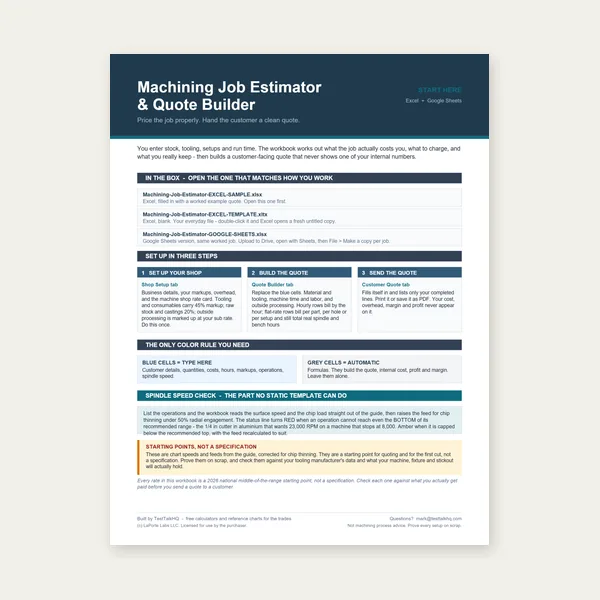
Quote shop work and check operations against your spindle's top speed.
Excel or Google Sheets. Best on a computer.
$29.00
Buy
Card, 27-page guide and the estimator workbook. All six files.
Excel or Google Sheets. Best on a computer.
$34.99
$45.98 if bought separately — save $10.99
BuyCheckout opens here — you stay on this page.
Dedicated V-belts, sheave sets, belt tension gauges, and laser tachometers are not in the current TestTalkHQ affiliate CSV — so they are not invented here. These are real catalog items you can use while sizing and checking a belt drive.
Measure driver and driven pulley outside diameters before you trust a stamped size. Pitch diameter may differ from OD on V-groove sheaves — confirm what the catalog calls out.
View on Amazon →Check pulley face runout and shaft end-play after a swap. A few thousandths of wobble will walk a belt off the groove and chew the sidewall.
View on Amazon →Confirm sheave faces are coplanar and shafts are parallel before you tension. Misalignment is the #1 cause of squeal that “needs more tension.”
View on Amazon →Probe V-groove wear and belt bottoming. If the belt rides on the groove floor instead of the flanks, ratio and belt life both go wrong.
View on Amazon →Torque taper-lock bushings and set screws to the sheave maker’s spec. Under-torque walks; over-torque cracks cast iron hubs.
View on Amazon →Common belt-driven shop compressor — the exact use case for a pulley swap when you need more CFM headroom or quieter lower RPM.
View on Amazon →As an Amazon Associate, TestTalkHQ earns from qualifying purchases.