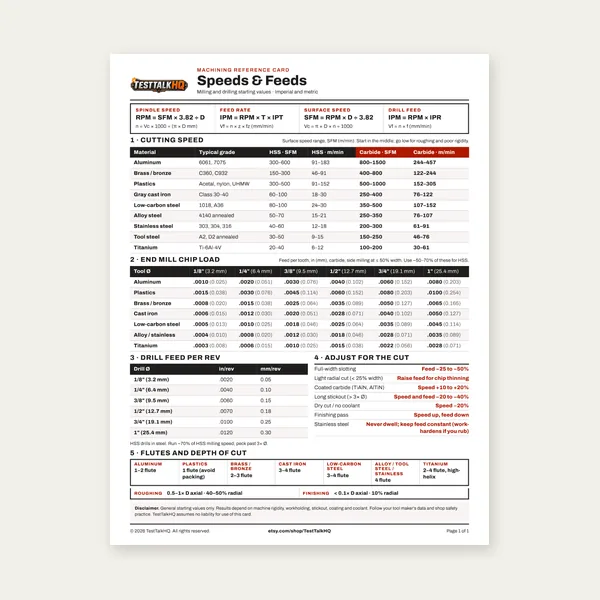
Machining Speeds & Feeds Card
One page. Speeds, chip load and drill feed, imperial and metric.
$3.99
BuyReal alternatives for shop equipment drives — not a marketing matrix
Same decision style as MIG vs TIG vs stick: each belt type wins on different jobs. Most modern shop machines use V-belts; older lines and specialty drives still run flats; timing (synchronous) belts show up when slip is unacceptable.
Size the ratio with the Pulley & Belt Ratio Calculator once you pick the belt family.
Trapezoidal cross-section that wedges into a matching groove. As load rises, the belt wedges tighter — that is why a properly tensioned V-belt can transmit serious horsepower in a compact width.
Flat belts ride on crowned pulleys and rely on friction across a wide face. Line shafts and older woodworking machines used them because they ran smooth and fast with low vibration.
Do not drop a flat belt onto V-grooves or expect a V-belt to track on a flat crown. The geometry is the drive.
Toothed belt meshing with a toothed pulley. Ratio is tooth count, not friction. Output RPM stays locked to input aside from belt jump under extreme overload.
Friction drives (V and flat) use diameter ratio. Timing drives use tooth count ratio: N₂ = N₁ × (teeth₁ / teeth₂). Mixing the formulas is how people order the wrong pulley.
Pitch diameter matters more on V-belts than on timing belts (where pitch is defined by tooth pitch). For charted shop sizes, use the Pulley / Sheave Size Chart. Theory and target-RPM sizing live in the complete guide.
Already picked V-belt?Run diameters and motor RPM for driven speed and belt length.
Open Calculator →Only if the sheaves and horsepower rating say so. Matched belt sets exist because length variation matters on multi-groove drives.
Related family (usually multi-rib), different pulley profile. Do not force a classical A/B belt into a serpentine rib pulley.
No. CFM follows pump RPM and displacement. Belt type does not add air — ratio does. Use the CFM calculator after any RPM change.
One page. Speeds, chip load and drill feed, imperial and metric.
$3.99
Buy
27 pages. Milling, drilling, tapping, turning and CNC routing.
$12.99
Buy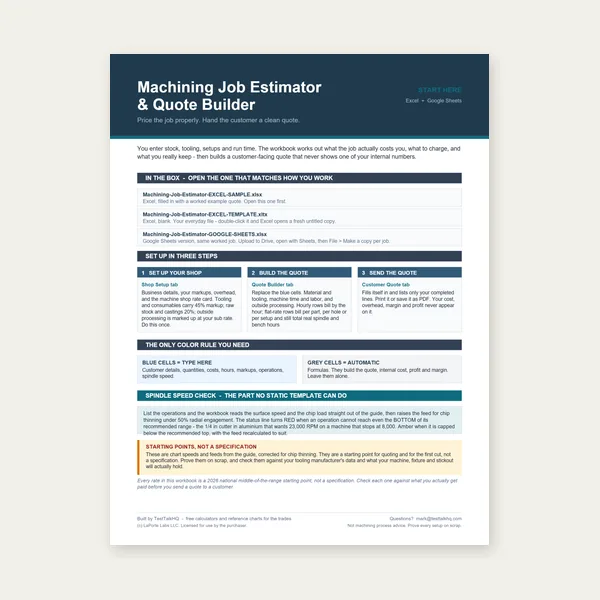
Quote shop work and check operations against your spindle's top speed.
Excel or Google Sheets. Best on a computer.
$29.00
Buy
Card, 27-page guide and the estimator workbook. All six files.
Excel or Google Sheets. Best on a computer.
$34.99
$45.98 if bought separately — save $10.99
BuyCheckout opens here — you stay on this page.
Dedicated V-belts, sheave sets, belt tension gauges, and laser tachometers are not in the current TestTalkHQ affiliate CSV — so they are not invented here. These are real catalog items you can use while sizing and checking a belt drive.
Measure driver and driven pulley outside diameters before you trust a stamped size. Pitch diameter may differ from OD on V-groove sheaves — confirm what the catalog calls out.
View on Amazon →Check pulley face runout and shaft end-play after a swap. A few thousandths of wobble will walk a belt off the groove and chew the sidewall.
View on Amazon →Confirm sheave faces are coplanar and shafts are parallel before you tension. Misalignment is the #1 cause of squeal that “needs more tension.”
View on Amazon →Probe V-groove wear and belt bottoming. If the belt rides on the groove floor instead of the flanks, ratio and belt life both go wrong.
View on Amazon →Torque taper-lock bushings and set screws to the sheave maker’s spec. Under-torque walks; over-torque cracks cast iron hubs.
View on Amazon →Common belt-driven shop compressor — the exact use case for a pulley swap when you need more CFM headroom or quieter lower RPM.
View on Amazon →As an Amazon Associate, TestTalkHQ earns from qualifying purchases.