Calculators & guides only — no articles or blog noise.
TestTalkHQ • HVAC Hub
HVAC Calculators: Airflow, Static, Charge
Eighth trade vertical on TestTalkHQ — the first dedicated HVAC hub. Duct CFM from velocity, equal-friction duct sizing, external static pressure vs the blower nameplate, piston superheat / TXV subcooling, return-vs-supply delta-T, a sq-ft-per-ton cooling load starting estimate (not Manual J), furnace heating BTU load with AFUE-to-input conversion, ductless mini-split per-zone BTU sizing, and extra refrigerant ounces for line-set length beyond factory charge stack into one diagnostic path. Starting point for field checks, not a Manual J certificate or a refrigerant ticket.
10Live calculators
CFMAirflow first
TESPNameplate check
SH / SCCharge path
32Companion articles
Start Here
Low airflow and high static look like charge problems until you measure them. Size or verify the duct, clock CFM from an anemometer traverse, compare total external static to the blower nameplate, then decide whether delta-T (air side) or superheat/subcooling (refrigerant side) is the next gauge set. Do not use living-area square footage as duct CFM. Do not charge by delta-T alone.
Main HVAC Calculator Tools
💨
Airflow · Measure
Duct CFM Calculator
CFM from anemometer FPM and round or rectangular duct area. Traverse math for the reading you already took — not a Manual D design CFM and not a substitute for a flow hood when registers are the job.
Equal-friction duct sizing from target CFM and friction rate. Round and rectangular options. Pair with measured CFM and ESP when the installed run underperforms.
Total external static (supply + return) vs the blower nameplate. High/low ESP flags, airflow notes, and the next link into CFM when the system is starved or over-pumped.
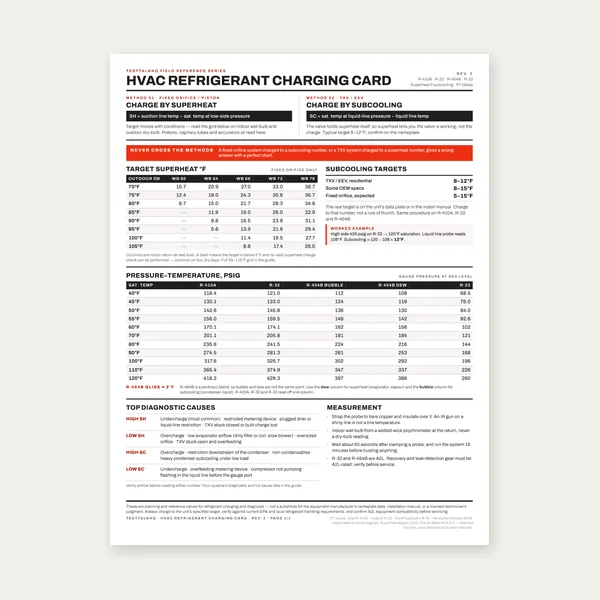
Piston superheat or TXV subcooling from line temperature, gauge pressure, and R-410A / R-22 / R-32. Target band with overcharge, undercharge, and airflow flags — not a recovery license.
Return vs supply air temperature split with a humidity-adjusted expected band (typical AC ~16–22°F). High split often means low airflow; low split often means charge or coil issues — confirm with SH/SC and CFM.
Total, sensible and latent cooling capacity from measured airflow and the dry-bulb and wet-bulb temperatures entering and leaving the coil, with the barometric pressure corrected for your site elevation. Returns the sensible heat ratio and the moisture removal in pints per hour — the latent half a Delta-T reading cannot see.
Rough residential cooling tons and BTU/hr from conditioned sq ft, climate band, ceiling height, and insulation quality. Square-footage rule of thumb with a Manual J disclaimer — starting point only, not a load calculation.
Heating BTU output from square footage, DOE-style climate zone, insulation, and ceiling height, then furnace input by AFUE and a round-up to 40k–120k. Rule of thumb with a Manual J heat-loss disclaimer — starting point only, not a load calculation.
Per-zone cooling BTU from climate, insulation, ceiling height, sun, and occupants. Round up to common head sizes, total the system, and flag single-zone vs multi-zone (or two outdoors above ~48k). Starting point only — not Manual J / Manual S.
Ounces to add for liquid-line length beyond the factory-charged 15 or 25 ft. R-410A, R-22, R-32, R-454B. Total system charge and a typical max-length flag. Starting point only — verify with superheat / subcooling after the system runs.
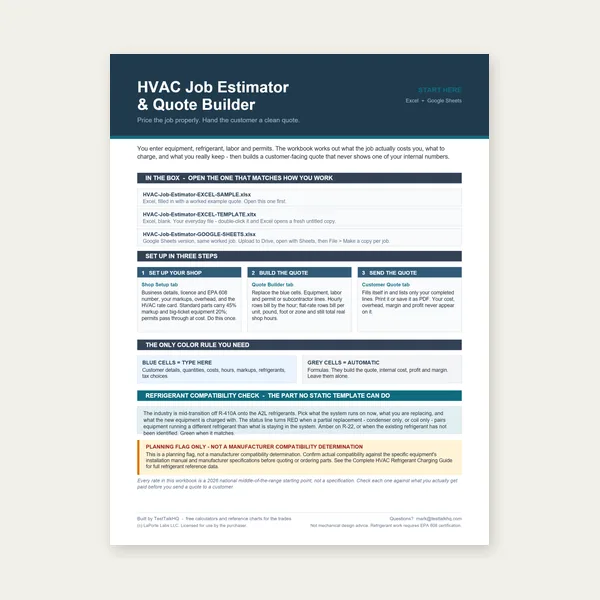
Labor hours, equipment, refrigerant, ductwork, disposal, permit, overhead, and markup or margin into a customer-facing quote. The pricing counterpart to the sizing and charge tools — not a load calculation.
Does this replace Manual J / Manual D / a refrigerant license?
No. These tools are arithmetic on the readings you enter. Load calculation, duct design sign-off, and charging still need the code path and the credential your jurisdiction requires.
Why put HVAC next to Electrical?
Blowers, condensers, and heat strips live on circuits. Voltage drop, ampacity, and breaker sizing sit on the electrical hub. Airflow and charge stay here. The two hubs link both ways because the equipment does.
Weigh-in or superheat / subcooling?
Weigh extra line-set ounces on a new or recovered system. After it runs, piston systems verify with superheat and TXV systems with subcooling. Different job from delta-T (air side). See weigh-in vs SH/SC.
Should I charge by delta-T?
Not as a primary method. Delta-T is an air-side symptom. Confirm airflow and static, then use piston superheat or TXV subcooling for charge. The comparison pages spell out which gauge set answers which question.
Where did these tools live before this hub?
On the free-calculators index under HVAC, without a dedicated vertical page. This hub is the eighth trade index so airflow, static, and charge tools share one entry point like welding, electrical, and the rest.