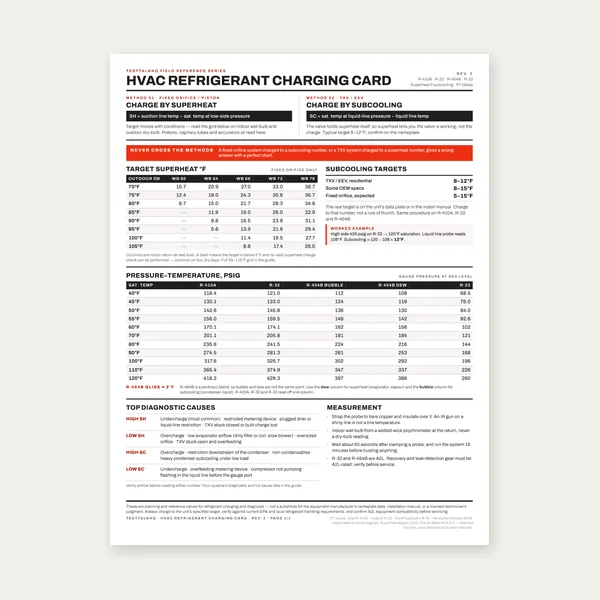
HVAC Refrigerant Charging Card
$3.99
BuyFriction · fabrication · space constraints · field tradeoffs
When round duct wins on friction and sealing, when rectangular is required for joist bays and clearance, and how airflow/friction tradeoffs play out between the two shapes.
Round and rectangular modes share the same equal-friction CFM input — pick the shape the job can actually fit.
Open Duct Sizing Calculator →Round duct carries more air for a given friction loss than a flat rectangle of similar cross-section — less wall drag per CFM. It is faster to hang in open basements and attics, easier to seal (one longitudinal seam + joints), and usually cheaper in spiral or snap-lock pipe. If you have the clearance, round is the default for mains and long trunks.
Joist bays, shallow soffits, and low ceiling chase work force flat duct. Rectangular lets you lock one dimension (often height) to the available space and solve the other side for capacity. That is exactly what the tool’s rectangular mode is for. Expect more surface area, more joints to seal, and slightly higher friction for the same equivalent capacity — the price of fitting the architecture.
At equal Huebscher equivalent diameter, round and rectangular are designed to match friction for the same CFM — that is the point of the conversion. In the real world, rectangular runs often need more careful aspect-ratio discipline (keep sides from getting extremely flat) and leak-tight seams, or they will not perform like the paper equivalent. Use the calculator’s equivalent diameter and velocity check as the bridge between shapes; then seal and support the run like a pro.
Open space → round. Joist bay / low clearance → rectangular with the constrained side fixed. Always verify velocity for the application. Walk through method details in the guide, or jump to troubleshooting if rectangular returns no solution.
$3.99
Buy
$12.99
Buy
$29.00
Buy
$39.00
BuyCheckout opens here — you stay on this page.