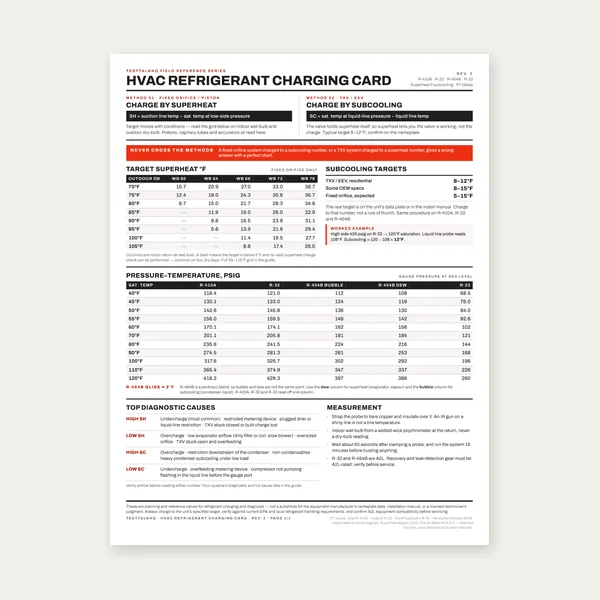
HVAC Refrigerant Charging Card
$3.99
BuyEqual-friction · friction rates · velocity · Manual J/D boundary
How the equal-friction method works, how to pick residential vs commercial friction rates, read round vs rectangular modes, and why velocity checks matter — plus a clear note that this tool needs known CFM and does not replace Manual J/D.
Enter known CFM and friction rate — get round diameter or a rectangular match with a velocity check.
Open Duct Sizing Calculator →Most residential and light-commercial duct systems are sized with the equal-friction method: you pick a target pressure drop per 100 feet of duct (inches water gauge), then size every run so it lands near that friction rate at the CFM it must carry. The classic Ductulator wheel is a slide-rule version of the same idea. This calculator solves the Wright-style galvanized friction equation for round duct, then uses the Huebscher equivalent-diameter relationship when you need rectangular.
0.06–0.08 in. w.g./100 ft — quieter residential work, longer trunks, noise-sensitive spaces. 0.10 — common residential default on many jobs. 0.12–0.15 — tighter commercial runs where space is limited and equipment can overcome more static. Lower friction → larger duct → lower velocity and less noise. Higher friction → smaller duct → higher velocity and more fan pressure. Match the rate to the job, not habit.
Round returns the required equivalent diameter and the next standard stock size up (4–48" common galvanized increments). Rectangular asks for the fixed side (height in a joist bay, or width under a soffit) and solves the other side so the Huebscher equivalent diameter matches the round requirement. If the fixed side is already larger than the required equivalent diameter, there is no physical solution — see troubleshooting.
Velocity (FPM) drives noise and, at the high end, erosion of lining and fittings. The tool flags results against typical ACCA Manual D / ASHRAE guideline maxima: residential branch ~600 FPM, residential main ~900, commercial branch ~1200, commercial main ~1500. A red/amber flag means the stock size at your friction rate is too fast for that application — upsize the duct or drop the friction rate. Velocity is not optional garnish; it is how you keep trunks from whistling and returns from roaring.
Explicitly: this calculator sizes duct for a CFM you already know. It does not replace ACCA Manual J (room-by-room load) or Manual D (full duct design with fittings, available static, and longest-path friction). Get CFM from a load calc or equipment schedule first, then size the run here. Fitting losses still need to be added in a complete design. For shape tradeoffs, read Round vs Rectangular.
$3.99
Buy
$12.99
Buy
$29.00
Buy
$39.00
BuyCheckout opens here — you stay on this page.