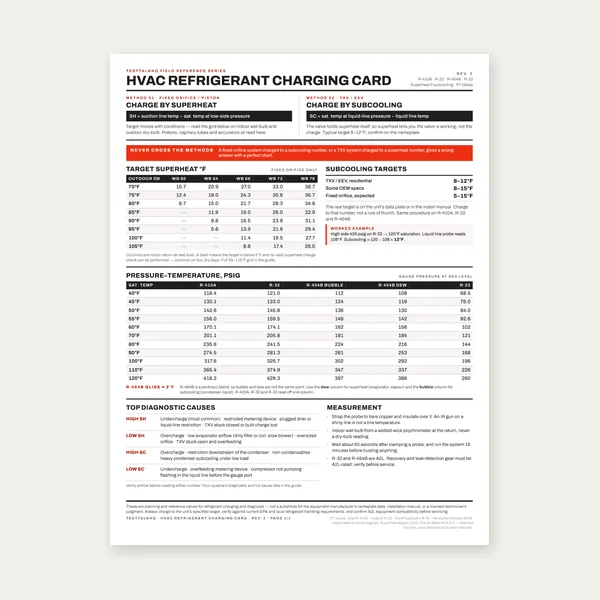
HVAC Refrigerant Charging Card
One page. Superheat, subcooling and PT for four refrigerants.
$3.99
BuyRough residential cooling tons and BTU/hr from square footage, climate band, ceiling height, and insulation — starting point, not Manual J
Enter conditioned area and envelope context. Results use a simplified sq-ft-per-ton rule of thumb with a visible Manual J disclaimer. How the math works: guide. Wrong-size symptoms: troubleshooting. ROT vs Manual J: comparison. Heating-side twin: furnace sizing calculator, rule of thumb vs Manual J heat loss. Field checks: delta-T, duct CFM. HVAC index: HVAC calculators hub.
Enter conditioned floor area, pick a climate band, set ceiling height, and choose insulation quality. Output is a rough tonnage / BTU/hr estimate from a public rule of thumb — not a room-by-room Manual J.
Heated/cooled living area only. Exclude garage, unconditioned attic, and unfinished basement unless those spaces are on the system.
Base bands: hot/humid 450, hot/dry 500, mixed 550, cold 700 sq ft/ton before insulation/height tweaks. Industry discussion of contractor rules of thumb often cites ~400–600 (sometimes up to ~800). Guide: what a ton means.
8 ft is the reference. Taller rooms increase effective volume in this estimate (linear vs 8 ft).
Coarse knob only. Poor lowers sq-ft-per-ton (more tons); good raises it (fewer tons). Still not Manual J R-values or ACH.
Field estimating aid only. 1 ton = 12,000 BTU/hr. Formula: tons ≈ (sq ft × ceiling_ft/8) ÷ (base_sf_per_ton × insulation_mult). This is not ACCA Manual J, Manual S equipment selection, Manual D duct design, or a permit document. Symptoms of wrong size: oversized vs undersized troubleshooting. What Manual J adds: rule of thumb vs Manual J.
Sq-ft-per-ton bands: public contractor rule-of-thumb ranges commonly cited around roughly 400–600 sq ft/ton (sometimes extending toward ~800 in milder climates), as discussed by ACCA’s HVAC blog and Energy Vanguard when contrasting rules of thumb with Manual J. Those sources also show real Manual J sf/ton values are often far higher on modern homes — meaning ROT sizing frequently oversizes. This calculator stays in the traditional ROT band on purpose and labels the result as a starting point only.
Enter conditioned square footage, choose the climate band that best matches your region, set average ceiling height, and pick insulation quality. Read estimated tons and BTU/hr, then treat the number as a conversation starter — not a purchase order.
What a ton means: guide. Oversize vs undersize symptoms: troubleshooting. Manual J comparison: rule of thumb vs Manual J. After the system runs: delta-T and duct CFM.
One ton of cooling removes 12,000 BTU per hour. The calculator divides an effective floor area by a climate/insulation sq-ft-per-ton factor. That is the public rule-of-thumb method contractors have historically used for ballpark sizing — and the method ACCA and Energy Vanguard criticize when it replaces Manual J on modern envelopes.
Single whole-house estimate. No window schedule, no orientation, no infiltration ACH, no occupancy, no appliance gains. Ceiling height scales volume linearly vs 8 ft. Insulation is a three-step multiplier, not an R-value takeoff.
Already have a noisy short-cycling system?Symptom checklist before you upsize again.
Oversized vs Undersized →One page. Superheat, subcooling and PT for four refrigerants.
$3.99
Buy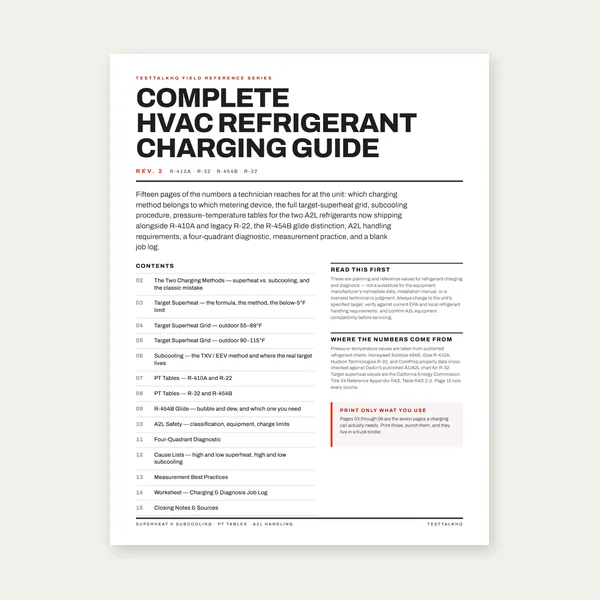
15 pages. Full superheat grid, PT tables, A2L safety and diagnosis.
$12.99
Buy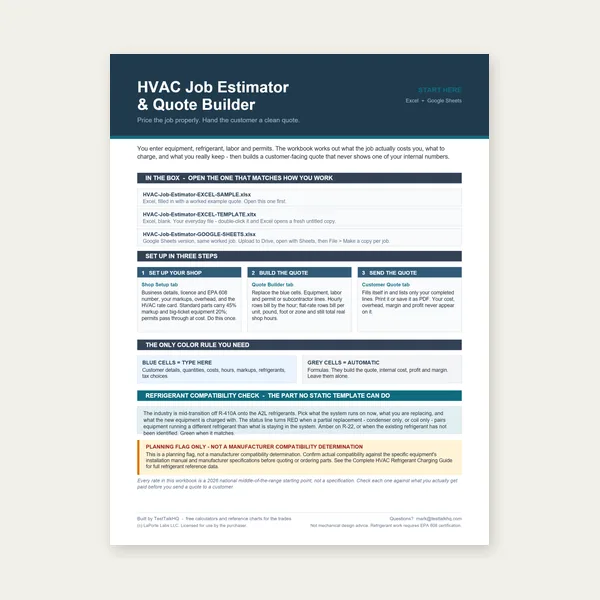
Quote HVAC work and catch a refrigerant mismatch before you order.
Excel or Google Sheets. Best on a computer.
$29.00
Buy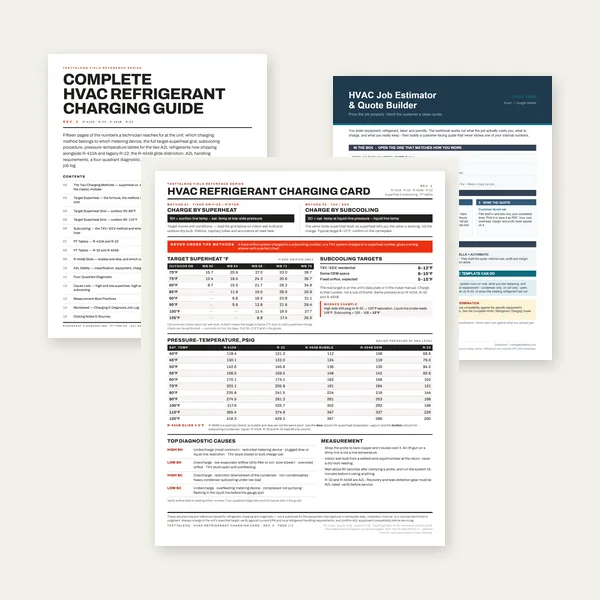
Card, 15-page guide and the estimator workbook. All six files.
Excel or Google Sheets. Best on a computer.
$34.99
$45.98 if bought separately — save $10.99
BuyCheckout opens here — you stay on this page.
A tonnage estimate is only a starting point. After install (or when a system misbehaves), confirm airflow and air-side split before you chase the wrong problem. These are tools already on the TestTalkHQ HVAC affiliate list.

Stable setpoints and sensor feedback help you see whether the system short-cycles or never reaches set point — classic oversize vs undersize symptoms.
View on Amazon →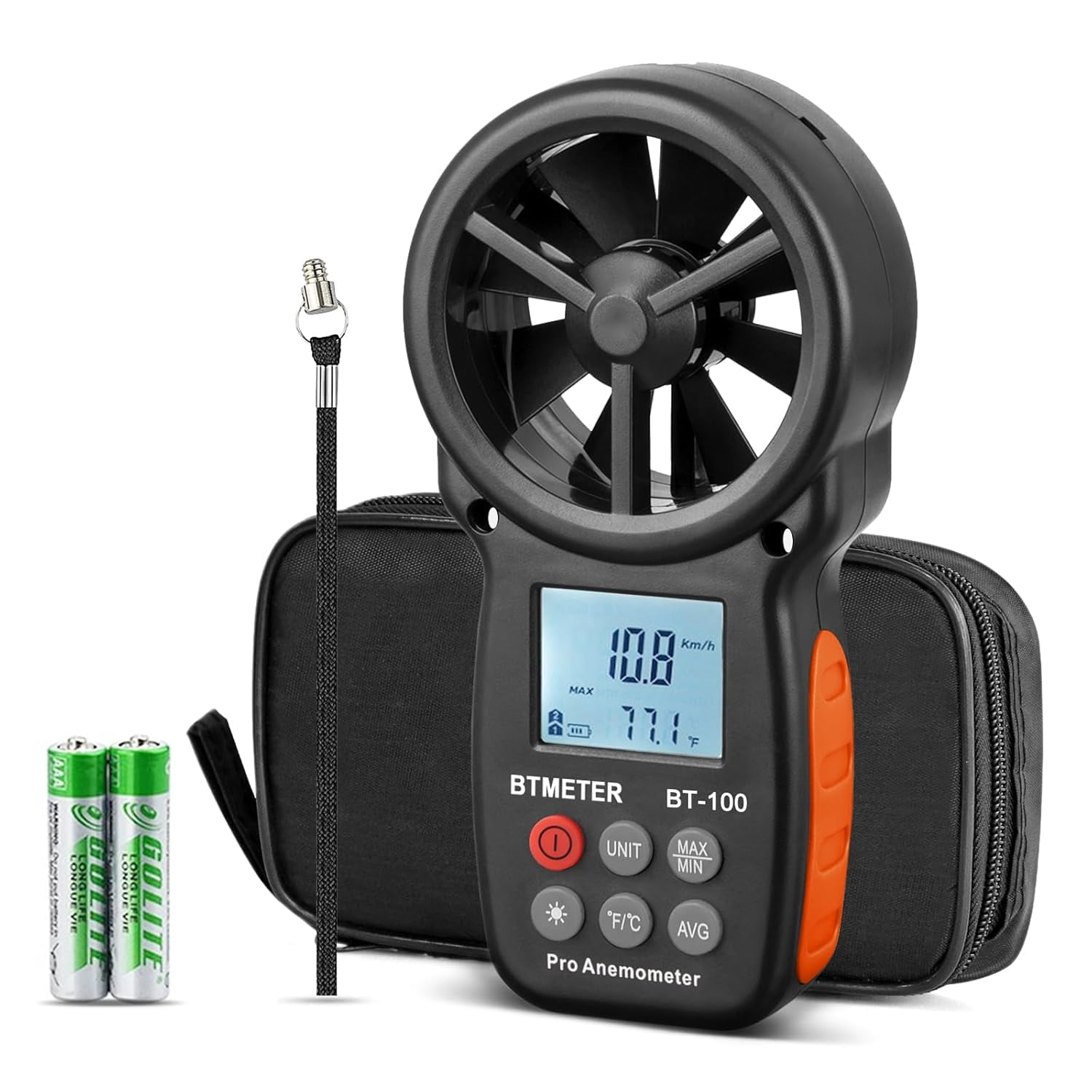
Rule-of-thumb tonnage does not prove duct CFM. Measure face velocity, then convert with the duct CFM calculator.
View on Amazon →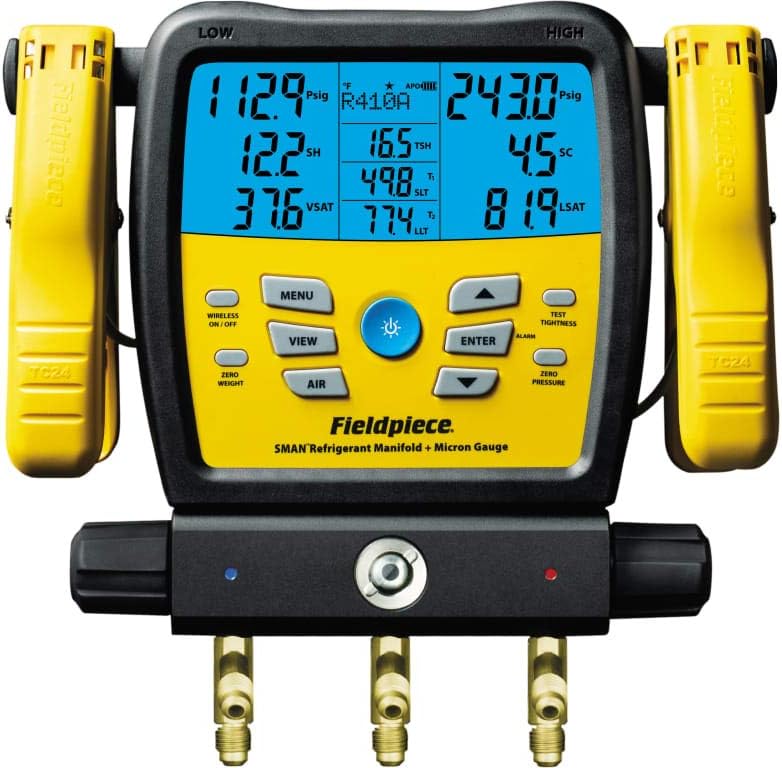
When the air split looks wrong, verify charge with superheat/subcooling — not with square footage.
View on Amazon →
Sq ft, climate band, ceiling height, insulation quality → rough tons and BTU/hr with Manual J disclaimer.
Open Cooling Load Calculator →
After the system is running, return-vs-supply split is a quick air-side health check.
Open Delta-T Calculator →
Why sq-ft-per-ton varies, and why this tool is not ACCA Manual J.
Read the Cooling Load Guide →As an Amazon Associate, TestTalkHQ earns from qualifying purchases.
Want a client-ready quote instead of just the numbers? Excel + Google Sheets workbook with a refrigerant compatibility check.
View on Etsy →