Two numbers that get confused constantly and set into the same thermostat parameter. What each one is calculated from, why the switchover temperature is usually warmer than the balance point, which parameter each belongs in for all-electric and dual-fuel systems, and which to use for each decision.
Two numbers, one thermostat setting, constant confusion
Ask three contractors where a heat pump should hand over to its backup and you will get the balance point, the switchover temperature, and a number somebody’s supervisor liked in 2009. The first two are real and they are not the same thing. They answer different questions, they are calculated from different inputs, and in a dual-fuel system they are frequently ten or fifteen degrees apart.
from: design heat loss, design temperature, AHRI capacities at 47 and 17 °F
Economic switchover temperature — where the backup becomes cheaper to run
from: electricity price, fuel price, heat pump COP at temperature, furnace efficiency
One is thermodynamics. The other is arithmetic on your utility bill. Confusing them costs money in whichever direction you got it wrong.
The balance point: a capacity question
The balance point is the outdoor temperature at which the heat pump’s capacity has fallen to exactly the building’s load. Above it the compressor holds the house alone. Below it the load exceeds what the compressor can make, and something else must supply the difference — a fact, not a preference. The federal test procedure defines the condition in exactly those terms: auxiliary heat runs below the balance point, which “occurs when the building load exceeds the space heating capacity of the heat pump condenser”.
Nothing about utility rates enters into it. A balance point is the same number whether electricity costs eight cents or thirty-eight, and whether the backup is a heater kit or a 95% gas furnace.
The load line loses 600 Btu/h per degree; the capacity line loses 433 Btu/h per degree the other way. They cross at 24.5 °F. At the 5 °F design condition the compressor makes 15,800 Btu/h against a 36,000 Btu/h load, leaving 20,200 Btu/h — 5.92 kW — for the backup.
That 24.5 °F is a physical fact about this house and this machine. It is what you use to size the backup heat and to set an auxiliary-heat lockout so the strips cannot energise on a mild morning.
The switchover temperature: a price question
In a dual-fuel system — heat pump outdoor unit over a gas or propane furnace — you have a genuine choice that an all-electric system does not have. Both heat sources can carry the house at moderate temperatures. The question is which one is cheaper per unit of heat delivered, and the answer changes with outdoor temperature because the heat pump’s efficiency falls as it gets colder while the furnace’s does not.
The switchover temperature is where those two running costs cross. Above it the heat pump is cheaper; below it the furnace is. It depends on four things this page cannot know: what you pay per kilowatt-hour, what you pay per therm or gallon, the heat pump’s coefficient of performance at each outdoor temperature, and the furnace’s efficiency. Change any one and the crossing moves.
It also moves during the life of the system, because fuel prices move. A switchover temperature that was right when gas was cheap is wrong after a price spike, and nobody goes back to change it. It is worth revisiting when rates change materially.
HVAC
HVAC Refrigerant Charging Card
$3.99
Buy
Complete HVAC Charging Guide
$12.99
Buy
HVAC Job Estimator
$29.00
Buy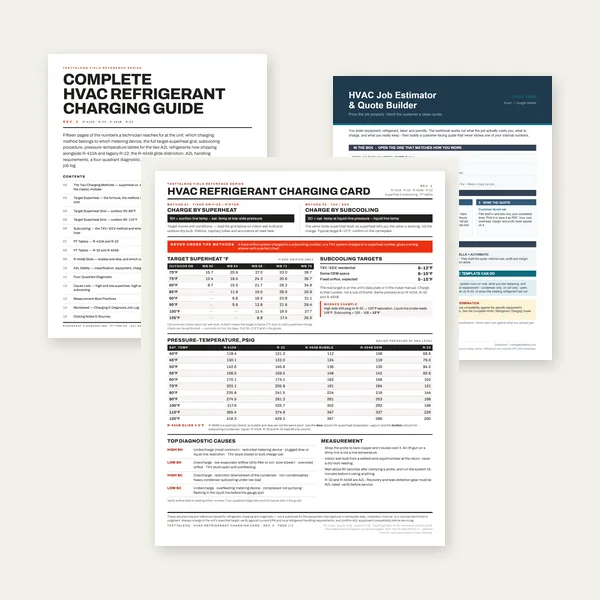
HVAC Complete Bundle
$39.00
BuyCheckout opens here — you stay on this page.
Where the answer actually gets applied
A balance point that lives only in a spreadsheet changes nothing. Two settings in the thermostat decide how much of the winter runs on the compressor and how much runs on resistance heat, and a clamp on the heater kit is the only way to find out which of them is winning. These are the parts of the job that turn the calculation into a lower bill.

ecobee Smart Thermostat Premium
- Runtime history separates compressor hours from aux hours
- Remote sensors show whether the house really drifts at design
- Heat pump settings include compressor and aux temperature limits
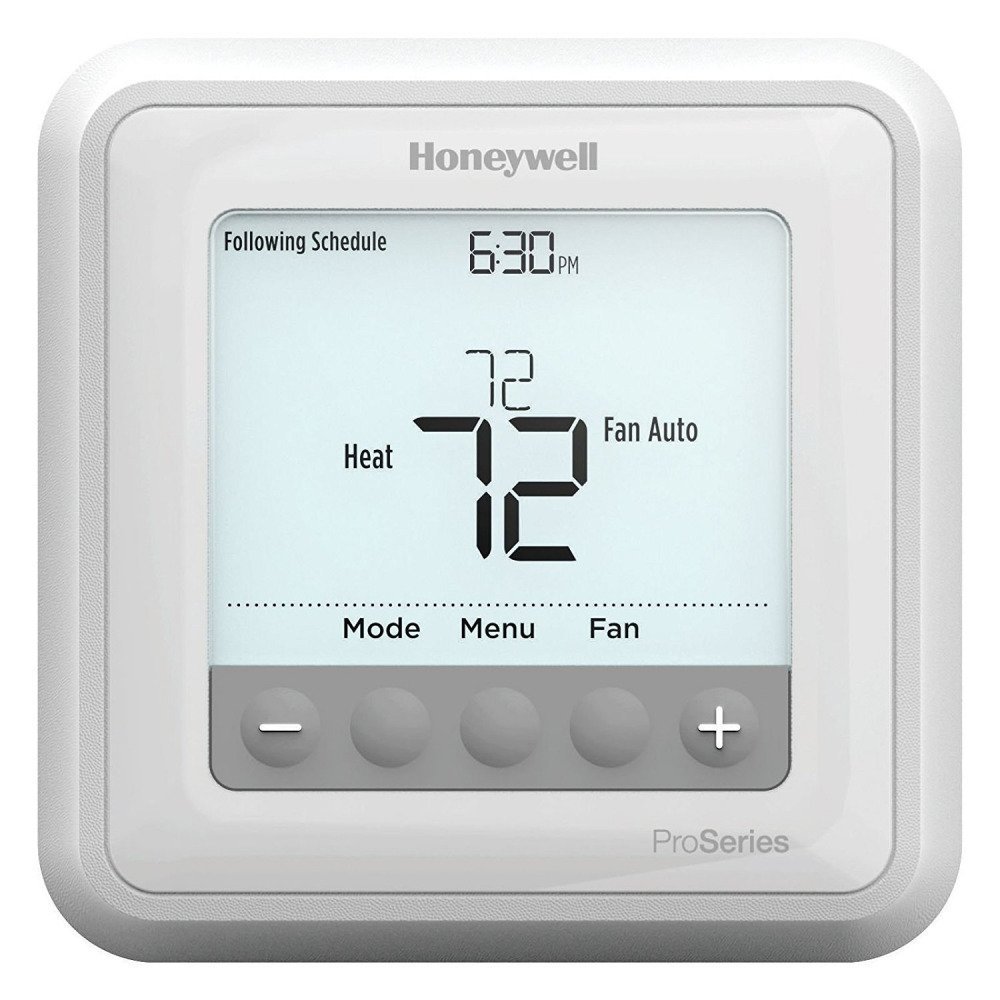
Honeywell T6 Pro Thermostat
- Installer setup exposes the heat pump staging parameters
- A stable setpoint is what makes a balance point observable
- The common replacement when a factory default was never changed

Sensi Touch 2 Smart Thermostat
- Usage reporting makes an always-on aux stage obvious
- C-wire required, which most heat pump air handlers already have
- Cheap way to catch a winter of unnecessary resistance heat
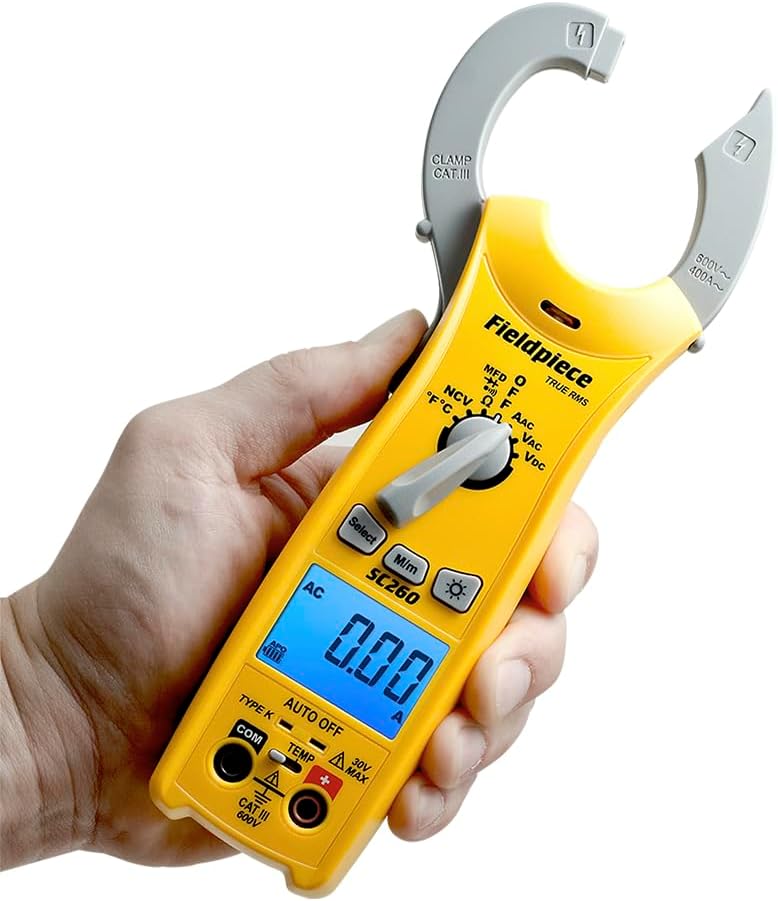
Fieldpiece SC260 Clamp Multimeter
- Clamp the heater kit legs and see which stages energise
- True RMS, compact enough for an air handler cabinet
- Turns “the strips come on a lot” into an amp reading

Klein Tools CL800 Digital Clamp Meter
- 1000V rating covers commercial air handler backup heat
- Amps times volts is how kW of strip heat gets confirmed
- True RMS matters on anything fed from a drive or inverter
As an Amazon Associate, TestTalkHQ earns from qualifying purchases. Prices and availability can change.
Which one do you set, and into what
Most thermostats expose two or three parameters and the names vary. Here is what each is for.
set from the balance point, a few degrees above it
Compressor lockout / compressor minimum outdoor temperature
all-electric: set it below the balance point, or not at all
dual fuel: this is where the switchover temperature goes
Backup heat sizing, kW or furnace output
set from the balance point and the design-day shortfall
In an all-electric system there is no economic choice to make. Resistance heat is always more expensive per unit of heat than the compressor, at every temperature, because the compressor is moving heat rather than making it. So you want the compressor running as far down the scale as it physically can. Set the aux lockout above the balance point to stop the strips helping unnecessarily, and do not set a compressor lockout at all unless the equipment requires one.
In a dual-fuel system, the switchover temperature goes into the compressor lockout parameter, because that is what switching over means: the compressor stops and the furnace takes the house. The balance point is still worth calculating, though, because it tells you whether the heat pump could have carried the house at that temperature — which is exactly the information that tells you whether your switchover is a real economic choice or a capacity necessity.
Which to use, by situation
Sizing backup heat: balance point, always
The kilowatts of resistance heat, or the furnace output, must cover the design-day shortfall. Prices are irrelevant to whether the house stays warm. Run the balance point calculation, take the shortfall at the design temperature, and size from that — then let kit availability, air handler minimum airflow and the electrical design constrain the final selection.
Setting an aux lockout: balance point
A few degrees above it. This is what stops resistance heat energising on a 45 °F morning because the setpoint was raised four degrees.
Setting dual-fuel switchover: economic calculation, bounded by the balance point
Work out where the running costs cross, then sanity-check it against the balance point. If your economic switchover comes out below the balance point, ignore it — the furnace has to run down there regardless.
Deciding whether to keep the furnace at all: both
If the balance point is low and the shortfall at design is small, an all-electric conversion is a much easier argument. If the balance point is 35 °F, the machine is not carrying much of the winter and the furnace is doing real work. That is a selection question that starts with the load — see furnace sizing for the same design load worked from the fuel-fired side, and the load calculator if the underlying number is still a rule of thumb.
Explaining a high bill: both, in that order
First establish where the balance point is and whether the strips are running above it, which is a control fault. Only then talk about rates. A customer told their switchover temperature is wrong when the real problem is a disabled aux lockout will pay for a service call and still have the problem. The diagnostic order for that is laid out in strip heat that will not stay off.
Three things that make the gap between them wider or narrower
Whether the switchover temperature sits well above the balance point or almost on top of it depends on the system and the market, and it is worth knowing which way yours leans before setting anything.
The equipment’s cold-weather efficiency
A heat pump’s coefficient of performance falls with outdoor temperature. The steeper that fall, the warmer the economic switchover, because the compressor loses its cost advantage sooner. Modern variable-capacity equipment holds both capacity and efficiency better at low temperature than single-speed equipment does, which pushes the switchover colder and widens the band where the heat pump is both capable and cheaper.
The electricity-to-fuel price ratio
This is the input that moves most and that nobody revisits. Cheap gas against expensive electricity pushes the switchover warm, sometimes above 40 °F, and the heat pump barely runs. The reverse pushes it cold, sometimes below the balance point entirely — at which point the furnace only ever runs because it has to, not because it is cheaper. Both situations are common, and both change when rates change.
How the equipment was sized
In a mixed climate, equipment is often selected on the cooling load, which leaves the heating capacity short of the heating load and the balance point high. A high balance point compresses the economic band from below: there is less temperature range in which you have a choice at all. Where the heat pump was sized for the heating load instead, the balance point drops and the economic question gets the run of a much wider band.
Frequently asked questions
What is the difference between balance point and switchover temperature?
The balance point is the outdoor temperature at which the heat pump’s capacity has fallen to the building’s heating load — a capacity fact, calculated from the design heat loss and the published AHRI capacities at 47 and 17 °F. The switchover temperature is the outdoor temperature at which the backup fuel becomes cheaper to run than the heat pump — an economic result, calculated from electricity and fuel prices, the heat pump’s COP and the furnace’s efficiency. In a dual-fuel system the switchover temperature is usually the warmer of the two.
Which one do I put into my dual-fuel thermostat?
The switchover temperature goes into the compressor lockout parameter, because switching over means stopping the compressor and letting the furnace take the house. Calculate the balance point anyway: if your economic switchover comes out below the balance point, ignore it and use the balance point, because the furnace has to run down there regardless of price.
Does an all-electric heat pump have a switchover temperature?
Not in the economic sense. Resistance heat is always more expensive per unit of heat than the compressor, at every outdoor temperature, because the compressor moves heat instead of making it. There is no temperature at which switching to strips saves money, so you want the compressor running as far down as it physically can. Set the auxiliary heat lockout above the balance point and do not set a compressor lockout unless the equipment requires one.
Why is the switchover temperature usually warmer than the balance point?
Because capability and cost stop coinciding before capability runs out. A heat pump can often still carry the entire house at 30 °F while its efficiency has fallen far enough that the gas furnace underneath it delivers the same heat for less money. The gap between the two numbers is exactly the temperature band in which you have a genuine economic choice.
Should I change my switchover setting when fuel prices change?
Yes, and almost nobody does. The switchover temperature is arithmetic on the ratio of electricity price to fuel price, so a material move in either shifts it. A setting that was right when gas was cheap can be several degrees wrong after a price spike, and it will sit there for years quietly costing money in one direction or the other.
Can I set switchover from the balance point if I do not know my rates?
You can, and it is a defensible fallback in an all-electric system where there is no economic crossing to find. In a dual-fuel system it means running the heat pump down to the edge of its capability, which is right if electricity is cheap relative to fuel and wrong if it is not. Rates are on the bill; the calculation is worth doing once properly rather than guessing every winter.