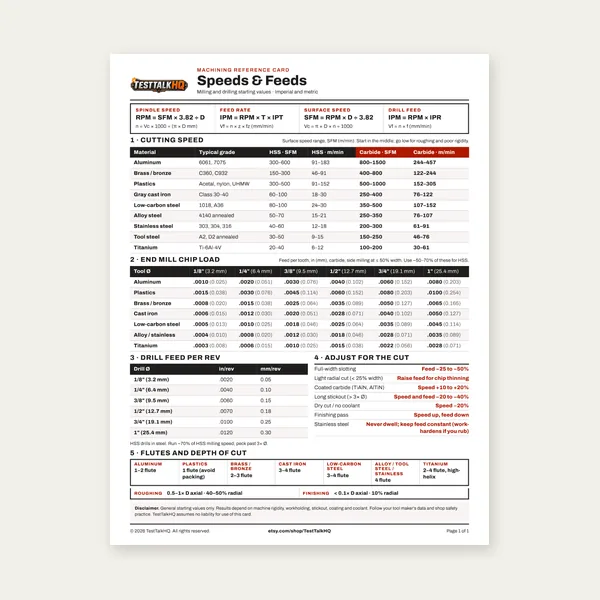
Machining Speeds & Feeds Card
One page. Speeds, chip load and drill feed, imperial and metric.
$3.99
BuySlip, squeal, premature wear, misalignment, wrong RPM, over-tension
Same angle as the MIG troubleshooting guides: start from the symptom, name the cause, give the bench fix. Recompute the intended ratio with the Pulley & Belt Ratio Calculator before you blame “a bad belt.”
Slip shows up as heat, glaze, and RPM that sag under load. Fix sequence:
Squeal is vibration at the belt/sheave interface. Common causes ranked:
Put a straightedge across both sheave faces. If you see daylight on one side, fix alignment before you add tension. An angle gauge on the motor base helps get shafts parallel after you loosen the mount.
Belts that die in weeks usually have a mechanical root cause:
If the belt rides on the groove floor, the sheave is worn or the section is wrong. Feeler gauges and a straightedge across the groove flanks tell you quickly. Replace sheaves in matched sets when grooves are dish-shaped.
Two checks matter: parallel shafts and coplanar faces. Offset faces make the belt run to one side. Angled shafts twist the belt every revolution.
Someone “put on a bigger pulley” without doing the math. Symptoms: compressor short-cycles or overheats, lathe finishes chatter at “the usual” belt step, drill burns bits on the “slow” step.
Over-tensioning deserves its own callout: it feels like it “cures” slip for a day, then takes out the motor front bearing or the compressor crank. Set deflection properly; never use the belt as a pry bar to stretch onto the sheave.
Belt-type limits (V vs flat vs timing) are in the comparison guide. Ratio theory is in the complete guide.
One page. Speeds, chip load and drill feed, imperial and metric.
$3.99
Buy
27 pages. Milling, drilling, tapping, turning and CNC routing.
$12.99
Buy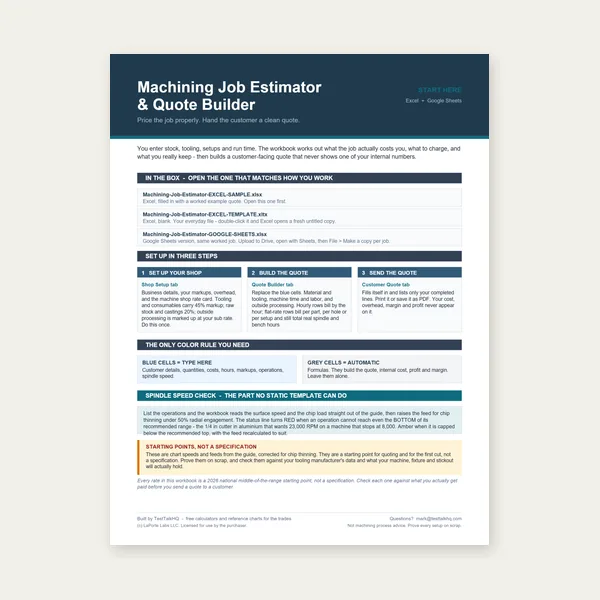
Quote shop work and check operations against your spindle's top speed.
Excel or Google Sheets. Best on a computer.
$29.00
Buy
Card, 27-page guide and the estimator workbook. All six files.
Excel or Google Sheets. Best on a computer.
$34.99
$45.98 if bought separately — save $10.99
BuyCheckout opens here — you stay on this page.
Dedicated V-belts, sheave sets, belt tension gauges, and laser tachometers are not in the current TestTalkHQ affiliate CSV — so they are not invented here. These are real catalog items you can use while sizing and checking a belt drive.
Measure driver and driven pulley outside diameters before you trust a stamped size. Pitch diameter may differ from OD on V-groove sheaves — confirm what the catalog calls out.
View on Amazon →Check pulley face runout and shaft end-play after a swap. A few thousandths of wobble will walk a belt off the groove and chew the sidewall.
View on Amazon →Confirm sheave faces are coplanar and shafts are parallel before you tension. Misalignment is the #1 cause of squeal that “needs more tension.”
View on Amazon →Probe V-groove wear and belt bottoming. If the belt rides on the groove floor instead of the flanks, ratio and belt life both go wrong.
View on Amazon →Torque taper-lock bushings and set screws to the sheave maker’s spec. Under-torque walks; over-torque cracks cast iron hubs.
View on Amazon →Common belt-driven shop compressor — the exact use case for a pulley swap when you need more CFM headroom or quieter lower RPM.
View on Amazon →As an Amazon Associate, TestTalkHQ earns from qualifying purchases.