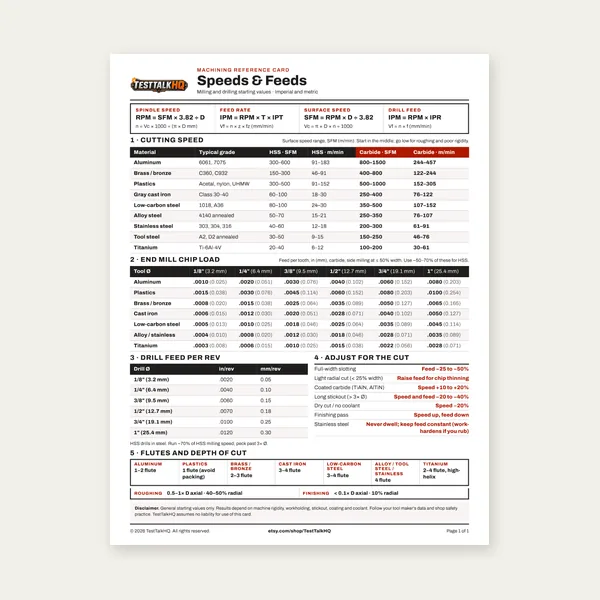
Machining Speeds & Feeds Card
One page. Speeds, chip load and drill feed, imperial and metric.
$3.99
BuyStack height ↔ angle with gauge-block suggestions
One page. Speeds, chip load and drill feed, imperial and metric.
$3.99
Buy
27 pages. Milling, drilling, tapping, turning and CNC routing.
$12.99
Buy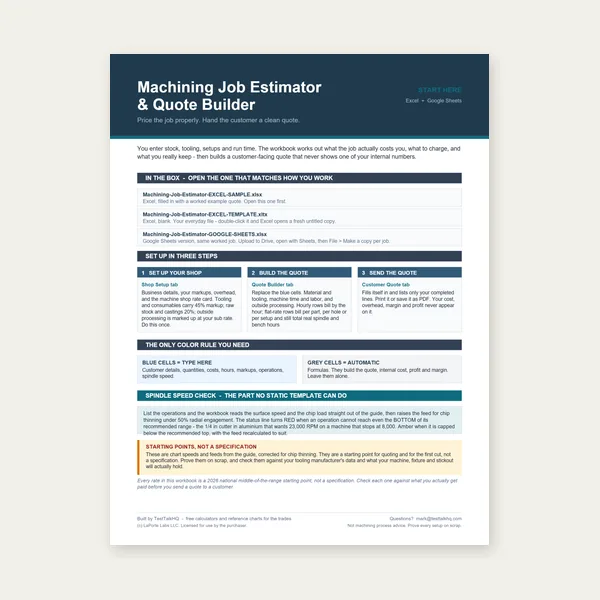
Quote shop work and check operations against your spindle's top speed.
Excel or Google Sheets. Best on a computer.
$29.00
Buy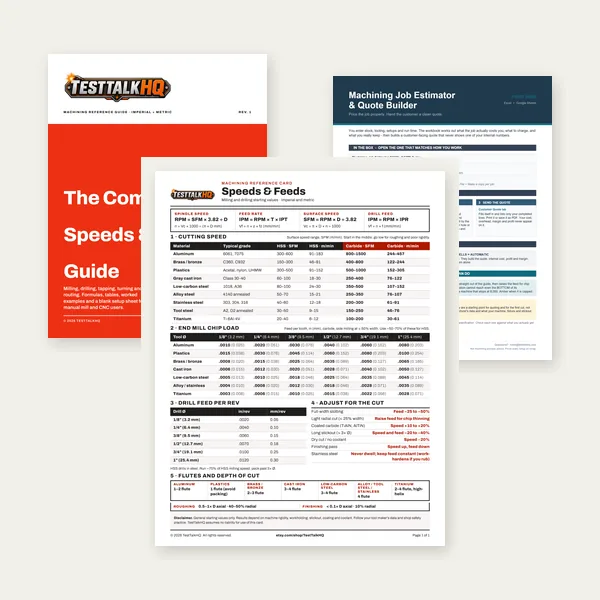
Card, 27-page guide and the estimator workbook. All six files.
Excel or Google Sheets. Best on a computer.
$34.99
$45.98 if bought separately — save $10.99
BuyCheckout opens in a new tab.
CSV-sourced shop tools for the hybrid workflow: rough the angle, indicate the bar, and verify stack height
Magnetic-base digital angle gauge for rough fixture and sine-plate setup. Get close in seconds, then verify critical print angles with the sine bar and a known stack.
View on Amazon →Indicate the top face of the sine bar after you seat it. Rock, taper, or a chip under a roller shows up here before you trust the calculated angle.
View on Amazon →Sanity-check overall stack height and roller center distance on the job. Not a substitute for wringing + a mic on the last digits, but it catches a missed 0.500" block immediately.
View on Amazon →Verify the small/last-digit blocks and wear pieces after wringing. Use it on the 0.001" and 0.0001" series before they go into a taller stack.
View on Amazon →Check for daylight under a roller or a poorly seated stack before you indicate. A feeler that slides under the high roller means the setup is not on the plate.
View on Amazon →As an Amazon Associate, TestTalkHQ earns from qualifying purchases.
Enter the sine bar length and the target angle in degrees, minutes, and seconds. The calculator returns H = L × sin(θ) and a largest-first gauge-block combination from an 81- or 83-piece set so you can build the stack without hunting the chart.
When you already know the stack height under the bar — measured with a micrometer or built from known blocks — switch modes to get θ = arcsin(H / L) in decimal degrees and DMS.
L is the center-to-center distance between the sine bar rollers (or sine plate cylinders), not the overall bar length. Use the stamped center distance on the tool — typically 5.000" or 10.000" on shop bars.
Wring the suggested blocks, seat them under one roller on a clean surface plate, and indicate or probe the top of the bar or workpiece. See the Sine Bar Setup Guide for wringing and plate technique.
H = 5 × sin(30°) = 5 × 0.5 = 2.5000 inches. A typical 81-piece suggestion is 2.000 + 0.500.
Yes. The math is identical — use the plate's roller center distance as L. Sine plates often include a magnetic chuck on top for holding the workpiece while you mill or grind to the set angle.
Common causes: dirty wringing faces, bare-hand thermal growth on blocks, worn rollers, a dirty surface plate, or using overall bar length instead of roller center distance. Walk through Sine Bar Troubleshooting.
Digital gauges are faster for rough setup and non-critical fixtures. Reach for the sine bar when the print needs arc-minute-class accuracy or when you are setting a grind/mill angle that must hold under cutting load. Compare both in Sine Bar vs Digital Angle Gauge.