Assemblies fail fits when every part hits the wrong extreme — or when you over-toleranced the drawing trying to prevent that. Stack-up analysis tells you whether worst-case or statistical (RSS) math matches how the parts are actually made.
What Tolerance Stack-Up Is
A stack-up is the accumulation of dimensional variation along a chain of features that determine a fit, gap, flush condition, or hole alignment. Each dimension in the chain has a nominal and a plus/minus (or limit) tolerance. The assembly result is the sum of the nominals plus a combined tolerance band from the individual contributions.
Fabricators see this on brackets that must clear a tube, covers that must sit flush, pin fits across multiple plates, and hole patterns that must line up with welded frames. Bend allowance and springback add their own variation — stack-up is how you decide whether the print’s tolerances are realistic for the process.
This guide covers linear plus/minus stacks — the same model as the tolerance stack-up calculator. MMC/LMC bonus and full GD&T position stacks need drawing rules applied separately after the linear envelope is clear.
Worst-Case Stack-Up
Worst-case assumes every dimension in the chain hits the extreme that makes the fit as bad as possible at the same time. You add the absolute values of all tolerances for the total envelope:
Worst-case tolerance = Σ |tᵢ|
Maximum assembly = sum of maximums (or minimums, depending on direction). This is the conservative method. Use it when a hard interference or clearance cannot be accepted even rarely — safety covers, sealed joints, tooling that must assemble without selective fit, and low-volume work where you will not scrap statistically rare outliers.
If five features each have ±0.010″, worst-case is ±0.050″. That can force tighter machining, extra ops, or rejected fab. Before you tighten every callout, check whether RSS is acceptable for the application.
RSS (Root-Sum-Square) Stack-Up
Statistical stack-up treats bilateral tolerances as independent random contributions that are unlikely to all hit extremes together:
RSS = √(Σ tᵢ²)
Five features at ±0.010″ give RSS ≈ ±0.022″ — much tighter than worst-case ±0.050″. That is why production assemblies often use RSS when processes are centered and capable. RSS is not a promise that nothing will ever exceed the band; it is an estimate of typical statistical variation under independence assumptions.
- Assumes all extremes stack the same way
- Safest for no-scrap-allowed assemblies
- Often over-constrains production cost
- Good for fixtures, seals, safety covers
- √(Σ tᵢ²) for independent dimensions
- Narrower band than worst-case
- Needs centered, capable processes
- Common for multi-part consumer/industrial fits
When Each Method Applies in the Shop
- Welded frames + machined covers — weld distortion may not be “centered.” Prefer worst-case or measure after weld and machine to fit.
- Laser-cut plate stacks — kerf and nest consistency are often good; RSS can be reasonable for non-critical gaps.
- Bent sheet metal — bend angle and flange length variation dominate. Use bend deduction tools and then stack the resulting flange tolerances; see the sheet metal bending guide.
- Bolted joints — hole location and bolt clearance interact. Torque and clamp load are separate; use bolt torque charts for fasteners, stack-up for hole-to-edge and pattern alignment.
| Situation | Prefer | Why |
|---|---|---|
| Must assemble every unit, no selective fit | Worst-case | Outliers still have to work |
| High volume, SPC in place | RSS | Independence + capability assumed |
| Weldment then machine | Measure / worst-case | Distortion is not random Gaussian |
| Cosmetic flush only | RSS or looser WC | Cost vs appearance tradeoff |
Tightening Fits Without Over-Tolerancing
The cheapest fix is rarely “±0.002 everywhere.” Better levers:
- Shorten the stack — fewer dimensions in the chain (datum from a common face, machine as an assembly).
- Move the precision — weld rough, machine critical faces and holes in one setup.
- Add clearance where it is free — slotted holes, shims, or adjustable brackets beat microscopic plate tolerances.
- Match process capability — do not call ±0.005 on a torch-cut edge that delivers ±0.030.
- Compare WC vs RSS on the print — if WC fails but RSS passes and volume justifies it, document the method on the drawing notes.
Assign each dimension a sense in the chain (+ or − contribution to the gap). A “plus” on one part can close a gap the same way a “minus” on another does. Wrong signs make a comforting but wrong answer.
Compare worst-case and RSS on your stack Add dimensions with plus/minus tolerances and see the total nominal, worst-case envelope, and RSS statistical band.
Frequently Asked Questions
Why is RSS smaller than worst-case?
RSS assumes dimensions do not all hit extremes together. Worst-case assumes they do. Same inputs, different risk model.
Can I mix worst-case and RSS in one assembly?
Yes — use worst-case on the critical gap and RSS on non-critical flush conditions, and note which method applies. Do not mix them inside a single chain without a clear statistical justification.
Does GD&T replace stack-up?
No. Position, profile, and MMC/LMC change available tolerance. Run the geometric rules, then fold bonus into the stack — or analyze with GD&T-aware methods. Linear ± stacks are the starting point. See the GD&T Symbol Reference Chart for symbols and modifiers.
How many decimal places should I use?
Match the drawing. False precision (six decimals on a brake-formed flange) creates inspection fights without improving fit.
What if weld distortion dominates?
Treat distortion as a measured process capability, not a print ± from the flat pattern. Sequence welds, fixture, and machine after weld when fits are critical.
Run your assembly stack Worst-case vs RSS side by side for multi-dimension fits.
WeldKit — Welding & Fab Calculators
Tolerance stack-up, bend deduction, bolt torque context tools, and shop welding calculators. Free on Android. Works offline.
Related Calculators & Guides
Any trade
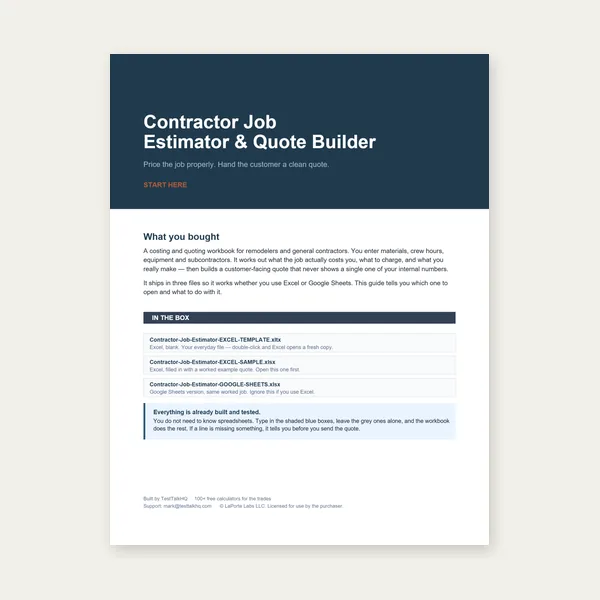
Contractor Job Estimator
Price remodels and GC work, then send a quote with no internal numbers.
Excel or Google Sheets. Best on a computer.
$29.00
BuyCheckout opens in a new tab.