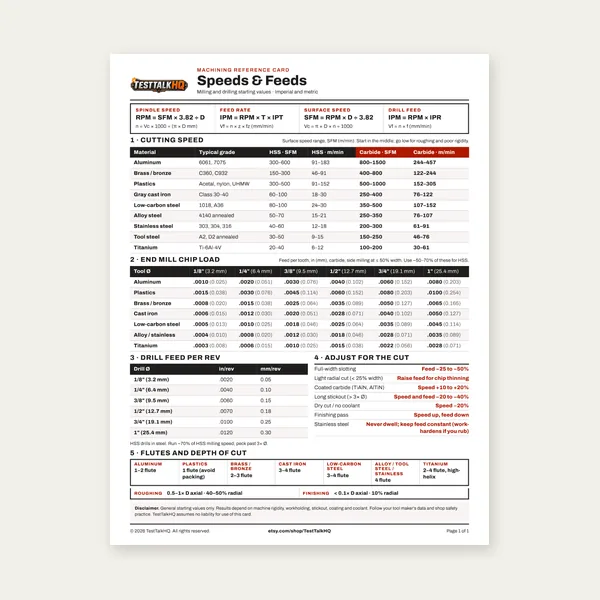
Machining Speeds & Feeds Card
One page. Speeds, chip load and drill feed, imperial and metric.
$3.99
BuyTaper, callouts, tap drill, and makeup depth for shop pipe work
NPT is not a straight machine thread with a different name. It is a 60° form cut on a 3/4" per foot taper, and the nominal size on the print is not the diameter you measure with a caliper. This guide is the NPT-specific companion to the imperial/metric tap-drill chart — use that page for UNC/UNF/metric, and this one when the callout says NPT.
Need the numbers now? Open the NPT Pipe Thread Calculator.
Need the numbers, not the lecture?Tap drill, L1, and L2 for every standard size 1/8"–4".
Open Calculator →American National Standard Taper Pipe Threads (NPT) follow ASME B1.20.1. The thread form is 60°, same family as Unified, but the pitch cylinder is a cone. The standard taper is 3/4 inch per foot of thread axis — 1 in 16 on diameter, or about 1° 47' included.
Because the thread gets larger as you go into the fitting (or smaller as you go toward the pipe end), the joint wedges. That wedge is the mechanical seal. Thread sealant fills spiral leak paths; it does not create the interference. If you stop short of the wrench-makeup plane, you still have a leak path no matter how much dope you brush on.
The useful thread is not the full visual thread. ASME splits the length into:
A print that says 1/2-14 NPT or 1/2" NPT means nominal pipe size 1/2 inch, 14 threads per inch, American taper pipe. It does not mean the hole or the OD is 0.500".
The same nominal size also drives schedule wall and weight — after you thread the end, the Pipe & Tube Weight Calculator is the right tool for lb/ft, and the Pipe Welding Calculator covers the bevel if the other end is welded.
An NPT tap is a taper tap. The hole must leave enough wall for the tap to form a full thread at the L1/L2 planes without bottoming the crest into solid metal. Shop charts use a slightly generous hole (about 75% thread in carbon steel) so the tap survives.
Common US tap drills:
The full 1/8"–4" table lives on the NPT Tap Drill Size Chart. Do not pull these sizes from the UNC/UNF tap-drill calculator — 1/2"-13 UNC wants a different hole than 1/2"-14 NPT, and the taper makes a straight-thread % formula the wrong model.
After you drill, chamfer the hole mouth. Start the tap square. For steel, use cutting fluid. Back the tap out to clear chips on through holes; on blind holes leave chip room past L4.
Hand-tight (L1) is the engagement you should feel when the threads are clean, undamaged, and the right form. If a brand-new pair will not go L1 by hand, you are cross-threaded, mixed with BSPT, or the tap/die is worn.
Wrench makeup takes you from L1 to L2. That extra interference is the seal. Typical additional wrench turns are about 2–3 on small sizes and a similar count on large sizes because L2 − L1 scales with pitch.
Count turns or measure engagement; do not use “until it feels tight” as the only stop. Cast elbows and thin stainless nipples fail in over-torque long before the steel pipe yields. Troubleshooting for leaks and cracks is in NPT Pipe Thread Problems and Solutions.
Unified and metric machine threads are cylinders. You check major, pitch, and minor on a constant diameter, and engagement length is “how many full threads are in the nut.” Percent thread is a function of tap-drill diameter vs pitch.
NPT is a cone. A thread mic at the pipe face reads a different pitch diameter than the same mic 0.300" back. Gauging uses an L1 plug or ring that must stand at a notch — not a “go/no-go” pair the way a 3/8-16 plug works. That is why this guide sits beside the complete imperial/metric tap-drill guide instead of being folded into it: the inspection method, the drill chart, and the failure modes are different.
Look up one sizeTap drill + L1/L2 without hunting the PDF of B1.20.1.
Open NPT Calculator →No. Different TPI (14 vs 13), different OD (0.840" vs 0.500"), and NPT is tapered. A UNC tap in an NPT hole is scrap.
No. Tape or dope fills the spiral. The taper still has to wedge. Short makeup leaks; tape just delays the drip.
BSPT is 55° and a different pitch on most sizes. It can catch a thread or two on NPT and then destroy both parts. See the comparison article.
One page. Speeds, chip load and drill feed, imperial and metric.
$3.99
Buy
27 pages. Milling, drilling, tapping, turning and CNC routing.
$12.99
Buy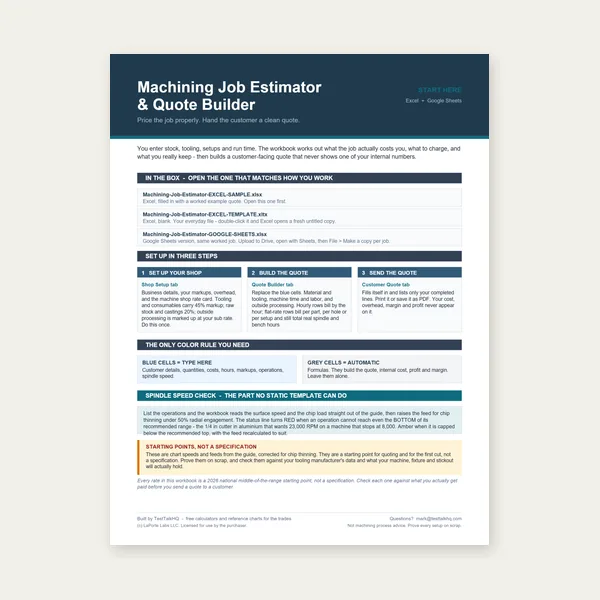
Quote shop work and check operations against your spindle's top speed.
Excel or Google Sheets. Best on a computer.
$29.00
Buy
Card, 27-page guide and the estimator workbook. All six files.
Excel or Google Sheets. Best on a computer.
$34.99
$45.98 if bought separately — save $10.99
BuyCheckout opens in a new tab.
Only products that already exist in TestTalkHQ's affiliate catalog — sealant, tap fluid, drill index, and a leak check. Dedicated NPT tap sets, PTFE tape, pipe wrenches, and NPT thread gauges are not in the current CSV, so they are not invented here.
Soft-set PTFE-filled pipe dope for NPT joints. Brush it on the male threads after you confirm size and engagement — it is not a substitute for correct makeup length.
View on Amazon →Thicker blue compound that stays put on vertical fittings. Use when T Plus 2 slumps, and still stop at the wrench-makeup length from the calculator — extra turns crack fittings.
View on Amazon →Machine-thread tap/die coverage for UN and metric holes on the same bench. It is not an NPT pipe-tap set — use a dedicated NPT tap for tapered pipe threads.
View on Amazon →Flood the tap when you cut NPT in steel or stainless. Dry taps glaze, undersize the minor, and leave a loose joint that sealant cannot save.
View on Amazon →Fractional sizes covering the common NPT tap drills from 7/16" through the larger pipe sizes you can still hand-drill. Verify the letter-R hole for 1/8" NPT with a numbered bit if you have one.
View on Amazon →Brush on after wrench makeup and pressurize. Bubbles at the last engaged thread mean you are short of L2 or the threads are the wrong form (BSPT/parallel mix-up).
View on Amazon →As an Amazon Associate, TestTalkHQ earns from qualifying purchases.