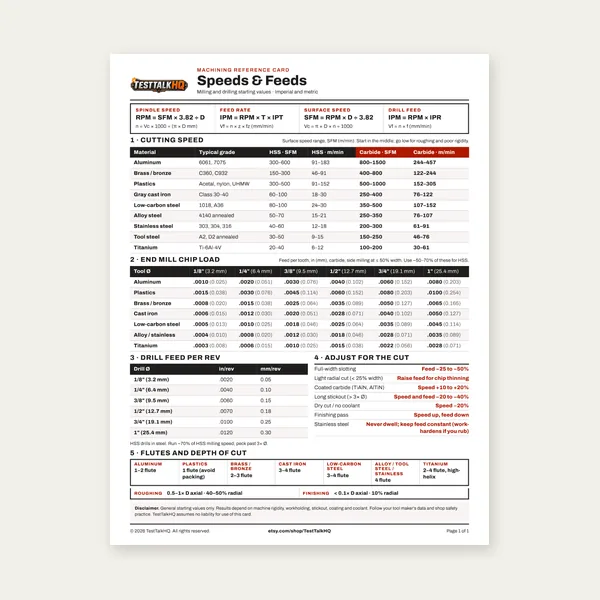
Machining Speeds & Feeds Card
One page. Speeds, chip load and drill feed, imperial and metric.
$3.99
BuyMinimum inside bend radius, springback, and overbend by material and temper
Calculate the minimum and recommended inside bend radius for mild steel, stainless, aluminum 5052 and 6061, copper, and brass. Enter gauge or decimal thickness, bend angle, and material temper to prevent cracking and compensate for springback on the press brake.
Pair with our Sheet Metal Bend Allowance Calculator, Sheet Metal Gauge Chart, and Metal Gauge to Thickness Converter. Also see Tube Bending Calculator — CLR, Arc Length & Bend Deduction and Tube Bending Guide — CLR, Wall Thickness & Springback.

One page. Speeds, chip load and drill feed, imperial and metric.
$3.99
Buy
27 pages. Milling, drilling, tapping, turning and CNC routing.
$12.99
Buy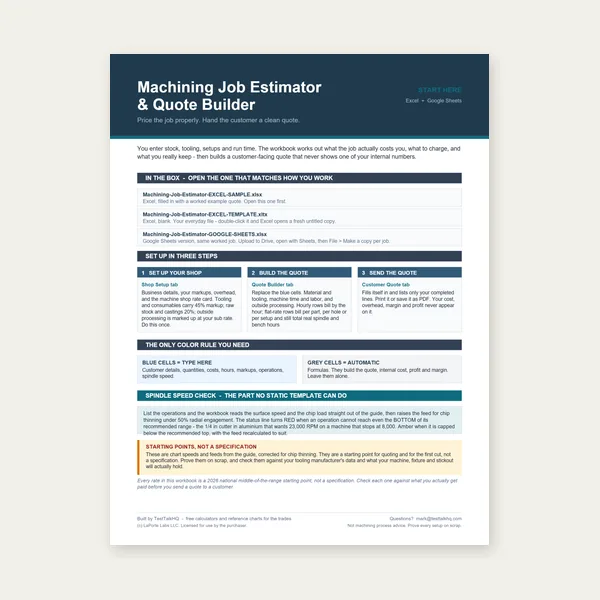
Quote shop work and check operations against your spindle's top speed.
Excel or Google Sheets. Best on a computer.
$29.00
Buy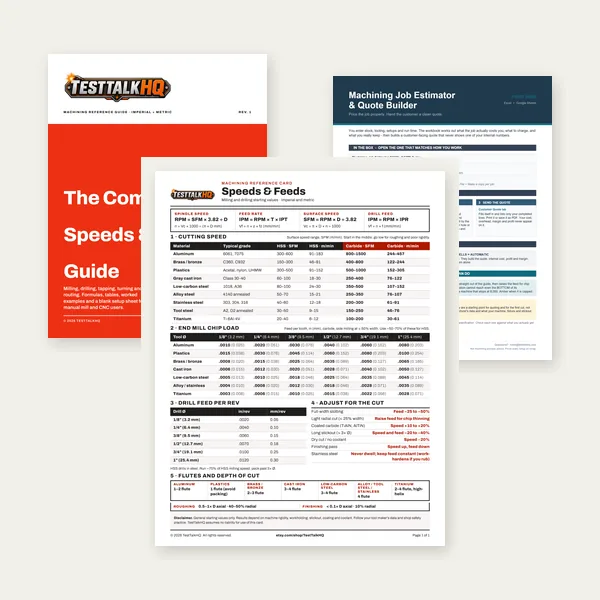
Card, 27-page guide and the estimator workbook. All six files.
Excel or Google Sheets. Best on a computer.
$34.99
$45.98 if bought separately — save $10.99
BuyCheckout opens in a new tab.
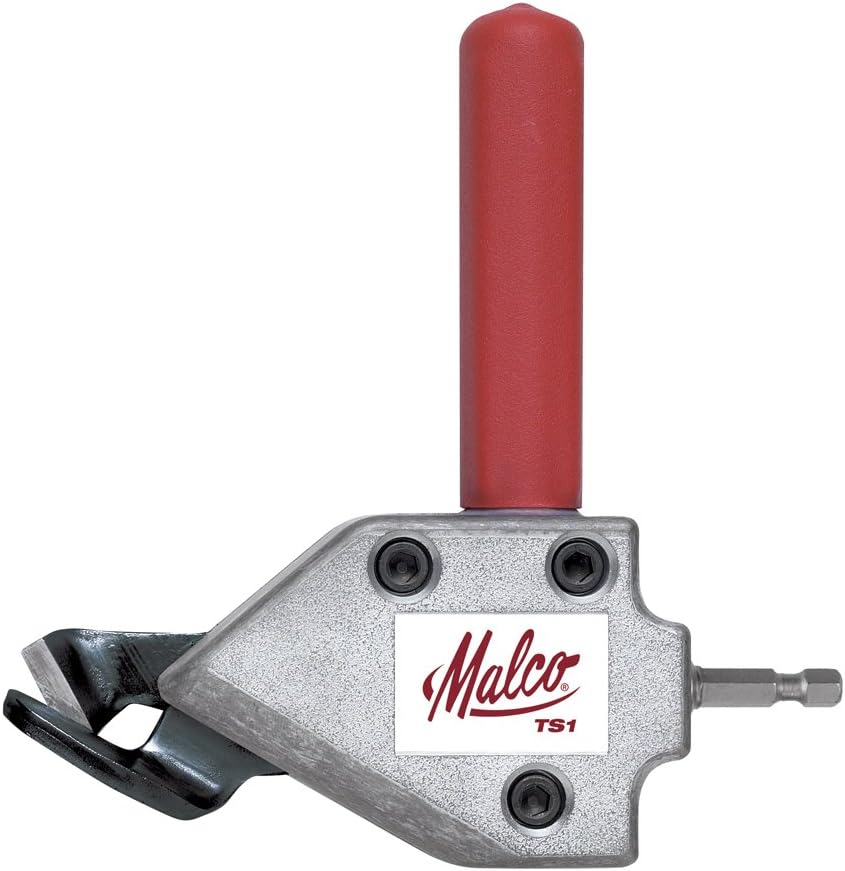
Radius gauges, cutting attachments, and cutting fluid for layout and forming work


As an Amazon Associate, TestTalkHQ earns from qualifying purchases.
Minimum bend radius is the tightest radius a material can be bent to without cracking or fracturing on the outside of the bend. It's expressed as a multiple of material thickness — a 1×t radius means the inside radius equals the material thickness.
Going below the minimum causes the outer fiber of the material to exceed its tensile elongation limit, resulting in cracking. Softer materials and lower-strength alloys tolerate tighter radii than hard or high-strength materials.
6061-T6 (the most common structural aluminum) has very low elongation compared to 5052. It's strong but brittle in bending. The minimum bend radius for 6061-T6 is 4× to 6× the material thickness depending on direction relative to the grain.
Bending across the grain (perpendicular to the rolling direction) requires a larger radius than bending with the grain. When 6061 must be bent tightly, anneal it first or switch to 5052 which is specifically designed for forming.
Springback is the elastic recovery that occurs after the bending force is removed. Every material springs back some amount — the punch removes, the part opens up slightly. Springback increases with material strength and decreases with tighter radii.
To compensate, overbend by the springback angle — if the part needs 90° and the material springs back 5°, bend to 85°. Always test a sample piece first and measure the actual springback before running production parts.
The inside radius is the standard reference for bend calculations — it's the radius at the compressed side of the bend. The outside radius equals inside radius plus material thickness.
When a drawing calls out a bend radius without specifying inside or outside, assume inside radius. For tooling selection on a press brake, the punch nose radius should match your target inside radius. The die opening determines the actual achieved radius through air forming.
Finished dims wrong, cracks, springback, or short flanges: Sheet Metal Bending Troubleshooting. Additive vs subtractive flat-pattern method: Bend Allowance vs Bend Deduction — Which to Use.
For developed cone, frustum, and lobster-back templates (printable PDF), use the Cone / Transition Flat-Pattern Generator, the usage guide, troubleshooting, and seam allowance by joining method.