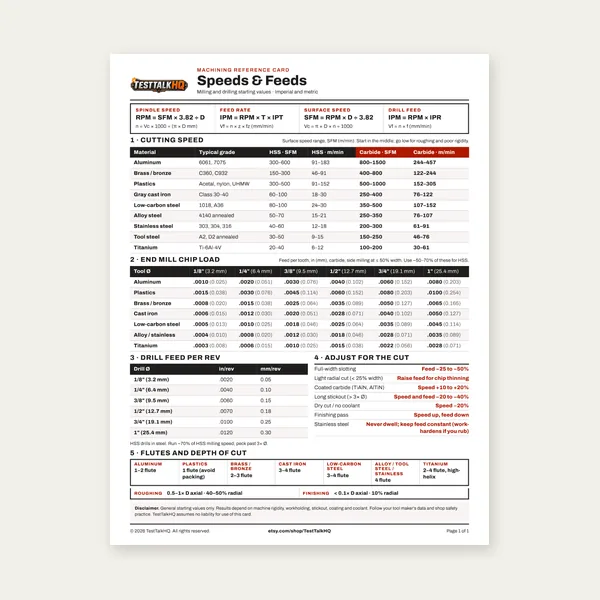
Machining Speeds & Feeds Card
One page. Speeds, chip load and drill feed, imperial and metric.
$3.99
BuyWhat tonnage measures, why V-die width matters, and air vs bottom bending
Press brake tonnage is the force required to form a bend — a machine-capacity question, not a flat-pattern layout question. Use the Press Brake Tonnage Calculator for estimates; pair with bend allowance and bend radius tools for complete sheet metal planning.

Tonnage is the bending force the press must deliver along the bend line — how hard the ram pushes the punch into the V-die to plastically deform the sheet. It depends on material strength, thickness squared, bend length, and how wide the V-die opening is. It does not tell you how long to make a flat blank — that is bend allowance math. It does not tell you the tightest radius before cracking — that is bend radius guidance.
Fabricators use tonnage estimates to answer: Will this 10-foot 1/4-inch stainless bend exceed my 100-ton brake? Should I stage shorter bend lengths? Do I need a wider V-die to bring force down? The calculator and this guide support those decisions — final numbers still come from the machine's published tonnage chart and test coupons.
The standard air-bending estimate is T ≈ k × 575 × t² × L / V (US tons; t and L in inches, V = die opening in inches, k = material factor). Notice V is in the denominator — a narrower die requires more force for the same thickness. Shops that mount too small a V for thick material often blame the material when the real issue is tooling selection.
Rule of thumb for mild steel air bending: start with V = 8× material thickness. Heavier plate often uses 10× or 12×. The wider die also produces a larger inside radius in air forming (roughly 16% of V), which ties directly to the Bend Radius Calculator and your K-factor in the Bend Allowance Calculator.
Air bending (three-point forming) is what the calculator models — the punch does not fully bottom the material into the die. Tolerance is looser but tonnage is lowest. Bottom bending forces the material to contact the die shoulders — tighter angle control, typically 3–5× higher tonnage than air bend for the same part. Coining exceeds bottom bending force further and is used for precision work on dedicated tooling.
Never use air-bend tonnage to set up a bottom-bend job — you will understate force and can overload the machine or snap tooling.
When calculator tonnage looked safe but the brake still overloaded or stalled, see Press Brake Tonnage Troubleshooting.
Mild steel (~60 ksi) uses k = 1.0 in the simplified formula. Stainless (~90 ksi) runs about k = 1.7. Aluminum (~35 ksi) runs about k = 0.5. Actual alloy and temper shift these — 6061-T6 behaves differently from 5052-H32. Convert gauge to decimal with the Sheet Metal Gauge Chart before plugging thickness into any calculator.
Typical workflow on TestTalkHQ tools:
One page. Speeds, chip load and drill feed, imperial and metric.
$3.99
Buy
27 pages. Milling, drilling, tapping, turning and CNC routing.
$12.99
Buy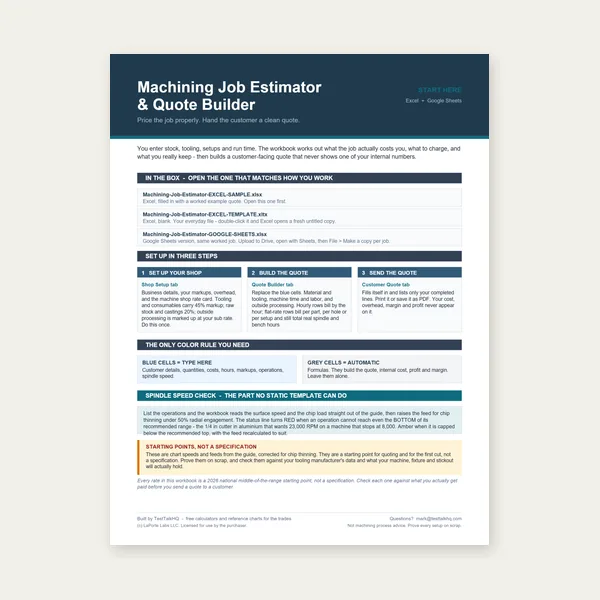
Quote shop work and check operations against your spindle's top speed.
Excel or Google Sheets. Best on a computer.
$29.00
Buy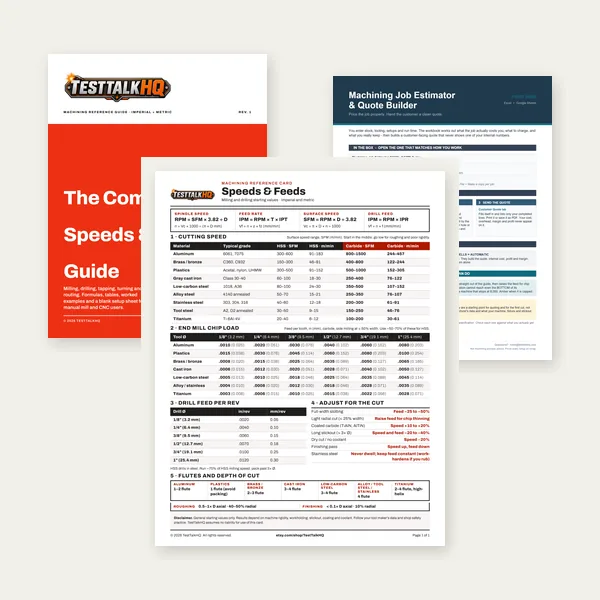
Card, 27-page guide and the estimator workbook. All six files.
Excel or Google Sheets. Best on a computer.
$34.99
$45.98 if bought separately — save $10.99
BuyCheckout opens in a new tab.
Measuring and cutting gear for brake-ready blanks

Prep blanks before they hit the brake — clean edges reduce unpredictable tonnage spikes from burrs and work-hardened shear lips.
Check Price
After the bend, verify inside radius against your allowance and radius calculations — air forming rarely hits theoretical radius on the first hit.
Check Price
Measure actual sheet thickness and V-die width — nominal gauge and stamped die labels are not always what is on the floor.
Check PriceAs an Amazon Associate, TestTalkHQ earns from qualifying purchases.
Machine nameplate tonnage is a structural limit — not a production target. Operating above 80% rated force accelerates wear on gibs, seals, and tooling. If the calculator approaches your brake limit, reduce bend length per hit, use a wider V, or move the part to a larger machine.
Tonnage formulas assume sharp tooling, consistent thickness, and air bending. A test coupon confirms actual springback, radius, and whether the ram deflects on a full-length bend. Document successful setups — thickness, V width, tonnage gauge reading, and overbend angle — for repeat jobs.
Every major press brake manufacturer publishes tonnage tables by material, thickness, and V opening. Use those for final setup when available — especially on high-strength steels, bottom bending, or when legal liability matters. The web calculator is a planning shortcut aligned with the same 575-based air-bend rule used in the Sheet Metal Bending Guide.
Tonnage gets the bend to move — blank method and diagnosis live next door: BA vs BD Decision and Sheet Metal Bending Troubleshooting.