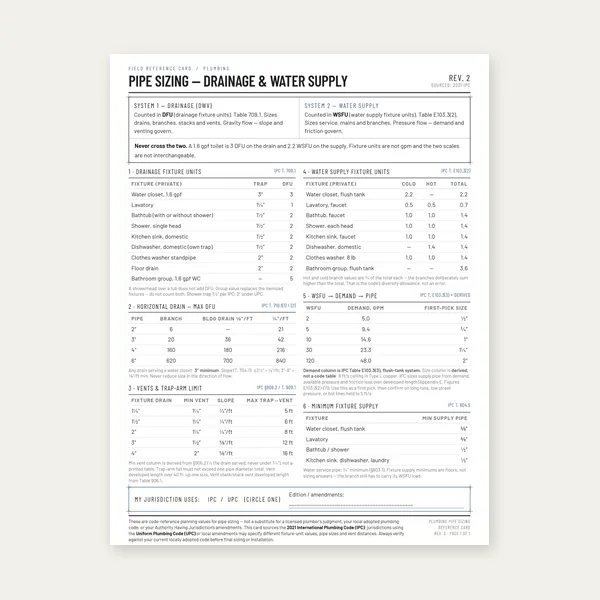
Plumbing Pipe Sizing Card
$3.99
BuyWhat water-supply fixture units actually count, how they differ from DFU, how to total a house, and why PEX is not copper at the same stamp
A water pipe is a pressure path. Too small and the second shower goes lukewarm because the first one already took the flow. The water supply pipe sizing calculator turns IPC 2021 Table E104.1 into a minimum trunk or branch diameter from the WSFU load, developed length, and pressure band you type. This page is the unit people mix up with drainage fixture units, and the ID difference the WSFU table will not mention.
Low pressure when two fixtures run: troubleshooting. Why this is not the vent worksheet: WSFU vs DFU. Vent diameter: DWV vent sizing calculator. Drain fall: drain pipe slope calculator. Plumbing index: plumbing calculators hub.
Scale in the incoming main is a hardness problem, not a fixture-unit problem. After you size the pipe, size the salt-based bed with the Water Softener Sizing Calculator.
Rural wells that feed the house still need trunk/branch pipe after the pressure tank: size supply with this calculator, then size the pump with the Well Pump Sizing Calculator.
Need the diameter?WSFU, developed length, pressure band, copper / PEX / CPVC. IPC Table E104.1 plus UPC Table 610.4.
Open Calculator →IPC Table E103.3(2) assigns each fixture a water-supply fixture unit — a Hunter-curve number for how hard that fixture hits the cold, the hot, or both. A private lavatory is 0.7 total (0.5 cold / 0.5 hot). A private kitchen sink is 1.4. A private water closet with a flush tank is 2.2, cold only. A private bathroom group on a flush tank is 3.6 total. Those numbers live in Appendix E, not Chapter 7.
Drainage fixture units live in Chapter 7 and Chapter 9. A private lav is 1 DFU. The same lav is 0.7 WSFU. A private WC is 3 or 4 DFU depending on gallons per flush, and 2.2 WSFU if it is a tank. The vent guide uses DFU because a vent is sized from the drain it serves. The drain-slope guide does not use fixture units at all; it uses pipe diameter and fall. If you paste a DFU total into the supply calculator you will size a water pipe from a waste table. The comparison page exists so that mix-up has a URL: WSFU vs DFU.
Hot-only and cold-only branches do not get the total column. Table E103.3(2) note 1: the separate hot and cold loads are three-fourths of the total. Size the cold main on the cold column plus cold-only fixtures (toilets, hose bibbs). Size the hot main on the hot column. Size the meter and the building supply on the combined total. That is why a house with 16.5 WSFU on the meter can still have a 3/4 in hot branch if the hot-only total is under the 3/4 in cell.
Walk the fixtures, not the rooms. One bathroom group (WC tank + lav + tub/shower) is 3.6 WSFU in Table E103.3(2), not 2.2 + 0.7 + 1.4 = 4.3. The group number already includes diversity inside that room. A second bathroom group adds another 3.6. Kitchen sink 1.4. Clothes washer 1.4. Dishwasher 1.4 hot. Two hose bibbs are not in E103.3(2)’s residential rows the way they sit in some UPC tables; if your jurisdiction uses a 2.5 WSFU hose bibb, add them. A typical three-bedroom, two-bath house lands in the mid-teens of WSFU on the combined column. That is the 16.5 number this calculator defaults to, and it is the number the Williams / UPC 610.4 worked example uses for a 1 in building supply at ~54 psi and 115 ft.
Do not double-count a bathroom group and then add the WC again. Do not use public-occupancy rows for a house. Do not treat a manifold home-run as one giant branch — each home-run is sized for that fixture’s WSFU, and the manifold trunk is sized for the total. Parallel systems have their own listing rules (UPC 610.4 / 610.13). This calculator is the trunk/branch table method.
IPC Table E104.1 and UPC Table 610.4 do not have a copper column and a PEX column. IAPMO ER-0253 and ICC-ES PMG 1006 say you may use those tables for Uponor / SDR 9 PEX at the same nominal size. That is the published permission. It is also why this calculator does not invent a fake PEX WSFU table.
IPC Table E105.1 is the table that actually splits materials. Ounces of water per foot of tube, which is a stand-in for internal area:
At 1/2 in: copper Type L 1.55 oz/ft, CPVC CTS SDR 11 1.25, PEX CTS SDR 9 1.18. At 3/4 in: copper L 3.22, CPVC 2.67, PEX 2.35. At 1 in: copper L 5.49, CPVC 4.43, PEX 3.91. PEX at 1 in holds about 71% of the water copper Type L holds. Same stamp on the coil, smaller hole, more friction per foot, higher velocity at the same gpm.
UPC 610.12 still caps copper tube at 8 ft/s cold and 5 ft/s hot, and caps copper fittings in non-copper tubing the same way. A 1/2 in PEX branch that Table 610.4 permits on WSFU can still be a noisy, erosive fitting if the peak gpm is high. This calculator bumps one nominal size when you pick PEX or CPVC and the Table E104.1 cell is 80% or more used. That bump is a friction check from E105.1, not a second code table. A 200-foot PEX main with a 20 psi elevation hit still wants Appendix E charts, not a bump.
IPC E104.1 Step 2: actual length of pipe between the source and the most remote fixture, including the hot run through the water heater or the cold branches, multiplied by 1.2 to cover fittings. Then pick the Table E104.1 column equal to or greater than that number. A 100-foot developed run becomes 120 ft, which uses the 150 ft column. That is why the results panel prints both lengths.
UPC 610.8 does not print that 1.2 factor. You pick the length column equal to or longer than the required length, then walk down to a WSFU cell that covers the load, then read meter and building-supply sizes from the two left columns. No building supply less than 3/4 in. The calculator uses entered length for UPC and entered × 1.2 for IPC so the two books stay honest.
Remote fixture means the farthest outlet this segment serves, not the farthest outlet in the building, unless you are sizing the building supply. A 20-foot lav branch does not inherit the 120-foot house developed length. Work from the remote outlet back toward the meter, adding WSFU as branches join, the same way you add DFU on a drain. The supply calculator sizes one segment at a time. The drain calculator sizes fall. The vent calculator sizes air. Three worksheets, one house.
No. DFU is Chapter 7 / 9. WSFU is Appendix E / UPC Chapter 6. The numbers look similar and they are not interchangeable. See WSFU vs DFU.
Building supply cannot be 1/2 in (IPC E104.1 note a, UPC 610.8). A branch can. Toggle segment type.
No. The published tables allow the same nominal size. This tool only recommends a bump when the table cell is already tight, because E105.1 shows less ID. Manufacturers and ER-0253 still allow the table size.
No. E103.3(2) assigns WSFU to fixtures. E103.3(3) converts WSFU to gpm for the hydraulic method. E104.1 is the simplified pipe-size table this calculator uses. Pre-2015 IPC called that simplified table E201.1.
$3.99
Buy
$12.99
Buy
$29.00
Buy
$39.00
BuyCheckout opens here — you stay on this page.
A WSFU diameter is a number until you cut the pipe, crimp or sweat it, hang it, and keep the thermal expansion from lifting a T&P. These are the pieces that actually leave the truck.
1/2 in and 3/4 in copper-ring crimps (ASTM F1807), go/no-go gauge, cutter, and ring puller. The iCrimp IWS-1807CN is how a PEX branch actually becomes the diameter Table E104.1 just printed.
View on Amazon →
Copper Type L still shows up on water heaters and meter tails. A RIDGID 57008 C-style cutter is the tool that squares a 3/4 in stub in a joist bay the wheel cutter will not fit.
View on Amazon →
A closed supply (PRV or check at the meter) needs somewhere for the heater to expand. Undersized pipe plus a dead-headed heater is how you get relief-valve drips that look like a pressure problem.
View on Amazon →
Meter couplings, galvanized nipples, and the last iron fitting on a remodel still need a wrench that bites. Same 14 in RIDGID that turns DWV no-hubs turns supply thread too.
View on Amazon →
PEX sags. Copper rings. Hang the run so the developed length you typed is the developed length that exists after the drywall goes up.
View on Amazon →
WSFU, developed length, pressure band, and copper / PEX / CPVC. IPC Table E104.1 plus UPC Table 610.4.
Open Water Supply Pipe Sizing Calculator →As an Amazon Associate, TestTalkHQ earns from qualifying purchases.