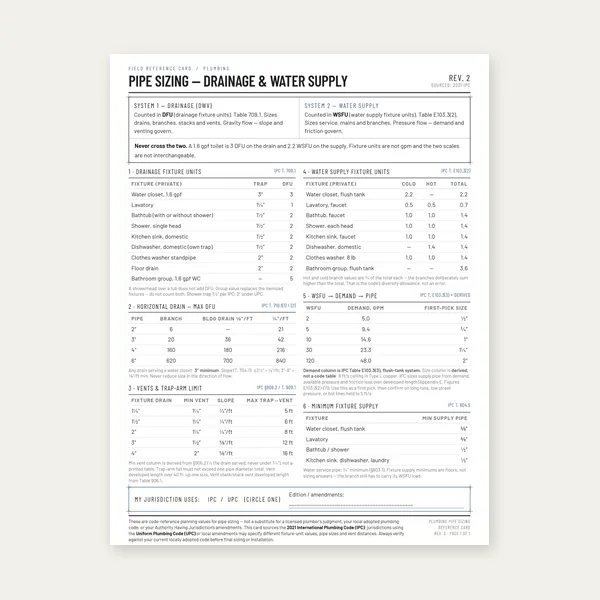
Plumbing Pipe Sizing Card
$3.99
BuyQuick-reference HP and GPM by well depth and bathroom count — and when to size past the table
The well pump sizing calculator computes total dynamic head (TDH) from well depth, fixture lift, pipe friction, and pressure, then picks HP from a curve. That is the right way. This page is the quick chart: HP class and approximate GPM by well depth and bathroom count, assuming typical residential conditions (1 in pipe, 120 ft run, 40/60 pressure, 15 ft fixture lift). Use the chart to get in the ballpark, then confirm with the calculator if your install has long pipe runs, high pressure, or unusual lift.
How TDH, GPM, and HP translate: sizing guide. Submersible vs jet pump: comparison. Low pressure, short-cycling: troubleshooting. Plumbing index: plumbing calculators hub.
Need exact HP for your well?Depth, lift, GPM, pipe, pressure. Computed TDH and HP.
Open Calculator →This table shows recommended HP class and approximate available GPM for common residential well depths and bathroom counts. GPM demand: 1–2 baths = 8 GPM, 3–4 baths = 12 GPM, 5+ baths = 18 GPM. TDH = well depth + 15 ft fixture lift + ~4 ft friction (1 in × 120 ft at mid-range flow) + 138.6 ft pressure head (60 PSI cut-out). HP is the smallest typical band that covers demand at that TDH. Tank size from 40/60 switch drawdown factor and 1-minute buffer.
| Well Depth (ft) | 1–2 Bathrooms (8 GPM) | 3–4 Bathrooms (12 GPM) | 5+ Bathrooms (18 GPM) | ||||||
|---|---|---|---|---|---|---|---|---|---|
| HP | ~GPM | Tank | HP | ~GPM | Tank | HP | ~GPM | Tank | |
| 20 ft | 1/2 | 10 | 32 | 3/4 | 13 | 44 | 1 | 18 | 62 |
| 50 ft | 1/2 | 9 | 32 | 3/4 | 13 | 44 | 1 | 18 | 62 |
| 100 ft | 3/4 | 9 | 32 | 3/4 | 12 | 44 | 1 | 16 | 62 |
| 150 ft | 3/4 | 9 | 32 | 1 | 13 | 44 | 1.5 | 18 | 62 |
| 200 ft | 1 | 10 | 32 | 1.5 | 15 | 44 | 1.5+ | 18 | 62 |
| 250 ft | 1.5 | 12 | 44 | 1.5 | 15 | 62 | Above 1.5 | — | — |
| 300 ft | 1.5 | 9 | 32 | 1.5 | 12 | 44 | Above 1.5 | — | — |
HP is horsepower class (1/2, 3/4, 1, 1.5). ~GPM is approximate pump capacity at the computed TDH for that depth (not demand, but what the pump delivers — confirm it exceeds demand). Tank is nominal gallon size (20, 32, 44, 62, 86 common residential). \"Above 1.5\" means this depth/demand combination is past typical 1.5 HP residential territory; options include 2 HP, multi-stage, or reduce TDH (lower pressure, larger pipe, less lift).
This table assumes typical residential: 1 in pipe, 120 ft run, 40/60 pressure, 15 ft fixture lift. If your install differs, the HP recommendation will shift. Common scenarios that make the chart wrong:
The tank sizes in the table (20, 32, 44, 62 gal) are based on a 40/60 PSI switch (28% usable drawdown) and 1 minute of demand as a conservative residential buffer. Larger tanks lengthen pump cycles and reduce wear. Smaller tanks may short-cycle if someone showers while the dishwasher fills. If you already have a tank, confirm it matches or exceeds the table recommendation. If the installed tank is too small, upsize the tank before you upsize the pump — short-cycling is often a tank problem, not an HP problem.
Pre-charge: the tank's air-side pressure must be set to about 2 PSI below the cut-in. A 40/60 switch wants ~38 PSI pre-charge. If the bladder is flat or the pre-charge is wrong, the tank has no usable volume and the pump will short-cycle no matter what size tank you installed. Check pre-charge with a tire gauge at the tank's Schrader valve (power off, tank drained). Detailed tank math: sizing guide.
Under ~25 ft: shallow-well jet pump is viable (motor at surface, pulls with suction). Budget and service access favor jet. Noise and aesthetics favor submersible if the well is near living space.
25–80 ft: convertible (deep-well) jet pump possible, but 4-inch submersibles are the residential default. Efficiency and operating cost favor submersible. Jet pumps in this range need a two-pipe ejector setup and lose efficiency with depth.
Over 80 ft: submersible only, practically speaking. Jet pumps at that depth are marginal. Confirm wire gauge and voltage drop if depth is over ~200 ft or the pump will not make rated HP. Full comparison: submersible vs jet pump.
Yes, but TDH is lower (less well depth). You may be able to use a smaller HP class than the table shows, especially if you have no second-floor lift. Run the calculator with your actual depth and lift to confirm. Do not oversize just because the table says so — extra HP costs more to run and does not help if the curve already covers demand.
Estimate peak GPM from fixture units (IPC Table 604.3) or add ~3–4 GPM per additional full bath beyond 5. Enter that GPM manually in the calculator. The table's 18 GPM for \"5+ baths\" is a conservative residential cap; larger homes or commercial may be 20–30+ GPM. Confirm the well yield supports that demand before sizing the pump.
If the installed pump is meeting demand (no low pressure, no short-cycling, reaches all fixtures), it may be adequate. The table uses conservative assumptions (typical pipe length, 1.5× margin on some parameters). Real-world installs with shorter runs, lower pressure, or less lift can sometimes get by on less HP. Do not replace a working pump just to match a chart. If you have symptoms (low pressure, won't reach upstairs), then size with the calculator using actual measured conditions.
$3.99
Buy
$12.99
Buy
$29.00
Buy
$39.00
BuyCheckout opens here — you stay on this page.
TDH and HP pick the pump. Torque arrestors, well-rated cable, and a pressure switch calibrated to the tank you actually have are why a “right-size” pump still cycles every 15 seconds or can't reach the second floor.
Typical shallow-to-moderate depth residential. Confirm the curve at your total dynamic head, not the HP alone.
View on Amazon →
Shallow or deep configuration depending on static lift. Above-ground service. Check if your depth is in jet or submersible territory.
View on Amazon →
Adequate drawdown for typical household demand. Prevents short-cycling when matched to the pressure switch range.
View on Amazon →
Standard residential band. Cut-in at 40 PSI, cut-out at 60. Must match your tank drawdown capacity and plumbing fixture minimums.
View on Amazon →
Prevents submersible pump from spinning on start-stop. Unanchored motors twist the drop pipe and stress wiring.
View on Amazon →
Submersible-rated, UV-resistant jacket. Must handle depth, voltage drop, and wet environments. Size by depth and pump load.
View on Amazon →As an Amazon Associate, TestTalkHQ earns from qualifying purchases.