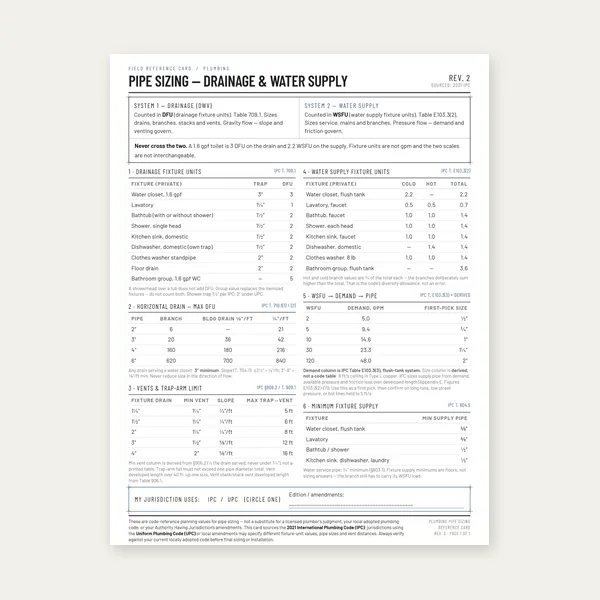
Plumbing Pipe Sizing Card
$3.99
BuyHow well depth, fixture lift, GPM demand, pipe friction, and pressure head become total dynamic head (TDH), horsepower, and tank size
People buy well pumps by the horsepower stamped on the box: 1/2, 3/4, 1 HP. Pumps live on a curve. Gallons per minute at a total dynamic head. The well pump sizing calculator takes well depth, additional lift, GPM demand, pipe dimensions, and pressure switch settings, then reports TDH, recommended HP class, and pressure tank size. This page is the why.
Low pressure, short-cycling, won't reach upper floors: troubleshooting. Submersible vs jet pump: comparison. Quick HP/depth table: sizing chart. Plumbing index: plumbing calculators hub.
Well water that feeds the house often needs softening and an iron test before you pick a grain class: Water Softener Sizing Calculator (daily grains × 7-day cycle, not pump HP).
This is potable well supply, not basement groundwater. Sump pumps are a different worksheet: sump pump sizing calculator (clarifies well vs sump). Gravity drains still use Drain Pipe Slope Calculator. Septic is waste out: septic tank sizing calculator.
Need HP and tank size?Well depth, lift, GPM, pipe, pressure. Starting point only.
Open Calculator →Total dynamic head (TDH) is the total equivalent feet of water column the pump must overcome. Three components: static lift, friction head, and pressure head.
Depth from the pumping water level (or static water level, whichever is deeper under load) to grade, plus the rise from grade to the highest plumbing fixture. A 100 ft well with a second-floor bath 18 ft above grade is 118 ft of vertical lift. Do not add grade-to-fixture twice if you already counted it.
Pressure loss from the pipe, fittings, valves, and bends between the pump discharge and the pressure tank. Depends on flow rate (GPM), pipe diameter, length, and pipe roughness (C-factor in Hazen-Williams, typically C=150 for PVC). A 1 in pipe at 12 GPM over 100 ft is about 3–4 ft of friction. A 3/4 in pipe at the same flow is much more. Undersized drop pipe or long horizontal runs add hidden head.
The calculator uses Hazen-Williams C=150 as a residential PVC default. Steel or old galvanized pipe has higher friction (lower C). If you know your pipe material is rough, manually add a few feet of head or use a lower C-factor in a detailed friction calc before entering TDH.
The cut-out pressure setting on the switch, converted to feet of water. 1 PSI = 2.31 feet of head. A 60 PSI cut-out is 60 × 2.31 = 138.6 ft of pressure head. The pump must push to that pressure to shut off. A higher pressure setting (say, 70 PSI for a large house or uphill lot) increases TDH and may push you to the next HP class.
The calculator sums these three for you and reports TDH. Then it picks HP from the curve at that TDH.
Gallons per minute (GPM) is the peak flow rate the house will demand when multiple fixtures run at once. Not the well's recovery rate (that is yield, measured by the driller). The pump must meet demand without running the well dry, so yield is a ceiling, but sizing starts with demand.
Typical residential fixture-unit conversion: 1–2 baths about 8 GPM peak, 3–4 baths about 12 GPM, 5+ baths about 18 GPM. This assumes normal coincidence (not every fixture wide open at once, but a realistic shower + toilet + kitchen scenario). Commercial or high-occupancy buildings need detailed fixture-unit tables.
If you have a fixture-unit total from code (IPC Table 604.3) or a known peak (e.g., irrigation + household), convert to GPM and enter directly. Do not use the \"rated GPM\" on an old failed pump unless you measured actual demand.
A driller's recovery test tells you how many GPM the well can sustain. If yield is 6 GPM and you size for 12 GPM demand, the pump will run the well dry every shower. Either accept longer recovery waits, install a large storage tank, or reduce simultaneous demand. The calculator assumes yield exceeds demand. If it does not, talk to the well driller before buying a pump.
Residential well-pump cartons cluster on 1/2, 3/4, 1, and 1.5 HP. Catalog curves for common 4-inch submersible pumps in those classes, in round numbers, look like this (not a named model):
| HP class | ~50 ft | ~100 ft | ~150 ft | ~200 ft | ~250 ft | ~300 ft |
|---|---|---|---|---|---|---|
| 1/2 HP | 14 GPM | 11 GPM | 8 GPM | 5 GPM | 2 GPM | 0 GPM |
| 3/4 HP | 18 GPM | 15 GPM | 12 GPM | 9 GPM | 6 GPM | 3 GPM |
| 1 HP | 22 GPM | 19 GPM | 16 GPM | 13 GPM | 10 GPM | 7 GPM |
| 1.5 HP | 28 GPM | 25 GPM | 22 GPM | 18 GPM | 15 GPM | 12 GPM |
Those are the bands the calculator interpolates. A 3/4 HP that makes 12 GPM at 150 ft TDH covers a 10 GPM demand. The same 3/4 HP at 300 ft is essentially dead. That job is 1 or 1.5 HP, or reduce TDH (larger pipe, lower pressure setting), not a pep talk to the 3/4 HP you already own.
Shallow vs deep, submersible vs jet: comparison. Under ~25 ft, a convertible jet pump is an option. Over ~25 ft, submersibles dominate residential. Both follow a GPM-at-TDH curve; the architecture differs.
A pressure tank holds water under pressure so the pump does not start every time a faucet opens. Tank size depends on the pressure switch range (cut-in to cut-out) and the GPM demand. Too small a tank = pump cycles every 20 seconds. Correct tank = pump runs for a reasonable interval, then the tank coasts through small draws.
Not all the tank's nominal gallons are usable. A 40/60 PSI switch (cut-in 40, cut-out 60) with a standard 38 PSI pre-charge gives about 28% usable drawdown. A 30/50 switch gives about 30%. The rest is air cushion and reserve below cut-in. You size the tank based on usable gallons, not sticker gallons.
The calculator uses 1 minute of demand as a conservative residential buffer. If peak is 12 GPM, you need 12 gallons usable. At 28% drawdown, that is 12 / 0.28 = ~43 gallons nominal, so round up to the next standard size (44 or 62 gal). A larger tank lengthens cycles and reduces wear. A smaller tank may short-cycle if someone showers while the dishwasher fills.
The calculator rounds up to the nearest standard tank size: 20, 32, 44, 62, 86, 119 gallons are common residential. Commercial or high-demand may need larger. If you already have a tank, confirm the pre-charge matches the cut-in (typically 2 PSI below cut-in) and the usable volume covers demand.
No. A 20 ft well with 12 GPM demand and 60 PSI pressure still has ~158 ft TDH (20 + friction + 138 pressure head). At 158 ft, a typical 1/2 HP is around 7–8 GPM. That job may need 3/4 HP. Run the calculator instead of assuming shallow = small pump.
No. Sump pumps are unpressurized groundwater discharge (no pressure tank, different GPM/HP relationship). Well pumps push into a pressurized system with different TDH components. Sump pump calculator clarifies the difference.
Options: (1) larger HP (2 HP, multi-stage), (2) reduce TDH (lower pressure setting, larger pipe, shorter run), (3) reduce demand (separate irrigation, cistern storage, or accept lower coincident flow). Confirm with a well installer.
$3.99
Buy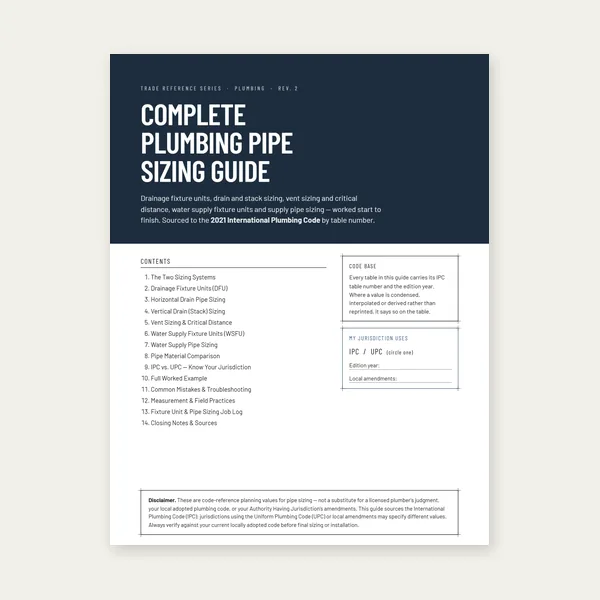
$12.99
Buy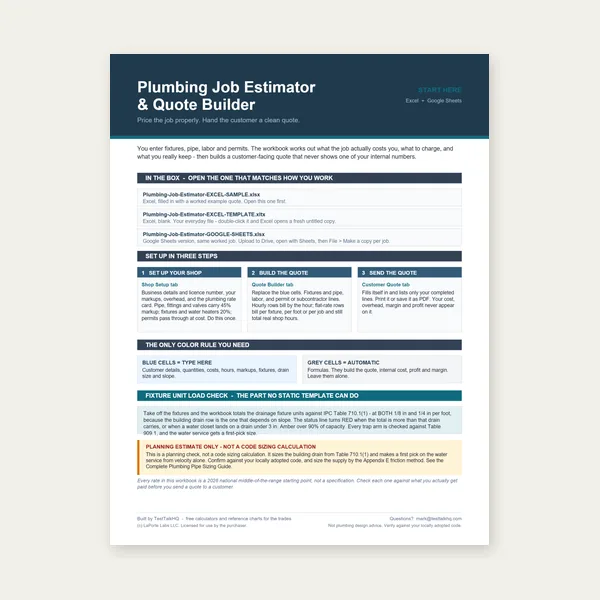
$29.00
Buy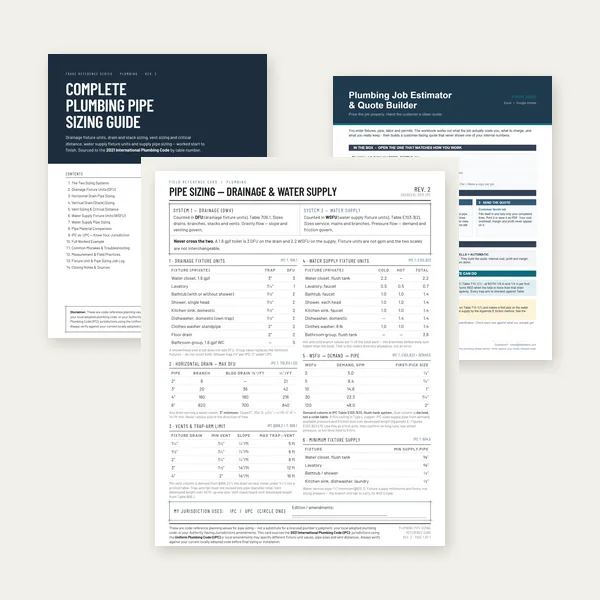
$39.00
BuyCheckout opens here — you stay on this page.
TDH and HP pick the pump. Torque arrestors, well-rated cable, and a pressure switch calibrated to the tank you actually have are why a “right-size” pump still cycles every 15 seconds or can't reach the second floor.
Typical shallow-to-moderate depth residential. Confirm the curve at your total dynamic head, not the HP alone.
View on Amazon →
Shallow or deep configuration depending on static lift. Above-ground service. Check if your depth is in jet or submersible territory.
View on Amazon →
Adequate drawdown for typical household demand. Prevents short-cycling when matched to the pressure switch range.
View on Amazon →
Standard residential band. Cut-in at 40 PSI, cut-out at 60. Must match your tank drawdown capacity and plumbing fixture minimums.
View on Amazon →
Prevents submersible pump from spinning on start-stop. Unanchored motors twist the drop pipe and stress wiring.
View on Amazon →
Submersible-rated, UV-resistant jacket. Must handle depth, voltage drop, and wet environments. Size by depth and pump load.
View on Amazon →As an Amazon Associate, TestTalkHQ earns from qualifying purchases.