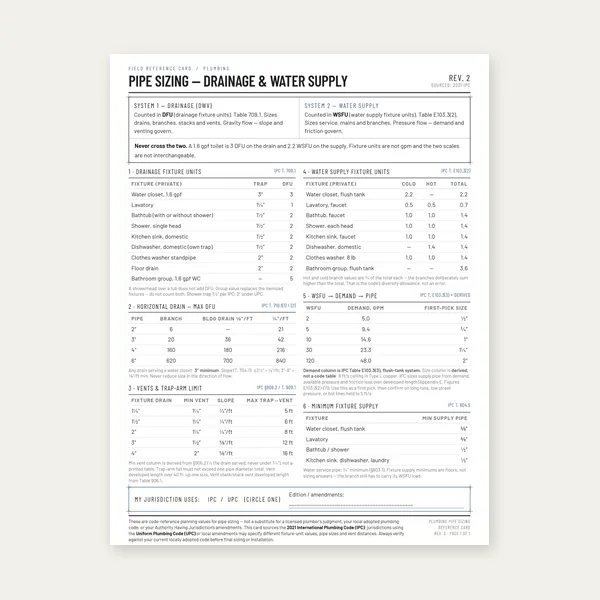
Plumbing Pipe Sizing Card
$3.99
BuyPeople × 75 gallons × grains per gallon, a 7-day regeneration cycle, a 25% reserve, ppm conversion, and the iron adder — then when to size up a full tier instead of rounding
Salt-based softeners are sized in grains of hardness they can remove between regenerations, not in the gallon stamp on the brine tank. The water softener sizing calculator runs that math: household size, gallons per person (default 75), hardness in GPG or ppm, and optional iron. This page is the why, including when rounding to the nearest capacity is not enough and you should jump a full commercial tier.
Spotting an undersized bed: troubleshooting. Grain capacity vs a salt-free conditioner: salt-based vs salt-free. Household × hardness lookup without plugging numbers: sizing chart. Plumbing index: plumbing calculators hub.
Hard water also scales heaters and supply pipe. Size the tank with the water heater sizing calculator. Size the incoming main with the water supply pipe sizing calculator. Well supply that feeds a softener: well pump sizing calculator.
Need a grain capacity now?People, hardness, optional iron. 7-day cycle with a 25% reserve.
Open Calculator →A grain is 1/7000 of a pound of calcium carbonate equivalent. Residential hardness is reported in grains per gallon (GPG). One gallon of 10 GPG water carries 10 grains. Run 300 gallons of that water through a resin bed and you have used 3,000 grains of capacity that day.
Gallons per person defaults to 75. That is a typical U.S. indoor-use average, not a code table. A water bill that shows monthly gallons is better: divide by days in the billing period, then by people if you want a per-person check, or enter the household daily total as an override in the calculator. A retired couple on a well who garden with untreated hose bibbs should not use 75 gallons each of softened water if most of the bill is irrigation that bypasses the softener.
If hardness is reported in milligrams per liter or parts per million, convert first (next section). Do not multiply ppm by gallons and call it grains. That oversizes by a factor of about 17.
Ion-exchange resin is not meant to run to empty every night. A 5–7 day regeneration cycle is the residential planning target: long enough that you are not burning salt and rinse water daily, short enough that hardness breakthrough does not sneak in on a Saturday when everyone is home. The calculator uses 7 days.
The 1.25 multiplier is the 25% reserve. Equivalently: plan so a normal week only draws the bed down to about 75% of the nameplate before regeneration. A 32,000-grain system then has about 24,000 grains of intended working capacity. If your week is 21,000 grains, you are inside that window. If your week is 28,000 grains, a 32,000-grain nameplate is already past 75% and you round up to 48,000.
Standard commercial grain classes this site rounds up to: 24,000, 32,000, 48,000, 64,000, and 80,000–96,000. Those are capacity classes, not model names. Two 32,000-grain tanks in a twin setup are a different architecture (continuous soft water during regen) and are not what this rounding table is for.
Regeneration frequency at the sized class is then rated capacity ÷ daily grains if you ran the bed to empty, or 75% of rated ÷ daily grains if you keep the reserve. For 32,000 grains and 3,000 grains/day, 75% is 24,000 / 3,000 = 8 days. A clock that regenerates every 3 days on that house is either undersized, set with the wrong hardness, or fouled — see troubleshooting.
Labs and many municipal reports list hardness as milligrams per liter of calcium carbonate. That unit is the same as parts per million for this purpose. Grains per gallon is what the grain-capacity formula wants.
180 ppm is 180 / 17.1 ≈ 10.5 GPG (hard). 120 ppm is about 7 GPG (moderately hard). 60 ppm is about 3.5 GPG (slightly hard). If you enter 180 in the calculator with the unit still set to GPG, you will size a commercial monster. Toggle the unit to ppm and the tool divides for you.
Strip kits that read in GPG can be used directly. Strip kits that read in ppm must be converted. City consumer confidence reports are usually ppm. Well reports from a county lab are mixed — read the units on the page, not the number in isolation.
Clear-water (ferrous) iron occupies exchange sites the same way calcium and magnesium do, and it fouls resin faster than hardness minerals alone. The compensation used on this worksheet is 4–5 GPG of equivalent hardness for every 1 ppm of iron. The calculator uses 5 GPG per ppm so you size toward the conservative end of that range.
Example: 10 GPG hardness and 2 ppm iron. Compensated hardness = 10 + 10 = 20 GPG. A family of four at 75 gallons each is then 300 × 20 = 6,000 grains/day, 42,000/week, 52,500 with reserve — a 64,000-grain class, not the 32,000-grain class that 10 GPG city water wanted.
Well water should be tested for iron (and manganese, which behaves similarly) before you buy a tank. City water occasionally has iron too, but the well case is where people skip the test, install a 24,000-grain unit that was sized on hardness alone, and watch it regenerate every other day by month three. The calculator shows an iron-test note when you pick well as the source. Treat that note as mandatory, not decorative.
Rounding 26,250 grains to 32,000 is the normal path. Jumping from 32,000 to 48,000 (or 48,000 to 64,000) on purpose is the other path. Do that when one of these is true, even if the raw number still fits the smaller class:
Do not size up “just because.” An oversized 64,000-grain tank on a two-person, 4 GPG city house regenerates so little water per cycle that the brine does not rinse cleanly, the bed channels, and you get hardness at the tap with a tank that looks huge on paper. The chart page covers that failure mode. The comparison page covers why none of this grain math applies to a salt-free conditioner.
Household × hardness without a form?Same 7-day + 25% math in a grid. Size up one tier off the table for well iron.
Open Chart →Weekly demand is 21,000 grains. The next standard class is 24,000 if you ignore reserve. This worksheet multiplies by 1.25 (26,250) so a normal week only uses about 75% of the nameplate, then rounds up to 32,000. Run the calculator with your own hardness before you argue with a 24,000-grain quote that omitted the reserve.
No. Salt-free conditioners do not exchange hardness ions and do not have a grain capacity. Size those by service flow rate. Full split: salt-based vs salt-free.
Only if they are on the softened side of the bypass. Most installs leave irrigation and hose bibbs untreated. Use the daily-use override from indoor consumption (or a bill with irrigation subtracted) rather than 75 gallons times people plus the garden.
No. A well pump is GPM at total dynamic head. A softener is grains between regenerations. They share a well, not a worksheet. Pump: well pump sizing calculator.
$3.99
Buy
$12.99
Buy
$29.00
Buy
$39.00
BuyCheckout opens here — you stay on this page.