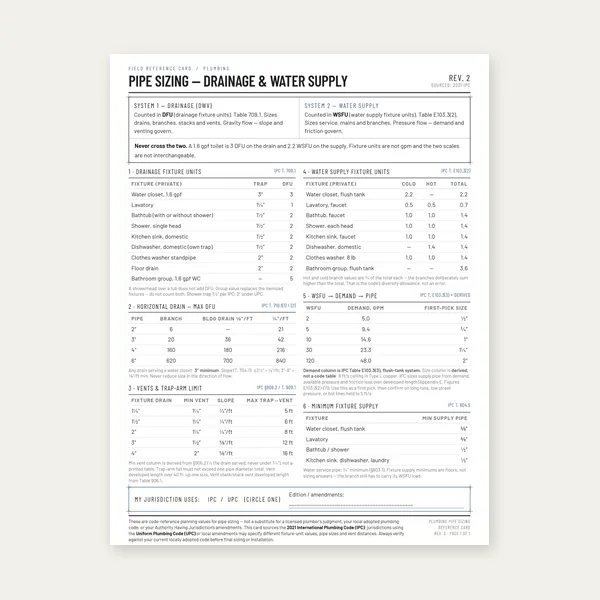
Plumbing Pipe Sizing Card
$3.99
BuyIon-exchange grain capacity (what this calculator sizes) versus salt-free conditioners that do not remove hardness and are rated by flow, not grains
The water softener sizing calculator answers one question: how many grains of ion-exchange capacity a salt-based system needs for a household, a hardness number, and a 7-day regeneration cycle with a 25% reserve. A salt-free conditioner is a different machine. It does not swap calcium and magnesium for sodium or potassium. It does not have a grain capacity. Using this calculator to “size” one is the wrong worksheet.
How the grain formula works when you do want salt-based: sizing guide. When a salt-based unit is already installed and misbehaving: troubleshooting. Household × hardness grid: sizing chart. Plumbing index: plumbing calculators hub.
Already sure you want ion exchange?People, hardness, iron. Standard grain class with a 25% reserve.
Open Calculator →A salt-based residential softener is an ion-exchange tank. Resin beads hold sodium (or potassium) ions. Hard water brings calcium and magnesium. The beads swap. The water that leaves is actually low in hardness minerals. A hardness test at a treated faucet should read near zero grains when the bed is in service.
When the beads are loaded, a brine drawn from the salt tank reverses the swap and the hardness goes to drain. That is regeneration. Capacity between regenerations is measured in grains. That is the number the calculator produces, rounded to 24,000 / 32,000 / 48,000 / 64,000 / 80,000–96,000 grain classes.
What you get: real soft water (soap lather, less spotting, less scale in a storage water heater). What you pay: salt, rinse water, a drain, and sodium or potassium in the treated water. On a septic system, brine volume is a design constraint, not a footnote.
Salt-free equipment (template-assisted crystallization and similar media) is sold as a softener in retail copy and is not one in the ion-exchange sense. Hardness minerals stay in the water. The media is meant to change how those minerals crystallize so they are less likely to plate out as hard scale on heating elements and pipe walls.
A hardness test after a salt-free unit still reads approximately the same GPG as the untreated water. Soap behavior changes little. Spotting on glass often remains. If your test of “is it working” is a $10 strip going to zero, a salt-free unit will always fail that test even when it is doing what it was designed to do.
There is no regeneration cycle, no salt bag, and no grain capacity. There is a service flow rating (GPM) and a media life in gallons or years. Size the housing so peak household flow does not blow past the rated GPM. That is a flow problem, not a 7-day grain problem.
Daily grains = gallons × GPG. Weekly = ×7. Rated = ×1.25. Round up to a standard class. Every one of those steps assumes ions are being removed and the bed has a finite number of exchange sites. A salt-free cartridge does not spend “grains.” Putting 32,000 into a shopping cart because the calculator said 32,000, then buying a salt-free cartridge with 32,000 printed in marketing copy, mixes two unit systems that do not convert.
If a listing shows both a grain number and “no salt,” read the mechanism. If it does not regenerate with brine, ignore the grain number for this worksheet. Walk through the salt-based formula when that is the architecture you want: sizing guide.
Peak flow, not weekly grains. A three-bath house that can run two showers and a dishwasher at once may see 7–10 GPM at the conditioner. If the media is rated 6 GPM, you will bypass internally or lose the conditioning effect during the peak, while a hardness test still looks unchanged (because it always does).
Supply-pipe diameter still has to carry that peak GPM. Pipe sizing is fixture units and pressure, not grains: water supply pipe sizing calculator.
Use salt-based ion exchange when you want hardness gone: well water in the hard / very hard bands, laundry and fixtures that show spotting, a storage heater filling with scale, or a lab report you actually want to drive to near-zero GPG at the tap. Size it with the calculator. If iron is present, read the iron adder and the troubleshooting mid-week failure mode before you buy the smallest class that fits.
Use a salt-free conditioner when you cannot discharge brine (some septics, some HOA rules, some indoor mechanical rooms with no drain), you accept that hardness stays in the water, and your goal is scale reduction rather than soft-water chemistry. Size by GPM. Do not use this calculator’s grain output.
Do not stack them hoping the grain number still applies. A salt-free unit upstream of a salt-based softener does not reduce the grain load on the resin. Hardness ions are still there. Size the softener as if the conditioner did not exist.
It may reduce how tightly scale bonds, depending on the media and the water. It will not turn 15 GPG water into 0 GPG water. Heater first-hour rating is still a separate size: water heater sizing calculator.
No. Zeroing salt does not switch the formula to GPM. The calculator always reports grain classes for ion exchange.
Only if you accept 20 GPG at every faucet for the life of the media. That is a preference, not a conversion from 64,000 grains. Very hard well water is the case where ion exchange is usually the honest fit, with iron tested separately.
$3.99
Buy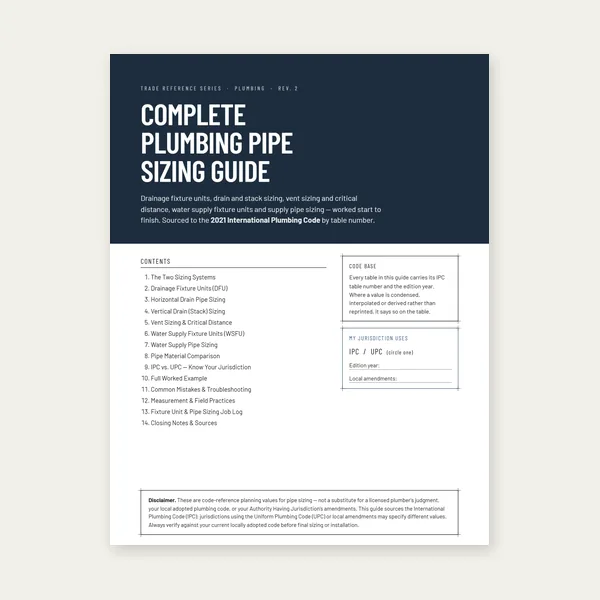
$12.99
Buy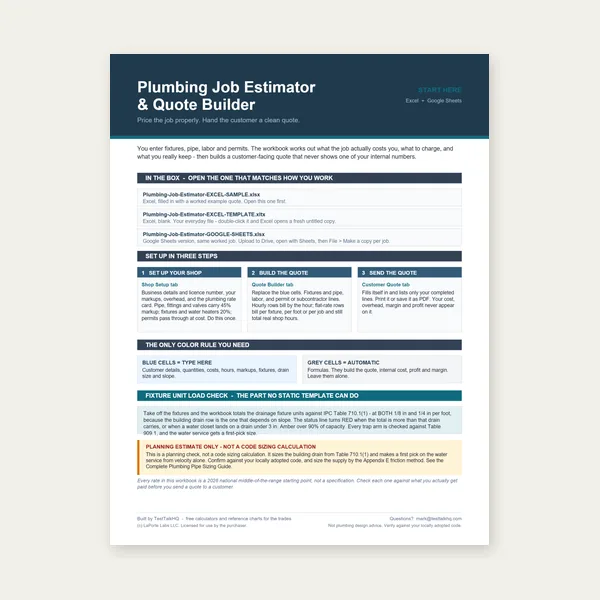
$29.00
Buy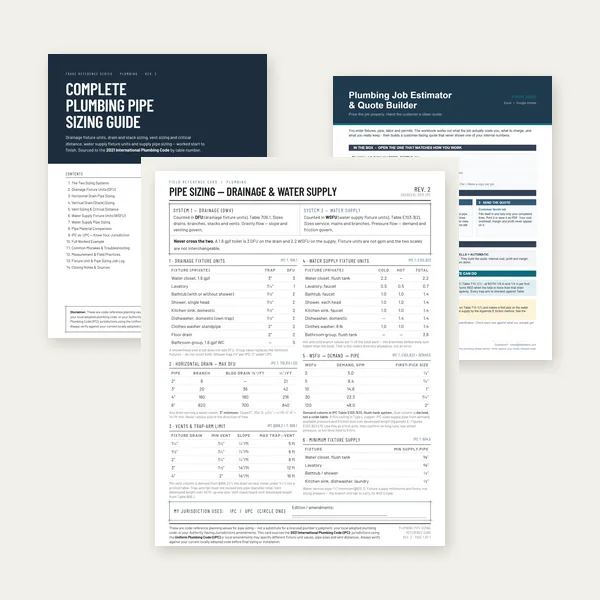
$39.00
BuyCheckout opens here — you stay on this page.