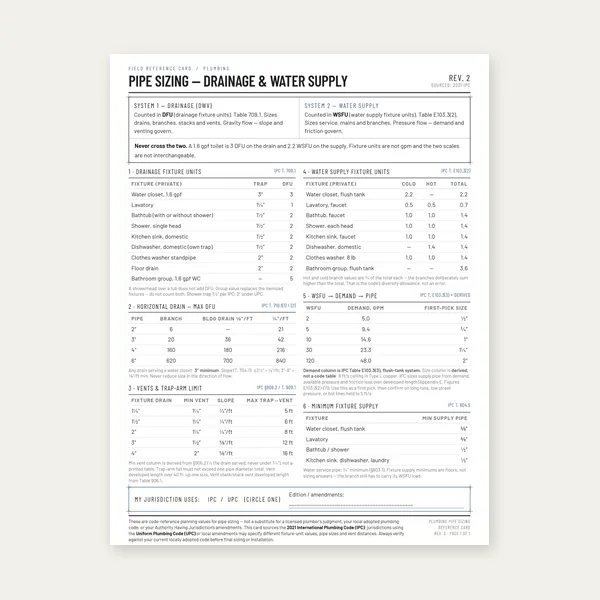
Plumbing Pipe Sizing Card
$3.99
BuyRecommended tank gallons and first-hour rating from household size, bathrooms, peak-hour use, and gas vs electric recovery
$3.99
Buy
$12.99
Buy
$29.00
Buy
$39.00
BuyCheckout opens here — you stay on this page.
Sizing gets you a tank or a tankless spec. Sediment, anodes, mixing valves, and T&P valves are why a “big enough” heater still runs out of hot water.
A spent anode does not shrink the tank, but it lets the steel rust from the inside. Check it before you assume you need more gallons.
View on Amazon →
Store hotter, deliver 120°F at the tap. A mixing valve changes how much usable hot water you actually get from the same tank.
View on Amazon →
Anode, drain valve, and dielectric unions still come apart with a wrench. Sizing math does not replace a drain-and-flush.
View on Amazon →
Safety first. A weeping T&P is not a sizing problem. Replace the valve; do not cap it.
View on Amazon →
Closed municipal systems need somewhere for heated water to go. Expansion tanks are not first-hour rating, but they save the T&P from dripping all winter.
View on Amazon →
Household size, bathrooms, peak scenario, gas or electric. Tank gallons and FHR starting point.
Open Water Heater Sizing Calculator →As an Amazon Associate, TestTalkHQ earns from qualifying purchases.
Count the people who live here, count the bathrooms that can actually run a shower, pick the busiest hour you really have (not the one you wish you had), and say whether the replacement is gas or electric. The calculator builds a DOE peak-hour demand from those choices, reports that number as the first-hour rating to match, then picks the smallest common storage tank whose estimated FHR clears it given gas or electric recovery.
Tank size vs FHR, and how to read the yellow label on the heater already in the basement: sizing guide. Running out of hot water before you blame the gallon number: troubleshooting. If you are deciding tank vs tankless, sizing is not even the same unit: tank vs tankless.