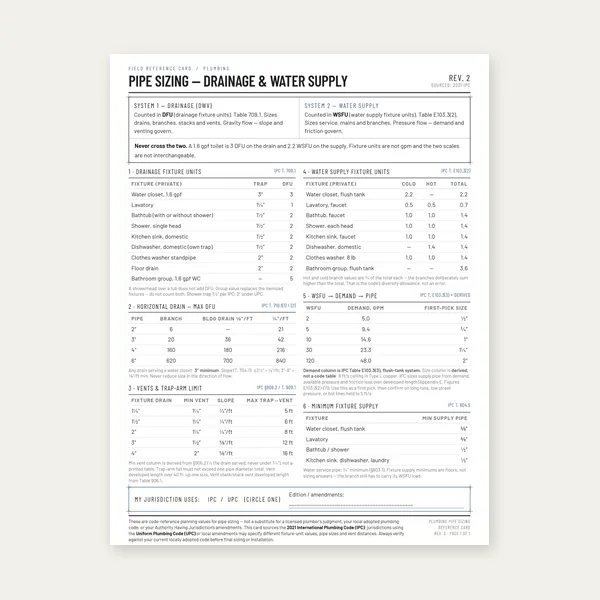
Plumbing Pipe Sizing Card
One page. DFU, drain and vent sizing, WSFU and supply, 2021 IPC.
$3.99
BuyMinimum tank gallons from water-heater volume, incoming pressure, PRV setting, and temperature rise
Size a potable-water thermal expansion tank for a storage water heater on a closed supply. Enter the heater’s actual tank gallons, city/main incoming pressure, the pressure-reducing valve setting (house static), and the temperature rise from cold inlet to stored hot water. The tool expands the water using interpolated density, then sizes the air cushion with Boyle’s law so that expanded volume fits before the 150 psi T&P relief. Fill / precharge is the lower of incoming pressure and the PRV setting — the pressure the closed system actually sits at when cold. This is a sizing starting point, not a substitute for the tank manufacturer’s selection table, a plumber, or the adopted plumbing code.
How the Boyle’s-law math works, and when a new PRV or backflow preventer first makes a tank code-required: sizing guide. T&P dripping, gauge spikes, and a waterlogged bladder: troubleshooting. Lowering the PRV vs installing a tank: expansion tank vs PRV adjustment. Plumbing index: plumbing calculators hub.
Heater gallons themselves are a different worksheet: Water Heater Sizing Calculator (DOE peak-hour / first-hour rating — starting point, not a plumber’s fixture survey). A closed supply is often why the T&P weeps after a heater swap: water heater troubleshooting.
Read the gallons on the water heater carton (or the rating plate), not the first-hour rating. Gauge incoming pressure on the street side of the PRV, and house static on the house side. If there is no PRV, those two numbers are the same. Enter the thermostat rise from cold inlet to stored hot — 90°F covers a 50°F inlet to a 140°F tank, which is the usual planning case. The calculator expands the stored volume using water density, then divides by the Boyle’s-law acceptance of an air cushion that starts at fill pressure and is allowed to reach 150 psig.
Why incoming and PRV are two different inputs: sizing guide. T&P dripping on every recovery: troubleshooting. Whether you can just crank the PRV down instead: comparison.
The result is the minimum total tank volume whose air cushion can swallow the expanded water before pressure hits the T&P. It is not the acceptance volume printed in small type on some cartons, and it is not the heater size. A 2.0 gal ST-5-class tank is a common answer for a 40–50 gal heater at ~50 psig fill. The same 50 gal heater at 80 psig fill needs more tank, because the air cushion is already compressed.
Storage water heater only (the tank gallons you typed). Density of saturated liquid water at atmospheric pressure, interpolated. Fill = min(incoming, PRV). T&P max = 150 psig. Isothermal Boyle’s law on the air side. No extra piping volume, no hydronic loops, no steam. Precharge equals fill, set on a drained tank.
Tankless heaters (tiny stored volume; expansion is a different conversation). Recirculation loops that add a lot of piping gallons you did not type. Commercial storage above ~120 gal. Hydronic / steam. A well system with a pressure tank that already absorbs domestic expansion. And an open main with no PRV and no backflow preventer — water can still push back into the street, so a tank may not be code-required (confirm locally). Adding the PRV or the RPz is exactly when this worksheet becomes mandatory: guide.
T&P dripping every time the heater recovers?Waterlogged bladder, wrong precharge, or a tank that is simply too small.
Troubleshooting →One page. DFU, drain and vent sizing, WSFU and supply, 2021 IPC.
$3.99
Buy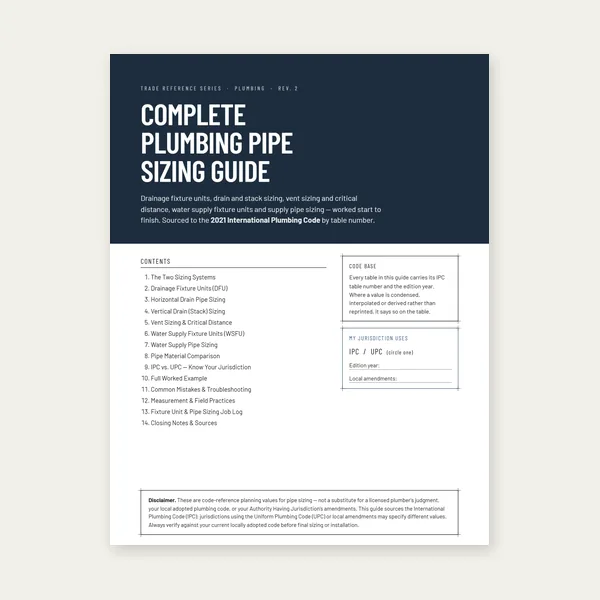
18 pages. DWV and supply sizing, plus one job worked end to end.
$12.99
Buy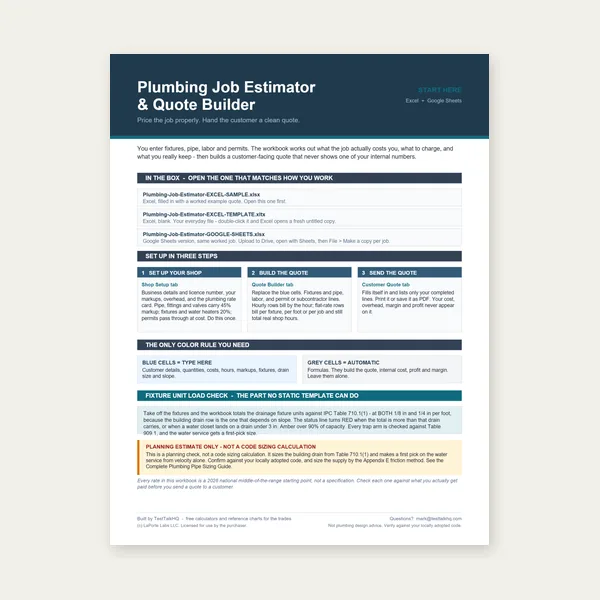
Quote plumbing work and total fixture units against the drain size.
Excel or Google Sheets. Best on a computer.
$29.00
Buy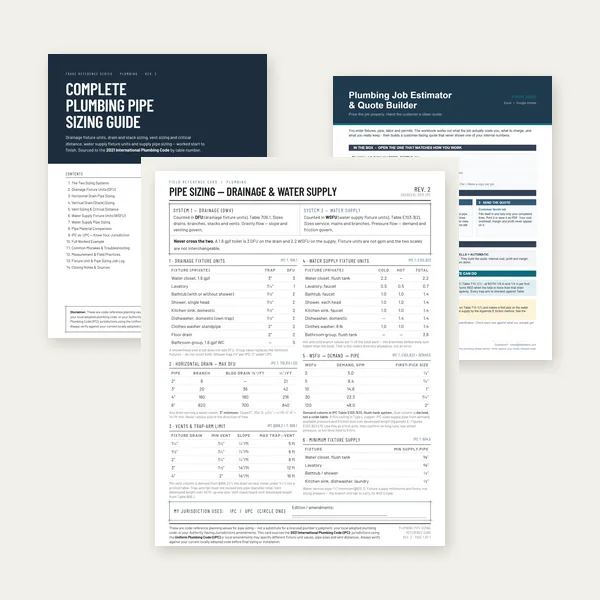
Card, 18-page guide and the estimator workbook. All six files.
Excel or Google Sheets. Best on a computer.
$34.99
$45.98 if bought separately — save $10.99
BuyCheckout opens in a new tab.
The gallons are a number until you hang a tank, set the precharge, and keep the T&P from becoming the expansion device.

Potable diaphragm tank on the cold inlet to the heater. Size it from the number above, then precharge it to house static before you fill the system.
View on Amazon →
150 psi / 210°F is the usual heater relief. A weeping T&P is a symptom, not a drain. Do not cap it. Fix expansion or replace the valve.
View on Amazon →
Dielectric unions, the tank tee, and a stuck T&P still come apart with a wrench. Sizing math does not break a painted nipple free.
View on Amazon →
Store at 140°F, deliver 120°F. That is a scald / legionella choice. It is not an expansion-tank substitute. ASSE 1017 covers the mixer, not this tank.
View on Amazon →
Hang it on the cold line, tank upright, air valve accessible. A tire gauge on that Schrader is how you catch a waterlogged bladder before the T&P weeps.
View on Amazon →
Heater gallons, incoming pressure, PRV setting, temperature rise. Minimum tank gallons and the next common size.
Open Expansion Tank Sizing Calculator →As an Amazon Associate, TestTalkHQ earns from qualifying purchases.