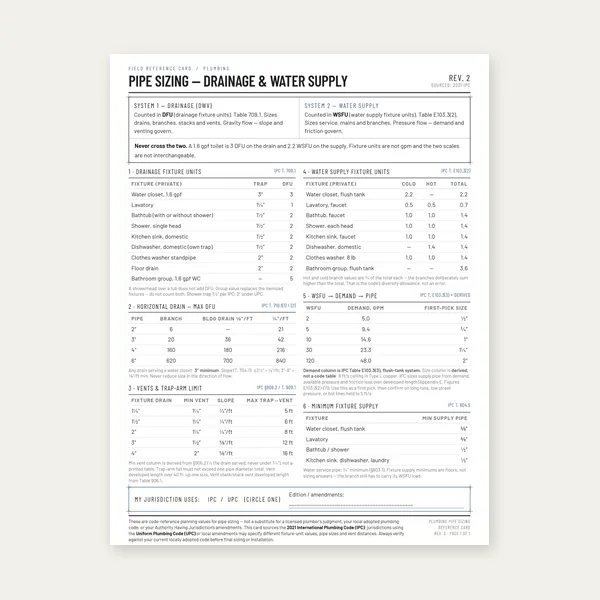
Plumbing Pipe Sizing Card
$3.99
BuyDeep well submersible in the water vs shallow or convertible jet pump at the surface — a depth, efficiency, and service decision
Once the well pump sizing calculator has given you a TDH, GPM demand, and HP class, you still have to pick a machine. Submersible: pump and motor in the well, efficient, quiet, deep-well capable, harder to service. Jet pump: motor and impeller above ground, shallow-well (under ~25 ft) or convertible (deep with ejector), easier to service, less efficient at depth. This page is that choice.
How to get the TDH/HP/GPM numbers: sizing guide. Low pressure, short-cycling, won't reach upstairs: troubleshooting. Quick HP/depth table: sizing chart. Plumbing index: plumbing calculators hub.
Size TDH, GPM, and HP first.Then pick submersible or jet. Starting point only.
Open Calculator →A submersible well pump is a sealed motor and impeller assembly that sits in the well, submerged below the static water level. It pushes water up the drop pipe. A jet pump (shallow-well or convertible deep-well) has the motor and impeller at the surface (in the well house, basement, or a surface cabinet). It pulls water up with suction (shallow) or uses an ejector assembly down in the well to assist lift (convertible deep-well jet).
Both are sized the same way: TDH (vertical lift + friction + pressure), GPM demand, HP from the curve. The calculator does not ask which style you want because the TDH formula does not care. Retail listings and well installers care a lot, because depth and service access decide the winner.
| Submersible | Jet Pump (Shallow) | Jet Pump (Convertible Deep) | |
|---|---|---|---|
| Depth limit | 300+ ft typical, 500+ ft with multi-stage | ~25 ft max | ~25–120 ft practical |
| Efficiency at depth | High (direct push) | N/A (can't reach) | Lower (ejector losses) |
| Motor location | In the well, submerged | Surface | Surface |
| Service access | Pull the pump (crane, helper, or pro) | Walk up and unbolt it | Motor at surface, ejector pull from well |
| Noise | Silent (in the well) | Motor noise in the pump house | Motor noise in the pump house |
| Priming | Self-priming (check valve holds column) | Needs priming on startup | Needs priming on startup |
| Price (typical 3/4–1 HP) | Higher | Lower | Mid (+ ejector kit) |
This is the same angle as MIG vs TIG: pick the process that matches the job constraints after the \"weld size\" (here: TDH, GPM, HP) is known. Do not buy a jet pump because it is cheaper if the well is 100 ft deep — it will not work. Do not buy a submersible for a 20 ft well in a pump house you service yourself if a shallow jet is adequate and you can reach it without rigging.
Deep wells (over ~25 ft). Submersibles are the residential standard for depth because they push directly from below the water. No suction lift limit. A 4-inch submersible in a 150 ft well with proper HP will deliver rated GPM at that TDH. A jet pump at 150 ft is into diminishing-returns territory or needs a two-pipe ejector setup that costs as much as a submersible and is less efficient.
Efficiency. A submersible has one stage of work: push water up. A deep-well jet has to create suction or drive an ejector, both of which lose energy. At 100+ ft, a submersible uses less power for the same GPM. Operating cost over 10–15 years favors submersible if you run significant flow.
Quiet operation. The motor is in the well. The house or pump room hears nothing. A jet pump motor is in the room, and you hear it cycle. If the well house is attached to living space or a bedroom is above the pump room, submersible wins on noise alone.
Shallow wells (under ~25 ft). A shallow-well jet pump pulls water with suction. Practical limit is about 25 ft; physics limits suction lift to ~34 ft (atmospheric pressure), and friction/elevation eat into that. If the static water level is 20 ft and you have a pump house at grade, a shallow jet is cheaper and simpler than a submersible you have to pull for service.
Service access. The motor, impeller, switch, and pressure tank are all at the surface. You unbolt the pump, replace the seal or impeller, and you are done. No rigging, no pulling 100 ft of drop pipe, no helper. If you service your own equipment and the well is shallow, that is a compelling reason for a jet.
Budget. A decent 1/2 HP shallow jet pump is still the cheapest way to supply water from a shallow well. Submersibles cost more (sealed motor, submersible cable, down-hole check valve). If the well is 15 ft and you have access to a pump house, a jet pump is the honest budget choice.
Under 25 ft: shallow jet pump is viable, and often the budget/service choice unless noise or aesthetics matter.
25–80 ft: convertible jet pump possible, but a 4-inch submersible is usually the residential standard. Efficiency and operating cost favor submersible. Installers stock submersibles. If service access is critical (commercial, rental property with on-site maintenance), a convertible jet may still win, but it is the exception.
Over 80 ft: submersible only, practically speaking. Jet pumps at that depth are marginal on efficiency, and the ejector setup costs as much as a submersible without the performance. Over ~200 ft, confirm wire gauge and voltage drop or the pump will not make rated HP. Deep submersibles (300–500 ft) may be multi-stage units; confirm with the well driller.
Yes, if the well casing diameter supports it (most 4-inch or larger casings work). You will abandon the jet pump and two-pipe suction setup, install a submersible on a single drop pipe with cable, and run new wiring. The TDH calc does not change; the architecture does. Confirm casing ID with the well driller before buying a pump.
Depends. A sealed 4-inch submersible in clean water with correct voltage can run 15–20 years. A shallow jet pump with regular service (seal, impeller) can also last decades. Submersibles die early if run dry or on low voltage. Jets die if the seal leaks or the motor overheats. Proper install and maintenance matter more than architecture.
Two-wire submersibles have the start components (relay, capacitor) in the motor housing down in the well. Three-wire submersibles have them in a control box at the surface. Three-wire is easier to service (replace the box without pulling the pump), but costs more upfront. Two-wire is simpler wiring, lower initial cost, but if the start relay fails, you pull the pump. Not a TDH or HP question — it is a service-access tradeoff. Residential installs split about 50/50.
$3.99
Buy
$12.99
Buy
$29.00
Buy
$39.00
BuyCheckout opens here — you stay on this page.
TDH and HP pick the pump. Torque arrestors, well-rated cable, and a pressure switch calibrated to the tank you actually have are why a “right-size” pump still cycles every 15 seconds or can't reach the second floor.
Typical shallow-to-moderate depth residential. Confirm the curve at your total dynamic head, not the HP alone.
View on Amazon →
Shallow or deep configuration depending on static lift. Above-ground service. Check if your depth is in jet or submersible territory.
View on Amazon →
Adequate drawdown for typical household demand. Prevents short-cycling when matched to the pressure switch range.
View on Amazon →
Standard residential band. Cut-in at 40 PSI, cut-out at 60. Must match your tank drawdown capacity and plumbing fixture minimums.
View on Amazon →
Prevents submersible pump from spinning on start-stop. Unanchored motors twist the drop pipe and stress wiring.
View on Amazon →
Submersible-rated, UV-resistant jacket. Must handle depth, voltage drop, and wet environments. Size by depth and pump load.
View on Amazon →As an Amazon Associate, TestTalkHQ earns from qualifying purchases.