Calculators & guides only — no articles or blog noise.
Well Pump Troubleshooting
Low pressure at fixtures, short-cycling tank, won't reach upper floors, and a pump that runs the well dry
An undersized pump is real. It is also the diagnosis people skip to. Low pressure is often an incorrect tank pre-charge or a clogged filter. Short-cycling is often a tank that lost its air charge. A pump that \"can't reach the second floor\" is often undersized supply pipe, not undersized HP. Size correctly with the well pump sizing calculator, then work this list before you upsize.
Turn off power before opening the tank or pressure switch.
Well pumps run on 240V (or 120V for shallow jets). Water and live wiring are a shock hazard. Kill the breaker. If the pump is in the well, do not attempt to pull it without proper rigging and help. Call a licensed well service if the equipment is damaged or the well is artesian.
Confirm the system is even in the right HP/tank band.Depth, lift, GPM, pipe, pressure. Then come back to this list.
Fixtures have weak flow, shower is a trickle, or the pressure gauge reads low even after the pump runs. Common causes:
Tank pre-charge wrong. The air cushion in the pressure tank must be set to about 2 PSI below the cut-in. A 40/60 switch wants ~38 PSI pre-charge. If the bladder or diaphragm is flat, the tank is \"waterlogged\" and has no usable volume. Pump will short-cycle or pressure will be erratic. Check pre-charge with a tire gauge at the tank's air valve (power off, tank drained or isolated). Restore to spec.
Pressure switch mis-adjusted. Cut-in and cut-out screws set the range. If someone lowered the cut-out to \"save energy,\" max pressure drops. Reset to design (typically 40/60 or 30/50). Do not crank it to 70 PSI unless the tank and pump are rated for it.
Clogged sediment filter or screen. Well water carries silt, iron, or sand. A plugged filter before the tank chokes flow and fakes low pressure. Replace or clean filters. Check the pump's inlet screen if accessible.
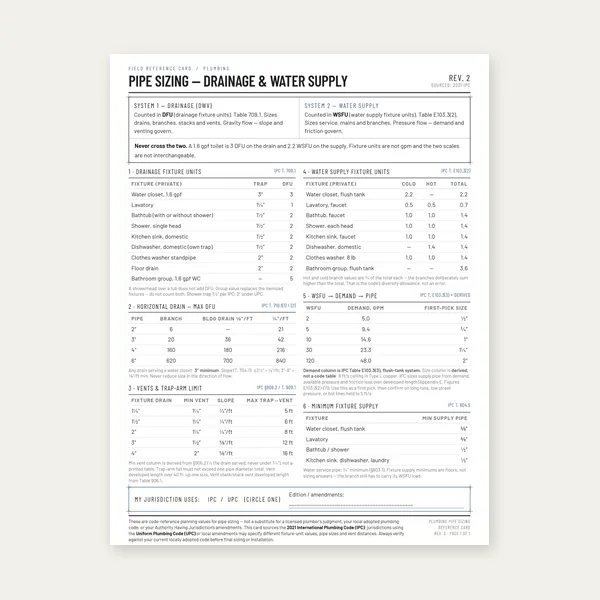
Undersized supply pipe. 1/2 in pipe from the tank to the house is a bottleneck at higher flow. Branch lines that are too small will have low pressure even if the tank reads fine. Confirm main is 3/4 in or 1 in; branches are properly sized per fixture-unit tables. Water supply pipe sizing calculator.
Pump at end of curve. If the pump is making pressure but can't sustain flow (gauge drops quickly under load), the HP may be undersized for this TDH. Read the installed pump's curve. If it is rated for 6 GPM at your TDH and you need 12 GPM, the carton HP is irrelevant. Upsize or reduce TDH (larger pipe, lower cut-out, less lift).
Waterlogged tank false-positive.A 44 gal tank with a blown bladder stores maybe 2 gallons before the pump kicks on again. Looks like \"the pump can't keep up,\" but the pump is fine — the tank is dead. Replace the tank (or bladder if serviceable) and pressure returns to normal.
Short-Cycling — Pump Starts Every Few Seconds
Pump runs, stops, runs, stops, every 10–30 seconds even with no fixtures open, or cycles rapidly during light use (hand-washing, single faucet). Heat builds. Contacts wear out. This is not \"the pump is too small\" — it is the storage system not holding pressure cycles.
Tank lost air charge. Same as waterlogged above. No usable volume. Check pre-charge. If the Schrader valve hisses water, the bladder is ruptured. Replace tank or bladder.
Tank too small for demand. A 20 gal tank with 28% drawdown is 5.6 usable gallons. At 12 GPM demand, that is 28 seconds of draw before the pump starts. If you have a tiny tank on a 3/4 HP system, upsize the tank before you upsize the pump. See sizing guide for tank math.
Leak in the system. A dripping toilet flapper, leaking pressure relief valve, or crack in the line downstream of the tank will cause slow-continuous cycling. Listen for running water with all fixtures off. Check the pressure relief valve on the tank and water heater.
Check valve failed (submersible). A failed check valve at the pump lets the drop pipe drain back into the well when the pump stops. Tank pressure drops, pump starts to refill the pipe, repeat. Symptom: pump cycles even with no draw, or you hear the column refilling. Replace check valve at the pump (requires pulling the pump if submersible).
Pressure switch differential too tight. A cut-in/cut-out only 10 PSI apart (e.g., 50/60 instead of 40/60) gives less usable tank volume. Reset the switch to a wider range if the pump and tank allow it, or install a larger tank.
The calculator's tank recommendation includes a 1-minute buffer to avoid short-cycling in normal use. If the installed tank is smaller than recommended, that is the first fix, not a bigger pump.
Won't Reach Upper Floors or Distant Fixtures
Ground-floor fixtures fine, but second-floor bathroom has weak pressure or won't flow at all. Or the end of a long run (master bath, barn) is a trickle.
Static pressure too low. The cut-out PSI sets max tank pressure. At 60 PSI cut-out, you have 60 PSI at the tank. Every foot of elevation costs 0.433 PSI. An 18 ft rise to the second floor is 18 × 0.433 = 7.8 PSI. Fixtures need ~20 PSI minimum (more for good flow). If you start with 60 PSI and lose 8 PSI to elevation, you have 52 PSI at the fixture — fine. But if the cut-out is only 50 PSI, you have 42 PSI at the second floor, which may be marginal. Raise the cut-out (say, 40/60 to 50/70) if the pump and tank are rated for it, or install a booster pump for the upper zone.
Undersized branch line. A 1/2 in line to a second-floor bath will choke flow even if the main is 1 in. Friction loss in small-diameter pipe is exponential. Upsize the branch to 3/4 in if demand is high (multiple fixtures).
Elevation + friction. A long run loses pressure to friction. A 100 ft run at 10 GPM through 3/4 in pipe is about 15 PSI loss (depending on pipe roughness). Add vertical lift and you may not have enough. The well pump calculator includes pipe length and diameter in TDH. If you entered a short run and the real supply is 200 ft, the pump is undersized for the actual friction. Re-run the calc with correct pipe length.
Pump GPM insufficient. If the pump makes 6 GPM at your TDH and you try to run 10 GPM peak (second-floor shower + kitchen), flow splits and pressure drops everywhere. Symptom: ground floor OK when alone, but both floors weak when simultaneous. That is real undersize. Upsize HP or reduce demand (close off zones, limit simultaneous use).
Booster pump for a zone. If the rest of the house is fine but one remote area (uphill barn, third-floor suite) is weak, a small booster pump for that zone is often cheaper and simpler than replacing the main well pump with a monster. The main pump fills a buffer tank at grade; the booster pressurizes the remote zone. Common in hillside or large-property installs.
Pump Runs the Well Dry
Pump runs, water stops, pump keeps running (or kicks on/off rapidly), pressure drops to zero. Well may recover after an hour. This is demand exceeding yield, not a pump problem per se, but it will destroy the pump if ignored (submersibles overheat when run dry).
Demand > yield. The well driller's recovery test said 5 GPM. You sized the pump for 12 GPM. During a shower, the pump empties the well faster than it refills. The pump is correctly sized for demand but the well cannot supply it. Options: reduce demand (low-flow fixtures, stagger use), install a large storage cistern to buffer recovery, or accept the limitation. You cannot fix this with a bigger pump — a bigger pump drains it faster.
Low water table / seasonal drop. The static water level dropped (drought, seasonal, or long-term aquifer decline). The pump intake is now at or below the water. Lower the pump (if depth allows) or reduce demand. A deeper well (re-drill or deepen casing) may be the only fix if the formation dried up.
Pump intake too high. A 4-inch submersible should sit at least 10–20 ft below the static water level (more if drawdown under pumping is significant). If it is only 5 ft below static, any load will pull the water below the intake. Move the pump deeper on the drop pipe.
Well screen clogged. Silt, iron bacteria, or mineral buildup can choke the well screen and reduce yield. A well that used to make 10 GPM and now makes 3 GPM after years of service may need rehabilitation (acid treatment, surging, or re-screen). Call a well service to diagnose.
Leak in drop pipe or casing. A cracked drop pipe or failed casing joint lets water recirculate instead of reaching the surface. Rare but catastrophic. Symptom: pump runs constantly, pressure never builds, well does not recover. Requires pulling the pump and inspecting the column and casing. Not a DIY job.
Submersible pumps have thermal overload protection, but repeated dry-run cycles still shorten life. If the well cannot sustain demand, the fix is on the demand or storage side, not the pump side. Do not keep upsizing HP hoping to squeeze more out of a 5 GPM well.
Do not run a submersible dry. Submersible motors use the well water for cooling. Running dry for more than a few seconds overheats the motor. Install a low-water cutoff or pump-protection relay if the well is marginal. Jet pumps (motor above ground) are more forgiving but still should not run against no flow.
FAQ
The pump hums but won't start.
Locked impeller, failed start capacitor (single-phase motors), or low voltage. Power off, check breaker and voltage at the pressure switch. If 240V is present and the motor hums, the capacitor or motor may be bad. Not an HP-class problem — call a pump tech.
Should I just buy 1.5 HP and be done?
Only if the curve at your TDH needs it. Extra HP at shallow depth and low demand just costs more to run. At deep TDH, extra HP may not help if you are past the pump's shutoff head. Size to the curve. Calculator.
Can I use the sump-pump troubleshooting for a well pump?
No. Sump systems are unpressurized, no tank, different failure modes. Sump troubleshooting is for basement groundwater. Well pumps are pressurized potable supply. Different worksheet.
TDH and HP pick the pump. Torque arrestors, well-rated cable, and a pressure switch calibrated to the tank you actually have are why a “right-size” pump still cycles every 15 seconds or can't reach the second floor.
Submersible Well Pump (1/2 HP Class)
Typical shallow-to-moderate depth residential. Confirm the curve at your total dynamic head, not the HP alone.