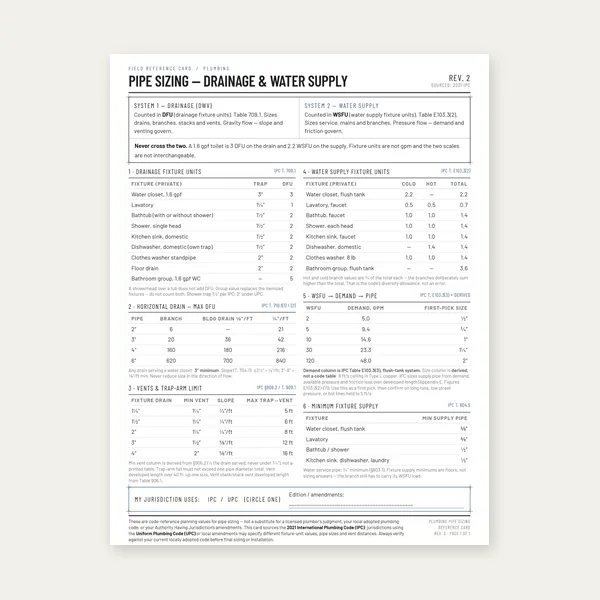
Plumbing Pipe Sizing Card
One page. DFU, drain and vent sizing, WSFU and supply, 2021 IPC.
$3.99
BuyShort-cycling, a pump that never shuts off, a pit that loses during heavy rain, and a check valve that is doing the opposite of its job
An undersized pump is real. It is also the diagnosis people skip to. Short-cycling is often a tiny basin or a tether that barely moves. A pump that runs constantly is often a failed check valve dumping the riser back into the pit. A flood during a storm is sometimes a clogged discharge, not the 1/3 HP carton. Size correctly with the sump pump sizing calculator, then work this list before you upsize.
How basin, inflow, and head translate: sizing guide. Submersible vs pedestal when you do replace it: comparison. Plumbing index: plumbing calculators hub.
A potable well pump is a different worksheet from this basement crock: Well Pump Sizing Calculator (TDH, HP class, pressure tank — not a sump pump).
Confirm the pit is even in the right HP band.Diameter, inflow, head. Then come back to this list.
Open Calculator →Short-cycling is on, off, on, off, every few seconds to half a minute. Heat builds. The start capacitor (where there is one) works too hard. The check valve slams. Impellers and floats die early. It looks like “the pump is too small and cannot keep up,” which is the opposite of what is happening: the pump is emptying a tiny volume too fast, then the float falls, then a cup of inflow brings it back on.
Check, in order:
If the motor never shuts off, either water never falls below the off level, or the float thinks it is still up. Those are different jobs.
Inflow equals or exceeds pump GPM at this head. Time a rise with the pump unplugged (guide). If inflow is 20 GPM and a tired 1/3 HP is making 12 GPM at 18 ft of real head, the pit will not empty. That is a real undersize or a real head problem (clog, ice at the outlet, crushed flex line). Run the calculator with measured numbers, not the carton.
Tether hung on the discharge, float stuffed against the liner, or a vertical rod bent. The pump is pumping. The switch never sees “off.” Free the float. Do not oil it; replace a waterlogged float.
Failed check valve. Next section. The pump empties the basin, shuts off, the 8 ft of standing water in the discharge falls back through a stuck-open check, the float rises, the pump starts. From the basement door it looks like the pump “never stops.” From the pit it is a 30-second cycle of the same gallons.
A pump that idles through a drizzle and loses the pit in a two-hour downpour is either seeing a real inflow spike, or the discharge is choking exactly when you need it.
Interior fixtures gurgling during the same storm is probably DWV, not the sump. Slope vs vent: drain slope vs vent sizing. Do not enlarge the sump pump to fix a wet vent.
A check valve on the discharge keeps the riser full when the pump stops. Without it, every gallon you just lifted falls back into the pit. Symptoms:
Replace a failed swing check. Install it in the direction of flow, with a union so the next pump change does not cut the stack. Vertical installation per the valve’s instructions — some checks are horizontal-only. A missing check is not a sizing problem and not a reason to jump from 1/3 to 3/4 HP.
Locked impeller, failed capacitor, or a pump sitting above the water (pedestal impeller clogged, submersible air-locked). Power off, inspect. Humming against a dead head (iced outlet) also happens. Not an HP-class problem.
Only if the curve at your head needs it. Extra HP in a small pit short-cycles harder. Extra HP on a clogged 1-1/4 in flex line still makes almost no flow. Measure inflow and head, then pick the band. Calculator.
No. Silt and groundwater will flood the field. Septic vs municipal sewer is about house waste. This pit is not house waste.
One page. DFU, drain and vent sizing, WSFU and supply, 2021 IPC.
$3.99
Buy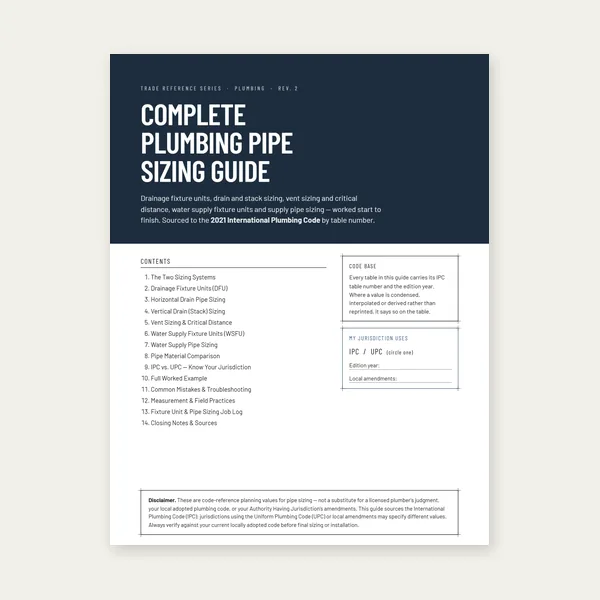
18 pages. DWV and supply sizing, plus one job worked end to end.
$12.99
Buy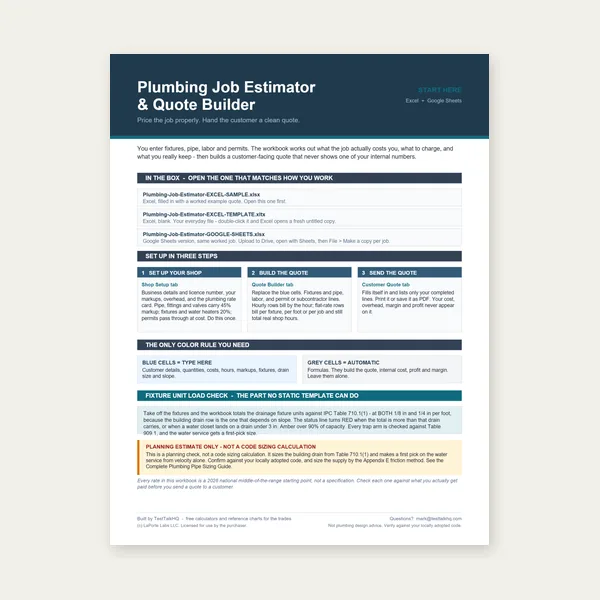
Quote plumbing work and total fixture units against the drain size.
Excel or Google Sheets. Best on a computer.
$29.00
Buy
Card, 18-page guide and the estimator workbook. All six files.
Excel or Google Sheets. Best on a computer.
$34.99
$45.98 if bought separately — save $10.99
BuyCheckout opens in a new tab.
Horsepower gets you a pump. Discharge pipe, a check valve, and a basin that actually holds a cycle are why a “right-size” pump still short-cycles or floods.

Discharge is usually 1-1/4 or 1-1/2 in PVC. Leaky joints at the check valve are how a pump short-cycles after you “fixed” it.
View on Amazon →
Check valves, unions, and the discharge adapter still come apart with a wrench. Sizing math does not replace a seized swing check.
View on Amazon →
A cocked basin liner and a discharge that sags back toward the pit both fake an undersized pump. Level the pit before you blame GPM.
View on Amazon →
Unsupported discharge adds equivalent feet of head and lets the check valve slam. Strap the riser; do not let it cantilever off the pump.
View on Amazon →
A pump that “cannot keep up” is often a discharge full of silt, a crushed corrugated line, or an iced outlet. Clear the pipe before you upsize HP.
View on Amazon →
Diameter, inflow GPM, and total head. Required GPM, HP class, and estimated cycle time.
Open Sump Pump Sizing Calculator →As an Amazon Associate, TestTalkHQ earns from qualifying purchases.