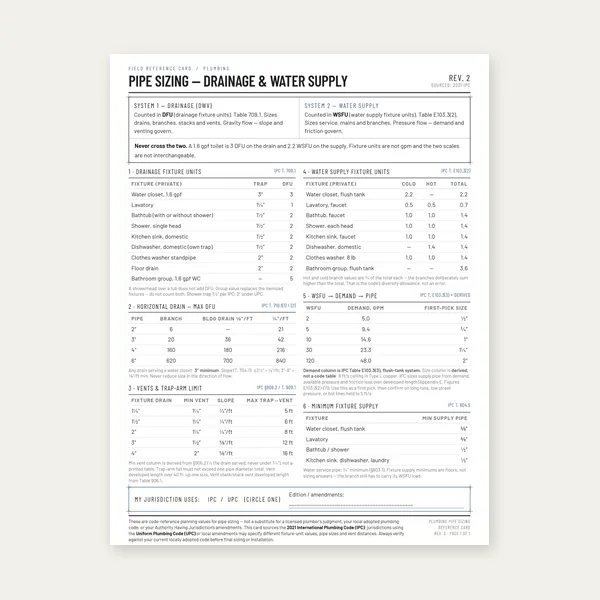
Plumbing Pipe Sizing Card
One page. DFU, drain and vent sizing, WSFU and supply, 2021 IPC.
$3.99
BuyHow basin diameter, inflow rate, and total head become GPM and horsepower — and how to measure inflow in the pit instead of guessing from the carton
People buy sump pumps by the horsepower stamped on the box: 1/3, 1/2, 3/4. Pumps live on a curve. Gallons per minute at a total discharge head. The sump pump sizing calculator takes basin diameter, a measured inflow in GPM, and head, then reports required GPM, a typical HP class, and estimated cycle time. This page is the why, including the field test for inflow.
Short-cycling, runs constantly, not keeping up in rain: troubleshooting. Submersible vs pedestal: comparison. Plumbing index: plumbing calculators hub.
A potable well pump is a different worksheet from this basement crock: Well Pump Sizing Calculator (TDH, HP class, pressure tank — not a sump pump).
This is groundwater in a basement crock, not house DWV. Gravity drains still use Drain Pipe Slope Calculator (IPC 2021 Table 704.1 / UPC 708.1 — prescriptive starting point, not a substitute for local code). Vents are a different chapter: drain slope vs vent sizing.
Need GPM, HP class, and cycle time?Basin diameter, inflow, total head. Starting point only.
Open Calculator →A sump basin is a cylinder of water the pump is allowed to move between float-on and float-off. Diameter sets how many gallons live in each inch of that travel. Height of the liner sets how deep you can bury it and how much emergency storage you have above the off level. Cycle time cares about the inches the float actually uses, not the sticker height of the crock.
231 cubic inches is one U.S. gallon. An 18 in pit is about 1.10 gallons per inch. A 24 in pit is about 1.96 gallons per inch. Same 8 in float travel: 8.8 gallons versus 15.7 gallons. That is why a “correct” 1/3 HP pump short-cycles in a 15 in laundry-tub crock and looks civilized in a 24 in liner. The motor did not change. The volume per cycle did.
Square or oval pits still use the water-surface area at the float. Measure the diameter (or length × width) at the waterline, not the flare at the lid. A corrugated liner that necks in will lie to a tape at the rim.
The calculator uses that cylinder math and a selectable drawdown (default 8 in, typical tethered-float residential). It does not invent a basin for you.
The number on the failed pump is what that pump could move at some catalog head, on a good day, with a clean impeller. It is not how much water is entering the pit. Size to inflow. Confirm with a watch.
Unplug the pump. Mark the waterline. Let the pit rise a known number of inches — 2 in is enough if you can see it; 4 in is better. Time it. Gallons in = gallons per inch × inches risen. GPM = gallons in ÷ minutes. Do this during the weather you actually care about: a soaking rain, not a sunny Tuesday, unless sunny Tuesday is when the pit still weeps.
If you can temporarily route the discharge into a 5-gallon bucket while the pump is running, you can time how long the pump takes to move 5 gallons, convert that to pump GPM at today’s head, then unplug and time the rise for inflow. Do not run a pump dead-headed against a closed valve to “see what it does.”
Foundation drains see storms. A 3 GPM weep in July can be 20 GPM when the downspouts dump next to the footing and the clay is saturated. The calculator multiplies measured inflow by 1.5 as a transparent storm margin. If you already timed a peak rain, you can treat that measurement as the inflow and still have the 1.5 factor as extra conservatism — or you can mentally back it out. The results page states the factor so you can disagree with it.
Total dynamic head (TDH) is the pressure the pump works against, expressed as feet of water. Two pieces: static lift, and equivalent friction from pipe, fittings, the check valve, and the outlet.
Static lift is vertical distance from the water surface in the pit (not the basement floor, not the lid) to the highest point in the discharge. If the pipe goes up 7 ft to a joist, across, then down 3 ft to a daylight window well, the lift is 7 ft, not 4. The downhill after the high point does not give the pump a refund on the way up.
Friction is the rest. A 1-1/2 in PVC run that is short and straight barely moves the number. A 1-1/4 in line with four elbows, a swing check, and 40 ft of pipe to the property line does. Order-of-magnitude adders plumbers actually use on residential sump discharge:
The calculator wants one head number. Add lift and those equivalents yourself. If you only enter the 8 ft from pit to rim, and the real discharge is 8 ft up plus 40 ft out, you will pick a pump that looks fine on paper and dies on the curve.
Interior sanitary drains are not this pipe. Slope on gravity DWV is IPC Table 704.1. A sump discharge is a force main to a legal outlet, not a 1/4 in/ft house drain.
Residential sump cartons cluster on 1/3, 1/2, and 3/4 HP. Catalog curves for common thermoplastic and cast-iron pumps in those classes, in round numbers, look like this (not a named model):
| HP class | ~5 ft | ~10 ft | ~15 ft | ~20 ft |
|---|---|---|---|---|
| 1/3 HP | 50 GPM | 40 GPM | 26 GPM | 10 GPM |
| 1/2 HP | 70 GPM | 58 GPM | 46 GPM | 30 GPM |
| 3/4 HP | 92 GPM | 78 GPM | 64 GPM | 50 GPM |
Those are the bands the calculator interpolates. A 1/3 HP that still makes 26 GPM at 15 ft covers an 18 GPM requirement. The same 1/3 HP at 22 ft is essentially done. That job is 1/2 or 3/4 HP, or less head (shorter run, fewer fittings, larger pipe), not a pep talk to the 1/3 HP you already own.
Cycle time is the check on whether the basin and the float match the pump. Manufacturers want the motor to run long enough to dissipate heat and to avoid a check valve that slams 40 times an hour. If pump-on is under ~45 seconds, lengthen the tether, switch to a vertical float, or install a larger liner. More horsepower in a 15 in pit makes short-cycling worse: the net rate goes up, the on-time goes down.
Submersible vs pedestal does not change these numbers. It changes where the motor lives, noise, and how you service it. That choice: submersible vs pedestal.
No. 1/3 HP is enough when inflow × 1.5 still sits on the 1/3 curve at your real head, and the basin can hold a decent cycle. High head, long discharge, or a 20 GPM storm weep needs 1/2 or 3/4. Run the calculator instead of a hallway rule of thumb.
Usually no, and often illegal. Groundwater and silt do not belong in a septic tank or a municipal sewer. Discharge to a legal storm / daylight / dry well per local rules. House waste is septic vs municipal sewer, not this pit.
A bigger basin does not reduce required GPM. Inflow still has to be beaten. It does lengthen each cycle so the motor and check valve survive. Undersize the pump and a huge pit just delays the flood.
One page. DFU, drain and vent sizing, WSFU and supply, 2021 IPC.
$3.99
Buy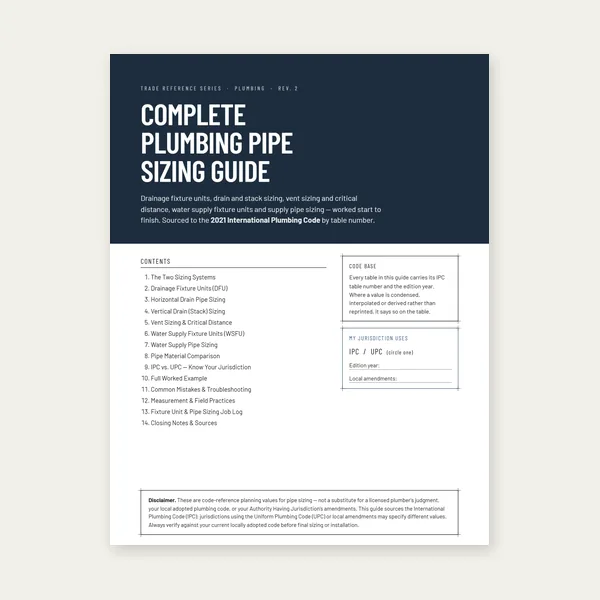
18 pages. DWV and supply sizing, plus one job worked end to end.
$12.99
Buy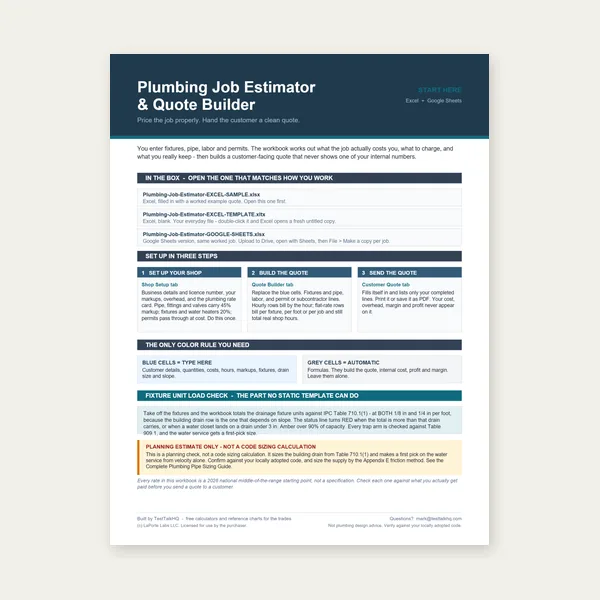
Quote plumbing work and total fixture units against the drain size.
Excel or Google Sheets. Best on a computer.
$29.00
Buy
Card, 18-page guide and the estimator workbook. All six files.
Excel or Google Sheets. Best on a computer.
$34.99
$45.98 if bought separately — save $10.99
BuyCheckout opens in a new tab.
Horsepower gets you a pump. Discharge pipe, a check valve, and a basin that actually holds a cycle are why a “right-size” pump still short-cycles or floods.

Discharge is usually 1-1/4 or 1-1/2 in PVC. Leaky joints at the check valve are how a pump short-cycles after you “fixed” it.
View on Amazon →
Check valves, unions, and the discharge adapter still come apart with a wrench. Sizing math does not replace a seized swing check.
View on Amazon →
A cocked basin liner and a discharge that sags back toward the pit both fake an undersized pump. Level the pit before you blame GPM.
View on Amazon →
Unsupported discharge adds equivalent feet of head and lets the check valve slam. Strap the riser; do not let it cantilever off the pump.
View on Amazon →
A pump that “cannot keep up” is often a discharge full of silt, a crushed corrugated line, or an iced outlet. Clear the pipe before you upsize HP.
View on Amazon →
Diameter, inflow GPM, and total head. Required GPM, HP class, and estimated cycle time.
Open Sump Pump Sizing Calculator →As an Amazon Associate, TestTalkHQ earns from qualifying purchases.