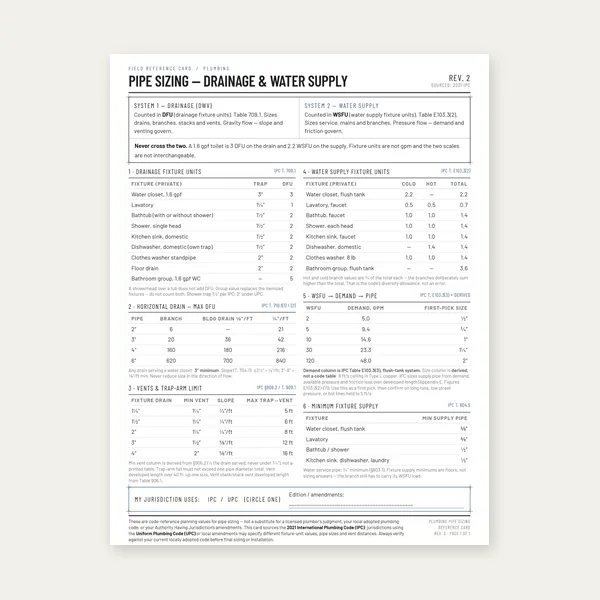
Plumbing Pipe Sizing Card
$3.99
BuySizing is not the same job. Storage is first-hour rating. Tankless is gallons per minute at a temperature rise. Pick the machine that matches how the house actually draws water.
A storage tank wins or loses on the busiest hour. A tankless unit wins or loses on the busiest moment. Those are different questions, which is why “just get tankless, it’s unlimited hot water” creates the most expensive lukewarm-shower stories in residential plumbing. The sizing calculator reports both: a storage tank size plus the FHR / peak-hour demand a tankless install still has to cover, and a simultaneous GPM starting point.
How FHR works: sizing guide. Existing heater acting undersized: troubleshooting.
Basement groundwater is a different worksheet: Sump Pump Sizing Calculator (basin, inflow GPM, total head — starting point, not a named-model pump curve).
See the FHR and the GPM side by side.Same household, two different sizing answers.
Open Calculator →DOE sizes storage water heaters with the peak-hour worksheet and first-hour rating. You add gallons used in the busiest hour. You buy a tank whose EnergyGuide FHR meets that total. Sequential showers in the same hour all count. They do not have to overlap.
Tankless (demand) water heaters are sized in gallons per minute at a stated temperature rise. You add the fixtures that will run at the same time, using their actual GPM. A 2.0 GPM shower plus a 1.3 GPM dishwasher is 3.3 GPM. The unit must hold outlet temperature at that flow when groundwater is whatever it is in January. Manufacturer charts are temperature-rise curves, not first-hour ratings. There is no honest way to say “this tankless is a 50-gallon heater.”
| Storage tank | Tankless | |
|---|---|---|
| What you size | First-hour rating (gallons in 60 minutes) | GPM at a temperature rise |
| What sequential showers do | Add volume to the peak hour | Mostly irrelevant if they do not overlap |
| What overlapping showers do | Add volume and can empty the tank faster | Add GPM; this is the whole game |
| Fuel effect | Recovery changes tank size for the same FHR | Gas tankless usually makes residential GPM; electric tankless often needs a huge electrical service |
| DOE public method | Energy Saver peak-hour worksheet | Fixture GPM + inlet/outlet temperature (not an FHR) |
The calculator still prints an FHR next to the tankless discussion because that is the first-hour equivalent you are giving up when you abandon storage. If your DOE peak hour is 66 gallons, a tankless system has to be able to produce that much hot water across the hour and survive the peak simultaneous GPM. Those can both be true, or only one of them. Two bathrooms overlapping at 2.0 GPM each is 4.0 GPM. Plenty of “whole-house” tankless units miss 4.0 GPM at a 70°F rise. They will feel like unlimited hot water for one shower and like a 0.9 GPM dribble when the second shower opens.
Tanks are boring in the best way. They forgive sequential use. They do not care that three people showered between 6:30 and 7:20 as long as the FHR held. They work on a standard 240-volt / 30-amp circuit (electric) or a standard flue (atmospheric gas). They cost less to hang. They are serviceable by every plumber in town.
Choose a tank when:
Tanks lose on standby heat, floor space, and the hard stop when the first hour is gone. If the honest peak hour is already past an 80-gallon electric FHR, you are looking at two tanks, a commercial-ish gas tank, or tankless anyway. The calculator will flag that instead of inventing a 120-gallon residential carton.
Tankless earns its keep when the constraint is duration, not overlap. One person who takes long showers, a household that rarely runs two baths at once, a small mechanical room, or a desire to stop paying to keep 50 gallons hot all afternoon. Gas tankless, correctly sized on the winter temperature-rise curve, can run a shower indefinitely. That is the feature. It is not the same as running two showers and a washing machine on a unit that was specced from a summer GPM number on a hang-tag.
Choose tankless when:
Gas tankless needs more than a flue. It wants a large gas line, combustion air, and usually a condensate drain on condensing units. Swapping a 40,000 Btu/h atmospheric tank for a 160,000–199,000 Btu/h tankless on a 1/2-inch gas pipe is how you get error codes instead of hot water. Electric tankless needs copper and breakers the existing water-heater circuit does not have. Heat-pump tanks need a space that can donate heat and a place for condensate; they also publish an FHR like any other tank — size them with the DOE worksheet, not with a tankless GPM chart.
Recirculation is the other silent decider. A tank with a recirc loop needs extra recovery or a timer. A tankless with recirc needs a model that supports it, or a small buffer tank, or you will get cold-water sandwiches and a unit that never sleeps. None of that shows up in the carton gallon number or the GPM hang-tag.
Start with how the house draws: sequential volume vs simultaneous flow. Run the calculator so those two numbers are on the same page. Then let fuel, venting, and the panel break the tie. That is a real decision. It is not a brand preference.
There is no 50-gallon-equivalent. Ask for GPM at your winter temperature rise, and make sure that GPM covers overlapping fixtures. The FHR you would have bought on a tank is useful only as the hourly volume the tankless must also be able to produce.
It can, because you are not storing 50 gallons all day. Recirc loops, poor sizing that forces a second unit, and hard-water scaling can eat the savings. Compare UEF on the actual models in the same usage bin, not a brochure percentage.
It is the DOE peak-hour demand — gallons in the busiest hour. A tankless system still has to deliver that much hot water across the hour. The number that will make or break the install is the simultaneous GPM line next to it. Read both. Then read a manufacturer curve at your inlet temperature, not at 70°F rise in a warehouse.
$3.99
Buy
$12.99
Buy
$29.00
Buy
$39.00
BuyCheckout opens here — you stay on this page.
Sizing gets you a tank or a tankless spec. Sediment, anodes, mixing valves, and T&P valves are why a “big enough” heater still runs out of hot water.
A spent anode does not shrink the tank, but it lets the steel rust from the inside. Check it before you assume you need more gallons.
View on Amazon →
Store hotter, deliver 120°F at the tap. A mixing valve changes how much usable hot water you actually get from the same tank.
View on Amazon →
Anode, drain valve, and dielectric unions still come apart with a wrench. Sizing math does not replace a drain-and-flush.
View on Amazon →
Safety first. A weeping T&P is not a sizing problem. Replace the valve; do not cap it.
View on Amazon →
Closed municipal systems need somewhere for heated water to go. Expansion tanks are not first-hour rating, but they save the T&P from dripping all winter.
View on Amazon →
Household size, bathrooms, peak scenario, gas or electric. Tank gallons and FHR starting point.
Open Water Heater Sizing Calculator →As an Amazon Associate, TestTalkHQ earns from qualifying purchases.