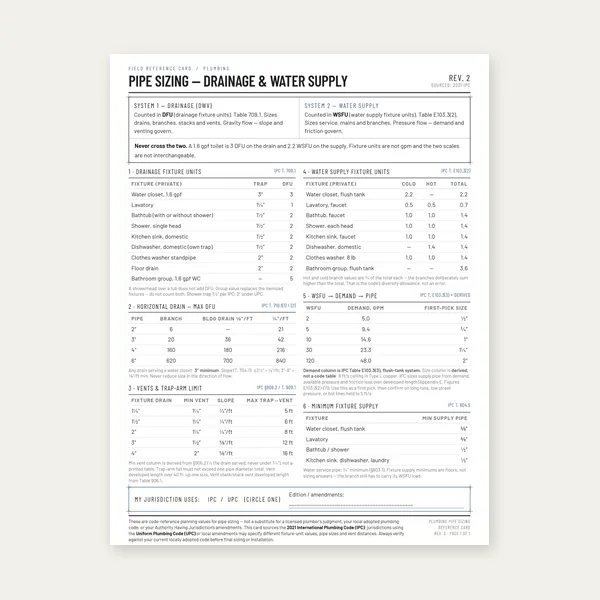
Plumbing Pipe Sizing Card
One page. DFU, drain and vent sizing, WSFU and supply, 2021 IPC.
$3.99
BuyT&P dripping, pressure-gauge spikes, banging pipes, and how to tell a waterlogged tank from one that is simply too small
The usual complaint is a T&P that drips into the pan every time the heater recovers, or a house pressure gauge that climbs toward 100+ psi while nobody is running water. Both are expansion with nowhere to go — missing tank, undersized tank, dead precharge, or a bladder that has filled with water. Size the tank with the expansion tank sizing calculator. This page is what to check before you buy a bigger one, and how to read a tire gauge on the Schrader.
How the Boyle’s-law math works: sizing guide. Whether cranking the PRV down is a legal substitute: comparison. Plumbing index: plumbing calculators hub.
Running out of hot water is a different failure: water heater troubleshooting. A weeping T&P is not first-hour rating.
Need a size, not a diagnosis?Heater gallons, incoming, PRV, temperature rise.
Open Calculator →On a closed system the heater is a sealed bottle. Heat it and pressure climbs. A working expansion tank takes that climb and parks it in compressed air. When the tank cannot, three things show up in the house.
Not a random drip at 2 a.m. A dribble that starts when the burner or element kicks in, fills a cup in the pan, and stops when the heater is satisfied. That is expansion finding the 150 psi relief because the tank is missing, waterlogged, or too small. A T&P that weeps continuously, even with a cold heater, is more often a tired valve or a thermostat that is overshooting. Replace the valve if it weeps at rest; do not stop there if it only weeps on heat-up. Heater-side diagnosis that is not expansion: water heater troubleshooting.
A house gauge that sits at the PRV setpoint (say 55 psi) with nothing running, then climbs through 80, 100, 120 while the heater recovers, then slowly bleeds back when someone opens a faucet, is the textbook closed-system plot. If the gauge never leaves 55 even during a long recovery, either the system is still open to the main or the tank is doing its job. If it slams into the T&P every cycle, the tank is not.
Expansion pressure can slam checks and make copper tick. So can water hammer from a fast-closing washer valve. Hammer is a millisecond spike when a fixture slams shut. Expansion banging is slower, tied to the heater cycle, and often paired with the T&P drip. Arresters at washing machines do not fix a missing expansion tank. An expansion tank does not fix a solenoid that hammers 3/4 in copper.
The air side of a potable expansion tank is a Schrader valve, same family as a car tire. The number on that gauge, with the tank isolated and empty of water, should match house static fill — the same fill the calculator used (min of incoming and PRV).
Check precharge once a year, or any time the T&P starts a new drip. Tanks in a hot closet die faster. A tank you cannot reach with a gauge is a tank you will replace by symptom, which is how people cap T&P valves.
Those are different repairs. Mixing them is how you hang a second 2.0 gal tank on a system that needed 4.4 gal, or replace a good tank because the PRV is set to 80.
Failed / waterlogged. Precharge is 0, or water exits the Schrader. The tank feels heavy (full of water) when you lift it. House pressure still climbs on recovery after you “added air” because there is no air chamber left. Replace. Do not keep pumping air into a wet Schrader.
Wrong precharge, bladder still good. Gauge reads 20 on a 55 psi house, no water from the valve, tank is light. Add air to 55 with the tank drained. One recovery later the T&P should stop if size was adequate.
Sized wrong, tank healthy. Precharge matches fill, Schrader is dry, tank is light, and the house gauge still walks into the T&P on a long recovery. The air cushion is too small for this heater, this rise, and this fill. Run the calculator. An 80 gal at 80 psig fill is not an ST-5 job. Buy the next class; do not add a second undersized tank in parallel unless the manufacturer says that configuration is listed.
A T&P that weeps because the thermostat is running 180°F is not a tank problem. Turn the setpoint down, confirm a mixing valve if you store hot, and stop blaming expansion for a scald setting.
Heater recoveries that make the cold line tick in time with the burner are often the tank bladder moving, or copper growing. That can be normal at a low volume. Bangs that throw the T&P are not.
Washer and dishwasher solenoids cause classic water hammer: one slam at shutoff, arresters at the valve, not at the heater. If the only bang in the house is during heater recovery and the gauge is climbing, size and service the expansion tank before you nail arresters to every tee.
A loose dielectric or a tank that is hung by the tee with no support will bang when the bladder moves. Strap the tank. The calculator does not hang it for you.
A new T&P that is not dripping at rest is good maintenance. It will drip again on the next recovery if the system is still closed and the tank is still dead. Fix expansion. Never cap the old valve.
Age is not a diagnosis. Check precharge. Many last longer; some bladders die in two years in a hot closet. Symptom plus a wet Schrader is failed. A dry Schrader at the right psi is not.
Lower fill increases acceptance, so a borderline tank might stop dripping. It does not make the tank optional on a closed system, and it can ruin shower pressure. That trade: expansion tank vs PRV adjustment.
One page. DFU, drain and vent sizing, WSFU and supply, 2021 IPC.
$3.99
Buy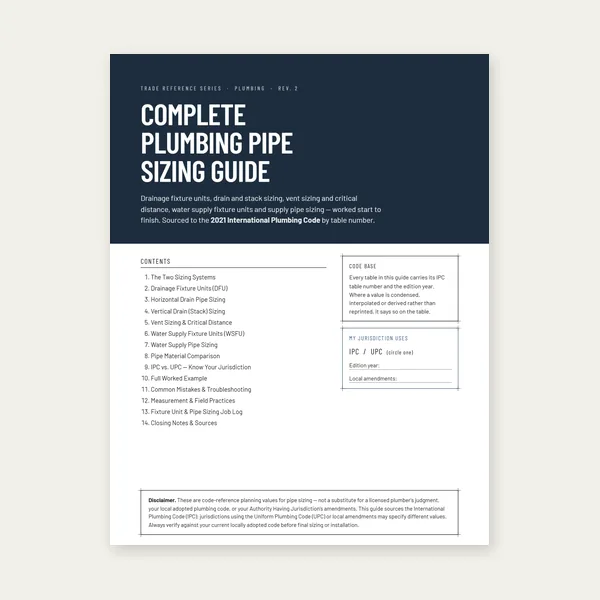
18 pages. DWV and supply sizing, plus one job worked end to end.
$12.99
Buy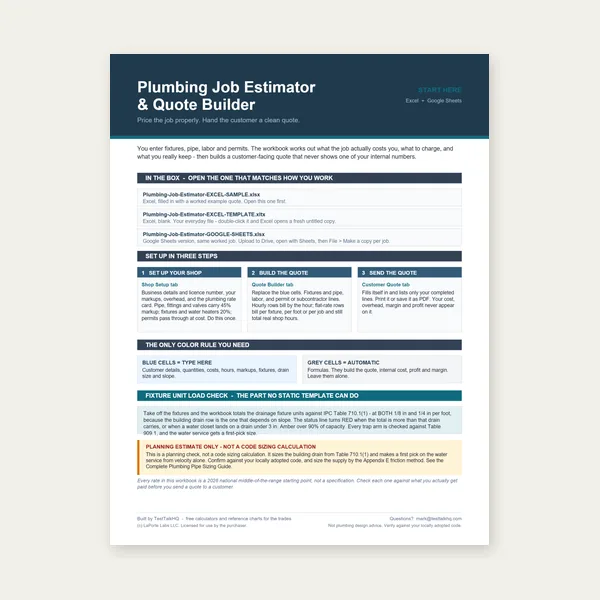
Quote plumbing work and total fixture units against the drain size.
Excel or Google Sheets. Best on a computer.
$29.00
Buy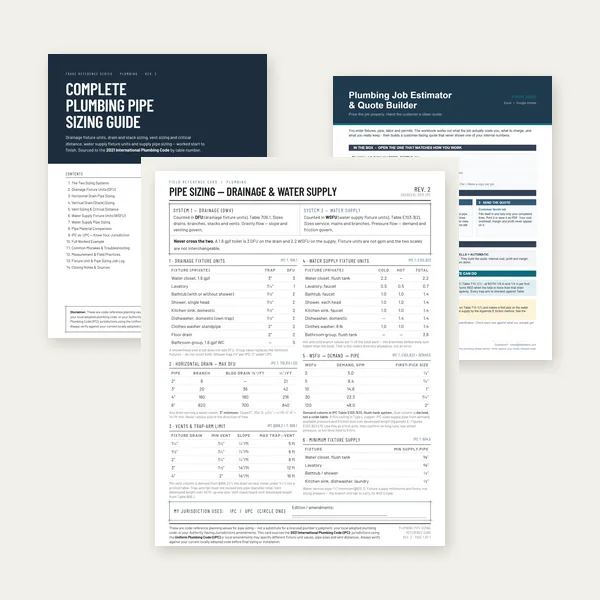
Card, 18-page guide and the estimator workbook. All six files.
Excel or Google Sheets. Best on a computer.
$34.99
$45.98 if bought separately — save $10.99
BuyCheckout opens in a new tab.
Diagnosis is a gauge on the Schrader and a gauge on the house. Replacement is a tank whose acceptance covers the calculated gallons.
Replace a waterlogged tank. Precharge the new one to house static before you open the cold inlet.
View on Amazon →
Replace a valve that weeps at rest. Do not cap it. A valve that only weeps on recovery is usually expansion.
View on Amazon →
The tank tee and a painted nipple still come apart with a wrench. Have a bucket under the drain.
View on Amazon →
If the heater is stored at 140°F, the mixer is scald control. It is not a substitute for expansion volume.
View on Amazon →
Hang it where the Schrader can take a tire gauge. A tank you cannot reach is a tank you will replace late.
View on Amazon →
If the bladder is good and the T&P still drips, the tank is too small. Calculate before you buy another ST-5.
Open Expansion Tank Sizing Calculator →As an Amazon Associate, TestTalkHQ earns from qualifying purchases.