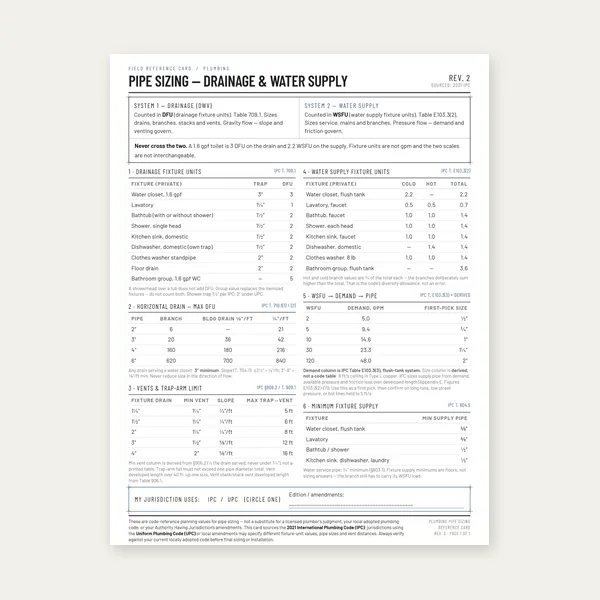
Plumbing Pipe Sizing Card
One page. DFU, drain and vent sizing, WSFU and supply, 2021 IPC.
$3.99
BuyWhen lowering the pressure-reducing valve shrinks the required tank — and when a tank is still code-required no matter where you set the PRV
Two knobs look like they fix the same T&P drip: hang a bigger expansion tank, or crank the PRV down so house pressure starts lower. They are not interchangeable. Lower fill pressure really does increase acceptance and can drop you from an ST-12 class tank to an ST-5. A closed system still needs a tank. IPC 607.3 does not care that your showers would still work at 45 psi. Size the tank with the expansion tank sizing calculator. This page is the decision.
How incoming and PRV enter the Boyle’s-law step: sizing guide. T&P dripping and a waterlogged bladder: troubleshooting. Plumbing index: plumbing calculators hub.
Fixture pressure that is already too low is the opposite problem: water supply pipe troubleshooting.
See how PRV setting changes tank gallonsSame heater, same rise, two fill pressures. Starting point only.
Open Calculator →Acceptance factor is 1 minus fill-absolute over T&P-absolute. Drop fill and the air cushion has more room to compress before 150 psig. Required tank volume falls. That is not folklore; it is the same Boyle’s-law step the calculator uses.
That is why the calculator asks for incoming and PRV as two numbers. If incoming is 85 and the PRV is 50, fill is 50. If you raise the PRV to 70 to “get better showers,” fill becomes 70 and the tank you already hung may start dripping. If you lower the PRV from 70 to 50, a borderline tank may stop dripping and showers may feel worse. Both outcomes are the same formula.
There is a floor. Residential fixtures and some tankless heaters want a minimum flowing pressure. A PRV at 35 psig can make a 2.0 gal tank look brilliant on paper and make the upstairs shower die when the washer fills. Do not size expansion by ruining the house. Size the tank at a PRV you can live with. Upstream low pressure is supply pipe sizing, not this page.
The PRV (or the backflow preventer) is usually why the tank is required. It is the check. Expanded water cannot leave. IPC 607.3 wants thermal expansion control on a closed water-heating system. UPC 608 is the same idea in different clothes. Neither section says “unless you set the reducer to 45 psi.”
You can lower the PRV until the required Vt is 1.1 gal. You still hang a listed potable tank, precharged to that new fill, because the system is still closed. The T&P is still the emergency, not the daily expansion device.
ASSE 1017 mixing valves are not a substitute either. They change outlet temperature. They do not give the heater a path back to the main. The devices that close the system are typically ASSE 1003 PRVs and ASSE 1013 / 1015 backflow preventers. The tank is the expansion control. Keep the jobs straight. Walkthrough of the formula: sizing guide.
Valid: you already have a tank, fill is high, showers can spare a few psi. House static is 75 because someone opened the PRV years ago. The 2.0 gal tank weeps on recovery. Precharge and bladder check out. Dropping the PRV to 55 (and recharging the tank to 55) can put Vt back inside that 2.0 gal cushion. Confirm upstairs flow after. Then stop. You did not delete the tank; you resized fill.
Valid: you are choosing fill before you buy the tank. Street is 90. You are installing a PRV anyway. Setting it at 50 instead of 70 is how you buy ST-5 class instead of ST-8, and how fixtures still see a number the WSFU tables understand. That is design, not a workaround.
Not valid: skipping the tank because “I turned the PRV down.” Closed is closed. The inspector is not signing off on a dripping T&P and a story about 48 psi.
Not valid: dropping the PRV to hide a waterlogged tank. If the Schrader spits water, replace the tank. A lower PRV will not reinflate a torn bladder. Diagnosis: troubleshooting.
Not valid: raising the PRV to fix weak showers when the branch is 1/2 in. That is pipe. The expansion tank will then need to be larger, and the T&P may start dripping. Measure, then size the supply: supply troubleshooting.
No PRV, no check, no RPZ, meter that will let water reverse: expanded volume can leave the house. Many jurisdictions still like a tank. Some do not require one until the system is closed. Confirm the adopted code. Do not assume a 1970s open main stays open after a meter swap.
The day the utility installs a dual-check or you add a PRV for 90 psi street pressure is the day this worksheet becomes mandatory, even if the heater is the same 40 gal that never dripped. That is the replacement-day trap in the guide.
Well systems with a pressure tank already have a large air cushion on the well side. Domestic expansion on the house side of a check is still a closed bottle. Do not point at the well tank and skip the potable expansion tank on the heater if a check separates them.
No. You may skip a larger tank. You do not skip the tank on a closed system. 40 psi may also make fixtures unhappy. Run the calculator at a PRV you can live with, then hang that size.
The backflow preventer closed the system. The drip is expansion. Add a correctly sized, correctly precharged tank. Do not open the PRV hoping the street will take the extra gallons — the check will not let them out.
No. The T&P is listed at 150 psi / 210°F for a reason. Swapping it for a higher-pressure valve to “make room” is not expansion control and is not how you treat a closed heater.
One page. DFU, drain and vent sizing, WSFU and supply, 2021 IPC.
$3.99
Buy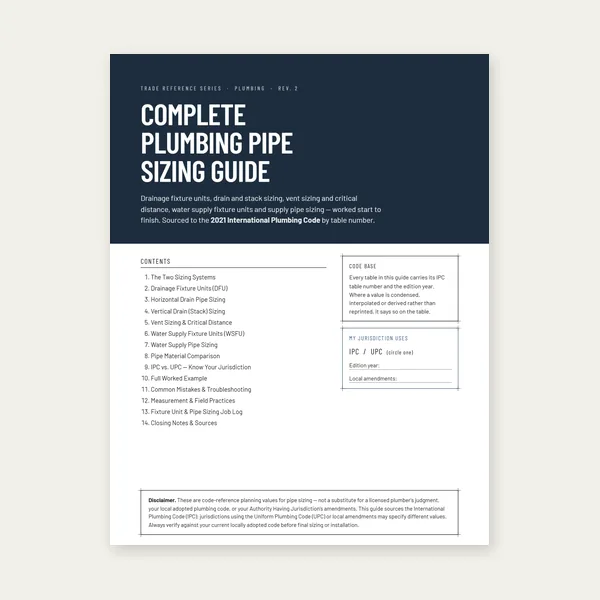
18 pages. DWV and supply sizing, plus one job worked end to end.
$12.99
Buy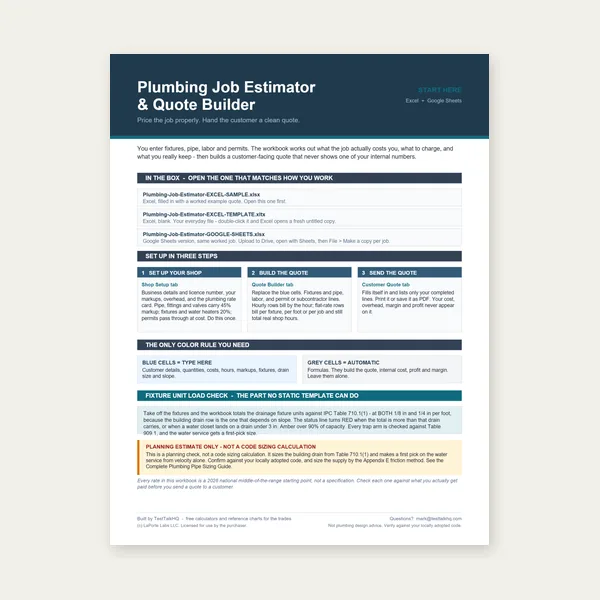
Quote plumbing work and total fixture units against the drain size.
Excel or Google Sheets. Best on a computer.
$29.00
Buy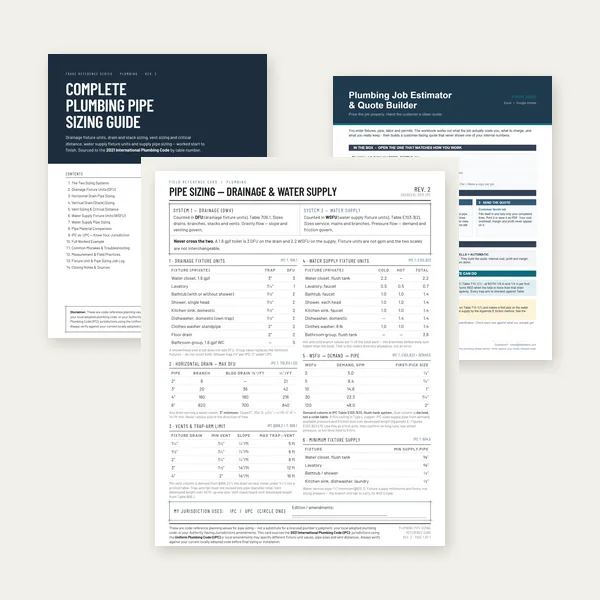
Card, 18-page guide and the estimator workbook. All six files.
Excel or Google Sheets. Best on a computer.
$34.99
$45.98 if bought separately — save $10.99
BuyCheckout opens in a new tab.
A PRV sets fill. An expansion tank swallows the heat-up. A T&P is the emergency, not the daily drain.

Required on the closed house. Size it at the PRV you actually run, then precharge to that fill.
View on Amazon →
Leave it at the listed 150 psi. A drip on recovery means expansion, not a request for a hotter relief.
View on Amazon →
PRV bells and tank tees still come apart with a wrench. Have two gauges: street side and house side.
View on Amazon →
ASSE 1017 mixer. Delivery temperature, not expansion control, not a PRV substitute.
View on Amazon →
Hang it on the house side of the PRV / backflow, Schrader accessible, precharged to the setting you chose.
View on Amazon →
Leave heater gallons and rise alone. Change only the PRV. Watch Vt move. Then hang the tank anyway.
Open Expansion Tank Sizing Calculator →As an Amazon Associate, TestTalkHQ earns from qualifying purchases.