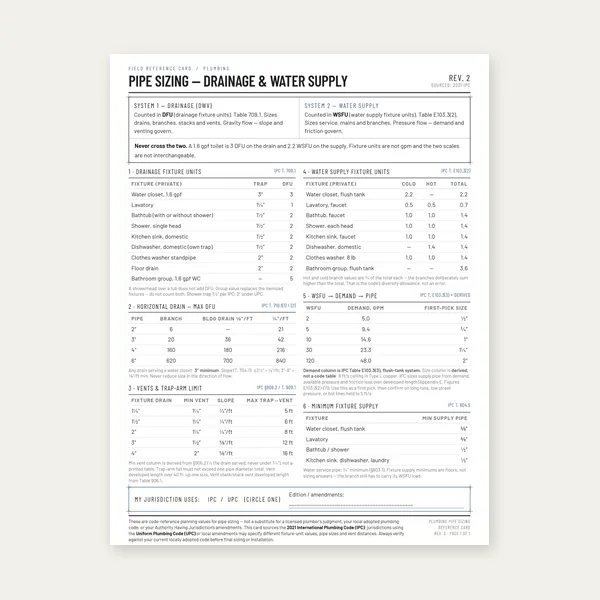
Plumbing Pipe Sizing Card
$3.99
BuyLow pressure at fixtures, pressure drop when two things run, and how to tell undersized pipe from a tired PRV or a weak street main
The supply sizing calculator tells you what diameter Table E104.1 wanted. This page is how to decide whether the pipe you have is why the shower dies, or whether the regulator, the meter, or the street is lying to you.
How WSFU is counted: supply guide. WSFU is not DFU: WSFU vs DFU. Gurgling on the waste side is a different chapter: vent troubleshooting. Plumbing index: plumbing calculators hub.
Size the segment first.If the table already wanted 1 in and you have 1/2 in home-runs teed into a 1/2 in trunk, stop blaming the city.
Open Calculator →Classic pattern: one fixture is fine. Two fixtures and the shower goes skinny, the washer fills slow, the upstairs lav turns into a trickle. Static pressure at the hose bibb still reads 55 psi. That combination — decent static, collapsed flow — is friction. Friction is diameter, length, fittings, and ID. A 1/2 in PEX trunk asked to carry 16 WSFU for 80 feet will do this all day while the gauge on a dead-head hose bibb still looks legal.
Other tells: the problem showed up after a bathroom add-on, after PEX was teed into an old 1/2 in copper branch, after a tankless that wants 5 gpm was hung on a 1/2 in hot. A tankless does not care that Table E104.1 would have given the house a 1 in cold. The water heater sizing calculator sizes storage and first-hour rating. It does not size the pipe that feeds the heater. Those are two failures that feel like one.
Noise, singing stops, and pinholes on copper are velocity and chemistry, not just WSFU. UPC 610.12 wants 8 ft/s cold and 5 ft/s hot on copper. If the pipe is legal on the WSFU table and screaming, the table was the wrong worksheet and you needed the hydraulic charts.
Undersized pipe: static pressure at the meter or the first hose bibb is fine. Flow pressure (gauge teed in while two fixtures run) collapses at the remote fixture and stays healthier near the meter. Upstairs is worse than downstairs by more than elevation (0.43 psi per foot). Adding a third fixture makes it worse in a straight line. The table in the calculator already wanted a larger diameter than what is in the wall.
Pressure-reducing valve: static at the house is a flat 50, 55, 60 — whatever the PRV is set to — even at 2 a.m. when the street is at 90. Flow pressure falls at every fixture together, including the hose bibb on the same side of the PRV as the house. The valve is undersized, clogged with scale, or set for a quiet house that now has a tankless and a soaking tub. A PRV with a 3/4 in body on a 1 in service is a bottleneck the WSFU table never saw. Replace or resize the valve before you open walls.
Street main / meter: static is low even with nothing running — 30 psi at 6 a.m., worse at dinner. Neighbors mention it. The 5/8 in meter that was fine for a 1960 bungalow is now a 1 in house on a 3/4 in tap. Table E104.1 prints a meter size on the same row as the pipe. If the row wanted a 1 in meter and you have 5/8 in, the pipe in the house can be perfect and still starve. That is a utility call, not a PEX coil.
Hunter’s curve — the idea behind WSFU — already assumes you do not open every fixture at once. Table E104.1 is that diversity, boiled into a cell. If the house fails only when three teenagers shower and the washer hits spin, you may be past what a 3/4 in trunk was ever going to do, even if the original permit was legal. Recalculate WSFU for what is actually in the house now, not what was on the 1988 plan.
If the house fails when one shower and one lav run, that is not diversity. That is a 1/2 in bottleneck, a clogged aerator farm, a failing cartridge, or a PRV. Clean the screens before you upsize. Then size the segment that actually feeds those two fixtures, not the whole building supply.
Waste-side symptoms (gurgle, trap seal loss, slow drain with legal slope) are air or fall, not supply. Do not chase a 1/2 in cold because the lav gurgles. That is the vent troubleshooting page and the slope calculator.
Static at the meter (utility side if you can), static house-side of the PRV, static at the remote hose bibb or laundry. Then flow pressure at those same three points with the remote shower wide open. Elevation difference in feet × 0.43 psi. Developed length along the pipe, not the tape across the bay. WSFU of the fixtures on that segment from Table E103.3(2). Put length, pressure band, and WSFU into the calculator. If the table wanted 1 in and you have 1/2 in, you have the answer. If the table wanted 3/4 in and you have 3/4 in and flow still collapses at the PRV, stop blaming the branch.
Yes, at one fixture. Not at every fixture on a trunk. Pattern matters.
Often yes, because it wants simultaneous gpm, not Hunter diversity. Size that branch for the heater’s listed flow, then still check the house WSFU on the cold main. The heater calculator does not replace this one.
Singing copper is velocity and water chemistry. Upsizing helps velocity. It does not fix aggressive water. UPC 610.12 is the velocity cap.
$3.99
Buy
$12.99
Buy
$29.00
Buy
$39.00
BuyCheckout opens here — you stay on this page.
A WSFU diameter is a number until you cut the pipe, crimp or sweat it, hang it, and keep the thermal expansion from lifting a T&P. These are the pieces that actually leave the truck.
1/2 in and 3/4 in copper-ring crimps (ASTM F1807), go/no-go gauge, cutter, and ring puller. The iCrimp IWS-1807CN is how a PEX branch actually becomes the diameter Table E104.1 just printed.
View on Amazon →
Copper Type L still shows up on water heaters and meter tails. A RIDGID 57008 C-style cutter is the tool that squares a 3/4 in stub in a joist bay the wheel cutter will not fit.
View on Amazon →
A closed supply (PRV or check at the meter) needs somewhere for the heater to expand. Undersized pipe plus a dead-headed heater is how you get relief-valve drips that look like a pressure problem.
View on Amazon →
Meter couplings, galvanized nipples, and the last iron fitting on a remodel still need a wrench that bites. Same 14 in RIDGID that turns DWV no-hubs turns supply thread too.
View on Amazon →
PEX sags. Copper rings. Hang the run so the developed length you typed is the developed length that exists after the drywall goes up.
View on Amazon →
WSFU, developed length, pressure band, and copper / PEX / CPVC. IPC Table E104.1 plus UPC Table 610.4.
Open Water Supply Pipe Sizing Calculator →As an Amazon Associate, TestTalkHQ earns from qualifying purchases.