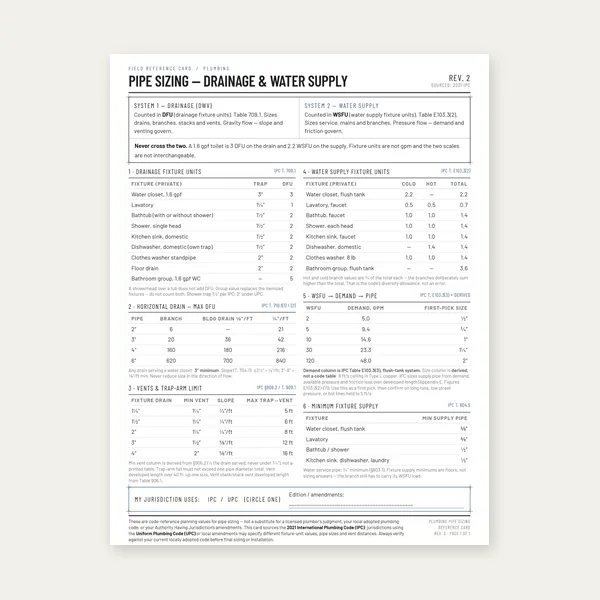
Plumbing Pipe Sizing Card
$3.99
BuyGurgling drains, slow fixtures that already have legal slope, trap-seal loss and sewer smell — how to tell a vent problem from a belly or a blockage
A missing vent, a flattened drain, and a wad of wipes can look identical from the sink. The vent sizing calculator tells you what diameter Chapter 9 wanted. This page is how to decide whether air is the reason the fixture is not behaving.
What the vent is for: vent guide. Individual vs wet vs common: configuration comparison. Slope vs vents: drain slope vs vent sizing. Measure the drop: drain pipe slope calculator. Plumbing index: plumbing calculators hub.
Confirm the diameter first.DFU and developed length. Then decide whether the pipe you have can possibly be the air path.
Open Calculator →Gurgling is air fighting through a trap because the intended air path is too small, too long, blocked at the roof, or missing. It often happens on the fixture next to the one you just used: flush the toilet, the lav pops. That is siphon, not a mystery.
Slow drainage with a camera-clean pipe and legal slope is the tell that fools people into recutting joists. The drain can be at Table 704.1 and still drain like molasses if the trap cannot breathe. Water will not leave a fixture faster than air can enter behind it. The slope troubleshooting page covers bellies and same-spot clogs. If the invert is uniform and the pipe is empty after a dump, look up, not down.
Trap-seal loss and sewer smell is the end state. IPC 901.2’s 1 inch of water column is gone. You will smell it at the lav or tub overflow first. A floor drain that dries out from evaporation is a different problem (prime it or use a trap primer). A floor drain that gurgles empty every time the washing machine dumps is a vent or a wet-vent that was never legal.
Blockage: camera or a snake hits a plug, the fixture above the plug is dead, fixtures below may be fine. Recurring plug at the same fitting is often a belly or a bad wye, which is slope/layout. See drain-slope troubleshooting.
Slope: standing water in a run that should empty, a dip you can measure with a level, slow drain that does not gurgle and does not smell until the standing water finally goes septic. The slope calculator tells you what the drop should have been.
Vent: gurgle, bubbling trap, toilet that “pulls” the lav, smell with an empty trap, symptoms that move from fixture to fixture when one fixture dumps, a clean pipe on camera. Size the air path with the vent calculator, then confirm the configuration is even allowed: individual vs common vs wet vent.
Diagnosis order that saves money: look at the roof terminal, confirm there is a dry vent (or a legal AAV) within trap-arm distance, size that vent against 906.2 / Table 703.2, then measure drain slope. Camera last if you still have a chronic plug. The slope vs vent page is the chapter split; this page is the fixture in front of you.
Measure developed length along the pipe, not the bay. If you are past 40 feet on IPC, the whole vent should already be one size larger than the half-drain minimum. A 50-foot 1-1/4 in individual vent on a 2-inch kitchen waste is the 906.2 miss in the wild.
If a water closet is on the vent, UPC will not accept 1-1/2 in (Table 703.2 note 3). IPC will, as half of 3 in. Know which book is on the permit before you call the pipe “undersized.”
Put a test cap on the stack and run the DWV test (IPC 312 / 901.5). A vent that will not hold is open to a wall cavity, a forgotten future-fixture stub, or a flashing that was never a seal. Fix the leak before you upsize anything.
Still looks like slope?Measure the drop. A belly and a missing vent are both “slow,” and only one of them is Chapter 9.
Slope calculator →Uniform 1/4 in/ft with a belly in the middle is still a slope defect. If a level shows a straight invert and the pipe empties, treat it as air until proven otherwise.
An AAV is a legal termination in some configurations, not a license to ignore diameter and developed length on the dry vent that feeds it. If the AAV chatters on every flush, the piping around it is still the problem.
The toilet dump is the piston. The lav trap is the weak seal. That is classic siphon from a shared, missing, or undersized vent — or a wet vent that was never a legal wet vent.
$3.99
Buy
$12.99
Buy
$29.00
Buy
$39.00
BuyCheckout opens here — you stay on this page.
A vent size is a diameter until you glue it, flash it, hang it, and test it. Primer/cement, a no-caulk flashing, a test cap, hangers, and a pipe wrench are how Chapter 9 leaves the book.

Vent joints are still solvent-weld joints. Purple primer and the matching cement are how a 1-1/2 in dry vent actually stays a dry vent after the stack test.
View on Amazon →
The vent is not finished until it terminates outdoors. A 3 in no-caulk flashing (Oatey 11890) is the common residential stack penetration — collar over the pipe, no roof cement on the rubber.
View on Amazon →
IPC 901.5 / 312: the vent system gets tested with the drain. A reusable 3 in Qwik Cap (Fernco QC-103) is how you cap a stack for a water or air test without solvent-welding a knockout you then have to punch out.
View on Amazon →
IPC 905.2: vents grade back to the drain. Hang the horizontal vent so it drains, the same way you hang the waste. A belly in a dry vent is a wet vent you did not design.
View on Amazon →
Cast-iron stacks, galvanized vents, and no-hub couplings still show up on remodel work. A 14 in RIDGID is the wrench that actually turns those joints when PVC is not the whole story.
View on Amazon →
DFU load and developed length. IPC 906.2 individual/branch minimum, plus UPC Table 703.2 comparison.
Open DWV Vent Sizing Calculator →As an Amazon Associate, TestTalkHQ earns from qualifying purchases.