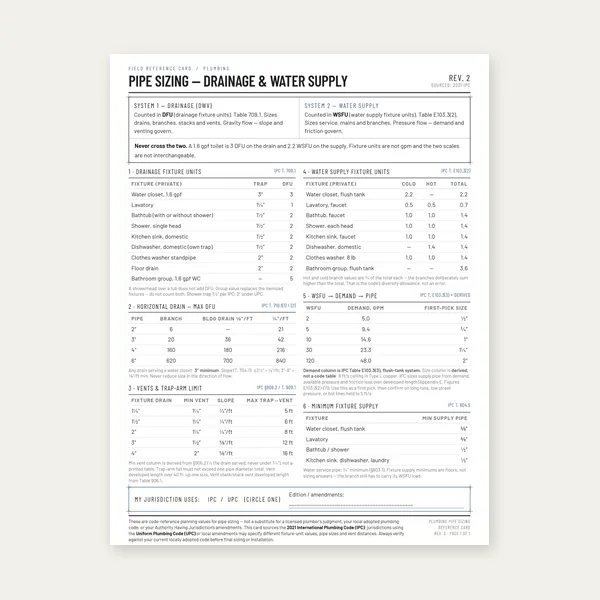
Plumbing Pipe Sizing Card
$3.99
BuySlow drains, gurgling, and the clog that always forms at the same spot — how to tell slope trouble from a vent problem or a blockage
A drain that is “fine until it isn’t” is rarely random. Flat pipe leaves a beach of solids. A belly is a trap you installed by accident. A missing or undersized vent makes the same sink gurgle and the same toilet suck the trap. A wad of wipes is just a wad of wipes. The drain pipe slope calculator tells you what the drop should have been. This page is how to decide whether the pipe you have is the reason it is not working.
How to set slope in the first place: slope guide. Slope vs vents: drain slope vs vent sizing. Plumbing index: plumbing calculators hub.
Basement groundwater is a different worksheet: Sump Pump Sizing Calculator (basin, inflow GPM, total head — starting point, not a named-model pump curve).
Need the code-minimum drop?Diameter and run length. Then measure what you actually built.
Open Calculator →Bad slope has a personality. It is not “sometimes slow when we have guests.” It is the same fixture, the same stretch of pipe, getting worse on a schedule.
These three share symptoms. They do not share fixes. Spend twenty minutes on diagnosis before you open a wall.
Sudden. One fixture or one branch. Often after a known insult (wipes, a toy, a kitchen weekend). Snake or camera finds a plug. Downstream fixtures still drain. After you clear it, the line stays clear for months. If it does not, you did not have a blockage. You had a slope or a vent wearing a blockage costume.
Gurgling, bubbling at the trap, a toilet that needs a second flush, a sink that drains then belches. Worse when a nearby fixture dumps. Traps that go dry. The line may be at perfect slope and still do this if the vent is missing, undersized, too far from the trap, or iced over on the roof. Wet vents and island fixtures are frequent. A camera in the drain will look clean. A manometer on the trap, or a simple test (run the nearby fixture with the suspect trap primed and watch it pull), points at air, not dirt. Vent size is not Table 704.1. See drain slope vs vent sizing.
Chronic. Same location. Camera shows a beach, a standing puddle, or a dry ridge. Cleanout holds water. History matches a long run, a remodel that went through shallow joists, or a “we just kept it as flat as we could.” Clearing the line helps for a short time. Measuring the invert against the calculator drop is the tell: if the high-to-low tape is 3 inches on a run that needed 8, you have the answer.
Access: a cleanout at the change of direction is worth more than another bottle of enzyme. If there is no cleanout, that is part of the diagnosis too.
Clear an acute blockage so the house can live. Then do not stop. If the measurement is short, add hangers, pick up the sag, or reroute. If the drop cannot fit the joists, the repair is a new path, not a flatter pipe. If the camera is clean, the traps gurgle, and the slope matches the table, go to vents — size, distance, and whether the roof terminal is open.
Do not “fix” a slope problem by pouring acid, running a bigger snake on a timer, or swapping to 3-inch for 10 feet in the middle of a 2-inch line (reduction in the direction of flow is its own code violation). Do not steal slope from a vent by using the vent as a drain. Uniform fall, legal fittings, legal vents. That is the whole job.
Need the why on 1/4 vs 1/8, and how to set it?Level, laser, and the joist-bay math the table never prints.
Slope Guide →Start with vent. That pattern is air being stolen through the toilet trap. Confirm the toilet’s drain slope anyway — a bellying closet bend can gurgle too — but do not re-pitch 20 feet of 3-inch until you have looked at the vent.
It proves standing water and debris ridges. It does not replace a tape between two elevations. Use both.
You added drop you may not have had room for, or you added a flat. Put the new length in the calculator and measure the actual fall. Remodel add-ons through existing joists are the most common way a legal line becomes an illegal belly.
$3.99
Buy
$12.99
Buy
$29.00
Buy
$39.00
BuyCheckout opens here — you stay on this page.
Slope is a number until you have to set it in a joist bay. A level, a laser, primer/cement, and a snake are how the number becomes a working drain.

The field standard for setting 1/4 in/ft: a 1-inch gap under a 4-foot level, or a 1/2-inch gap for 1/8 in/ft. Check both ends of the run, not one fitting.
View on Amazon →
Long basement and building-drain runs are faster with a laser and a grade rod than with a 4-foot level walked 40 feet. Same math. Fewer accumulated errors.
View on Amazon →
A correctly sloped pipe that leaks at every joint is still a failed drain. Purple primer and the matching cement are the joint, not a suggestion.
View on Amazon →
Slope is set with hangers, not hope. J-hooks and perforated strap that can be nudged a quarter-inch are how you hold 1/4 in/ft after the glue sets.
View on Amazon →
Recurring clogs at the same spot are often a belly, not a hairball. Snake it once to confirm, then measure slope before you snake it every month.
View on Amazon →
Pipe diameter and run length. Minimum drop from IPC Table 704.1, plus a joist-bay headroom check.
Open Drain Pipe Slope Calculator →As an Amazon Associate, TestTalkHQ earns from qualifying purchases.