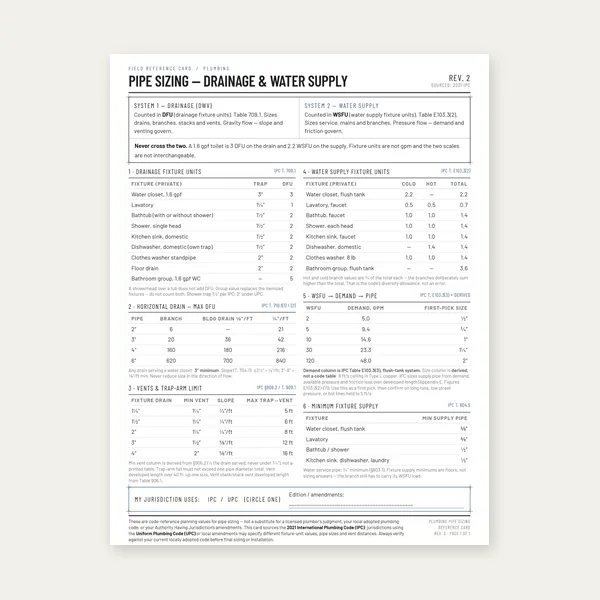
Plumbing Pipe Sizing Card
$3.99
BuyWater-supply fixture units and drainage fixture units share a name. They are two different code systems, two different tables, and two different calculators
The plumbing hub now has a supply-pipe calculator sitting next to a vent calculator and a drain-slope calculator. People will paste the same number into all three. This page is why that fails. WSFU sizes the pipe that brings water in. DFU sizes the pipe that takes water out and the vent that lets air in. Slope is not a fixture-unit number at all.
Supply diameter: water supply pipe sizing calculator. How to total WSFU: supply guide. Vent diameter from DFU: DWV vent sizing guide and the vent calculator. Drain fall: drain pipe slope guide and the slope calculator. The bridge that already said slope is not vent: drain slope vs vent sizing.
Size the incoming pipe.WSFU, length, pressure, material. IPC Table E104.1 / UPC Table 610.4.
Open Supply Calculator →A private lavatory is 0.7 water-supply fixture units in IPC Table E103.3(2) and 1 drainage fixture unit in Table 709.1. A private flush-tank water closet is 2.2 WSFU and 3 or 4 DFU. A private bathroom group is 3.6 WSFU and a different DFU total depending on whether you count the group or the fixtures. Those are not rounding errors. Supply diversity (Hunter) and drain diversity (Chapter 7) were built by different committees for different physics: peak probable flow into the fixture versus peak probable load on the waste.
The vent guide needs DFU because IPC 906.2 sizes the vent from the drain served, and the drain comes from Table 710.1(2) in DFU. The drain-slope guide does not take fixture units. It takes diameter and length and prints fall from Table 704.1. The supply calculator takes WSFU, developed length, and pressure and prints a water-pipe diameter from Table E104.1. Three inputs, three chapters, three answers. A working house needs all three. None of them substitutes for another.
| WSFU | DFU | Slope | |
|---|---|---|---|
| What it measures | Peak probable supply demand | Peak probable drain load | Grade so solids move |
| IPC table | E103.3(2) assign, E104.1 pipe size | 709.1 assign, 710.1(2) drain, 906.2 vent | 704.1 |
| UPC table | 610.3 assign, 610.4 pipe size | 702.1 / 703.2 | 708.1 |
| This calculator | Yes — supply | Vent: vent | Yes — slope |
| Private lav example | 0.7 total | 1 DFU | n/a |
| Private WC tank | 2.2 | 3 or 4 DFU | n/a |
Because a plumber sizes a bathroom as a system. Cold and hot come in. Waste and air leave. If you only run the slope calculator you can still siphon the trap. If you only run the vent calculator you can still starve the shower. If you only run the supply calculator you can still belly the 2 in drain. The drain slope vs vent sizing page already exists to stop people from treating Chapter 7 as Chapter 9. This page stops people from treating Appendix E as Chapter 7.
Material splits the same way. PEX ID vs copper ID is an E105.1 problem on the supply side. PVC vs cast iron is a Chapter 7 problem on the drain side. They are not one “pipe material” dropdown for the whole house.
Need the vent diameter?That is DFU and developed length. IPC 906.2, not Table E104.1.
Open Vent Calculator →Paste 16 DFU into the supply calculator and you may get a 1 in water pipe for a load that was actually two public WCs on a drain. Paste 16.5 WSFU into the vent calculator and you will treat a house water total as a drain load and print a vent that has nothing to do with Table 710.1(2). The tools will not stop you. The code books will, on inspection day.
Hot-only WSFU is three-fourths of the fixture total. There is no “hot DFU.” That alone should kill the idea that the numbers are interchangeable.
$3.99
Buy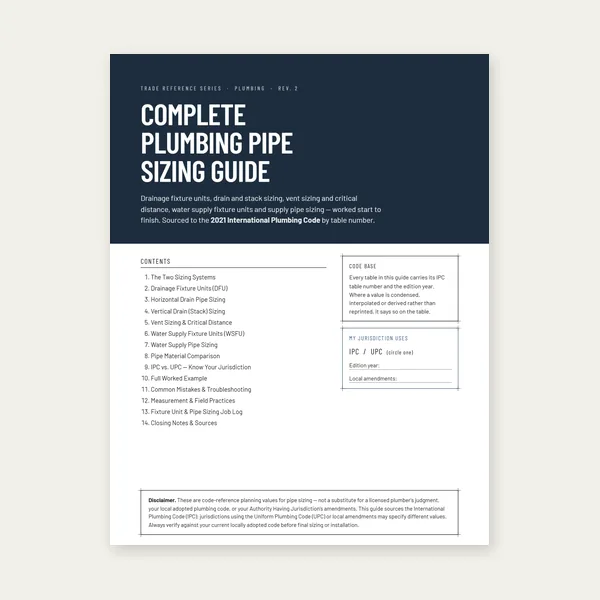
$12.99
Buy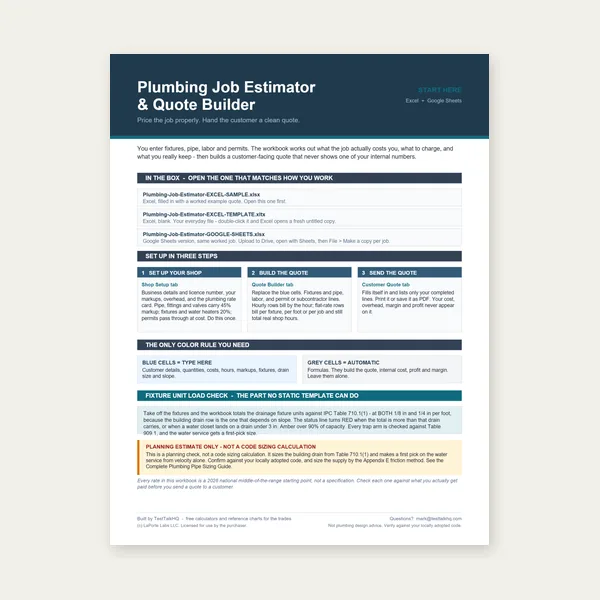
$29.00
Buy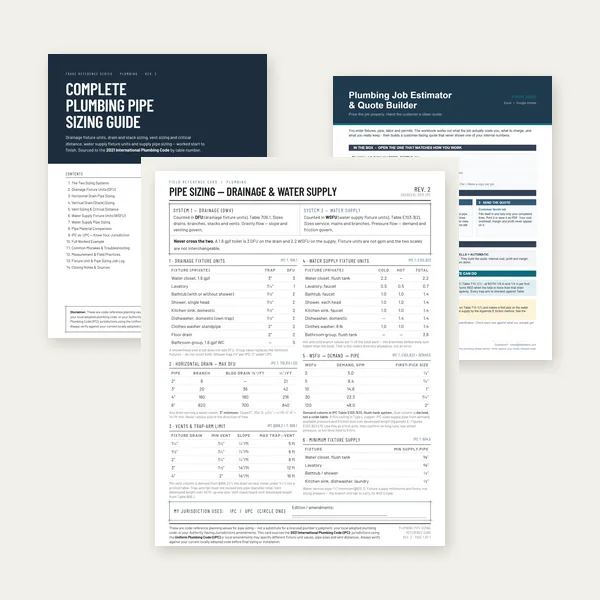
$39.00
BuyCheckout opens here — you stay on this page.
A WSFU diameter is a number until you cut the pipe, crimp or sweat it, hang it, and keep the thermal expansion from lifting a T&P. These are the pieces that actually leave the truck.
1/2 in and 3/4 in copper-ring crimps (ASTM F1807), go/no-go gauge, cutter, and ring puller. The iCrimp IWS-1807CN is how a PEX branch actually becomes the diameter Table E104.1 just printed.
View on Amazon →
Copper Type L still shows up on water heaters and meter tails. A RIDGID 57008 C-style cutter is the tool that squares a 3/4 in stub in a joist bay the wheel cutter will not fit.
View on Amazon →
A closed supply (PRV or check at the meter) needs somewhere for the heater to expand. Undersized pipe plus a dead-headed heater is how you get relief-valve drips that look like a pressure problem.
View on Amazon →
Meter couplings, galvanized nipples, and the last iron fitting on a remodel still need a wrench that bites. Same 14 in RIDGID that turns DWV no-hubs turns supply thread too.
View on Amazon →
PEX sags. Copper rings. Hang the run so the developed length you typed is the developed length that exists after the drywall goes up.
View on Amazon →
WSFU, developed length, pressure band, and copper / PEX / CPVC. IPC Table E104.1 plus UPC Table 610.4.
Open Water Supply Pipe Sizing Calculator →As an Amazon Associate, TestTalkHQ earns from qualifying purchases.