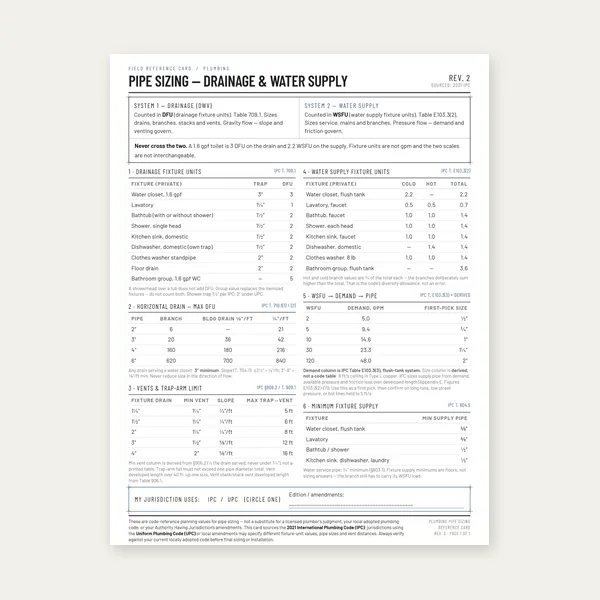
Plumbing Pipe Sizing Card
$3.99
BuyRegenerating too often, hardness still at the tap, salt bridging or mushing, and mid-week capacity loss on a well that was never sized for iron
A salt-based softener that was sized with the water softener sizing calculator can still fail in the field. The symptoms below are the ones that get blamed on “a bad unit” when the cause is an open bypass, a wrong hardness number, iron on the resin, or a brine tank that is not actually making brine. This page is symptoms, causes, and fixes — not a model-specific service manual.
How the grain math is supposed to work: sizing guide. Salt-based vs salt-free (wrong architecture, not a setting): comparison. Quick household × hardness table: sizing chart. Plumbing index: plumbing calculators hub.
Confirm the unit was not undersized on day one.People, hardness, iron. 7-day capacity with a 25% reserve.
Open Calculator →A correctly sized residential bed on a 5–7 day plan should not be rinsing to drain every night. If the valve is in regen when you did not schedule it, or the salt level drops a bag a week in a two-person house, treat it as a sizing or fouling problem first, not a “powerful” unit.
Daily grains = use × hardness. A 24,000-grain tank on 4 people × 75 gal × 12 GPG is 3,600 grains/day. A 7-day week is 25,200 grains before reserve. That bed is exhausted in under a week even if the hardness number was right. Metered valves will regen early because they are telling the truth.
Fix: Re-run the calculator with a lab hardness, not the number the salesperson guessed. If recommended class is a tier above what is installed, you can sometimes raise salt dose and shorten the interval as a stopgap. The real fix is a larger bed or a twin. Formula walkthrough: sizing guide.
Ferrous iron uses exchange sites and coats beads so they stop exchanging. The control still thinks it has 32,000 grains. The water does not. The meter sees hardness leaking through and calls for regen again.
Fix: Test well water for iron. Add 5 GPG per 1 ppm on the worksheet (the calculator does this). Clean or replace fouled resin; a citric or resin-cleaner cycle is a maybe, not a promise, once the bed is brown. Consider an upstream iron filter above ~1–2 ppm. Well supply hardware is a different tool: well pump sizing calculator.
A metered valve regenerates when it has treated the gallon count that matches programmed hardness. If someone entered 30 GPG because the strip was hard to read, a 10 GPG house will regen about three times too often.
Fix: Re-test. Enter actual GPG (ppm / 17.1). Do not “pad” hardness in the valve to fake a reserve — that wastes salt. The 25% reserve belongs in the tank class, not in a fake hardness setting.
After a working softener, dishes sheet, soap lathers with less product, and a hardness test at a treated faucet should read near zero grains. If it does not, the bed may be fine and the plumbing is not going through it.
Installers open bypass to swap a tank or winterize a vacant house. The handle gets left in bypass. The unit regenerates on schedule into a bypassed loop. The house drinks raw water. This is the first thing to look at because it costs nothing and it is common.
Fix: Put the bypass in service. Confirm inlet and outlet orientation. Test hardness at a treated faucet, then at a known-untreated hose bibb. If both read the same, you are still in bypass or the unit was never piped in.
No salt, a failed brine draw, a stuck piston, or a control board that is not starting regen will leave a bed that looks installed and does nothing. Hardness at the tap climbs over days, not instantly.
Fix: Salt in the brine tank, water above the salt (you need brine, not a dry pile), and a manual regen. If a manual regen does not drop hardness at the tap within a few hours of the rinse finishing, the valve is not drawing brine or the resin is spent. That is a service call, not a bigger tank.
A 24,000-grain class sized on 4 GPG city water, then installed on a 12 GPG well without a re-test, will leak hardness before the scheduled 7-day regen. It looks like “the softener does not work.” It worked. It ran out.
Fix: Test current hardness and iron. Re-size. If the installed class is more than one tier small, replacing settings will not catch up. Chart for a second opinion: sizing chart.
The brine tank should have loose pellets or cubes with a water line that actually wets them. Two failures look similar from the lid and are not the same.
A hard crust forms across the tank, hanging a few inches above the water. The chamber below is empty or low. The valve draws water, not brine. Regen runs. Hardness returns. From above, it still looks “full of salt.”
Fix: Break the crust with a broom handle (not a screwdriver through a poly tank wall). Push the pile down so salt sits in the water. Humidity, cheap salt fines, and filling the tank to the lid all encourage bridging. Keep the tank around half to two-thirds full, not heaped.
A sludge of dissolved fines sits in the bottom and clogs the safety float or the pickup. Brine draw is weak or zero. Mush is more common with evaporated pellets that break down, or with high-humidity garages.
Fix: Bail or wet-vac the sludge, rinse the grid if there is one, and restart with cleaner pellet or cube salt. Mush that returns every month is often a tank that is overfilled and never fully drawn down — which is also a sign the regen interval is wrong (see regenerating too often).
This is the well-system failure mode the calculator is built to prevent. Hardness was entered. Iron was not. The week starts soft. By Thursday the bed is exhausted. Weekend guests make it obvious. A metered valve may regen mid-week and hide the pattern; a timer set for Saturday night will not.
Compensated hardness was never applied. 8 GPG + 1.5 ppm iron is not 8 GPG. It is about 8 + 7.5 = 15.5 GPG on this worksheet. Four people at 75 gallons is 4,650 grains/day. A 32,000-grain tank at 75% usable is 24,000 grains — about 5 days, not 7. Iron fouling then shortens that further as the beads coat.
Fix: Lab test for hardness and iron. Re-size with iron in the calculator. Size up a full tier from the city-water class if iron is present, even when the rounded number still fits — that is the guide’s “jump a tier” rule, not optional padding. Clean or replace resin that already stains rust-brown. Pair with an iron filter when ppm is not a trace.
A well that cannot keep up GPM is a different problem (low pressure, pump short-cycle). Do not turn the softener into a pump diagnostic. Pump worksheet: well pump sizing calculator. Softener grain math: sizing guide.
A scheduled regen that lasts about 1–2 hours and then stops is normal. Failure is regen every night, regen that never stops, or regen with no salt use and hard water afterward. Time the drain flow. If it runs for six hours, the valve is stuck in a cycle — service, not a larger tank.
Salt-free units do not regenerate with brine and do not drop a hardness test to zero. If you expected soft water from a conditioner, the architecture is wrong, not the settings. Salt-based vs salt-free.
Scale in a storage tank is downstream evidence. Close the softener bypass question first, then deal with heater sediment. Heater first-hour rating is a separate size: water heater sizing calculator.
$3.99
Buy
$12.99
Buy
$29.00
Buy
$39.00
BuyCheckout opens here — you stay on this page.