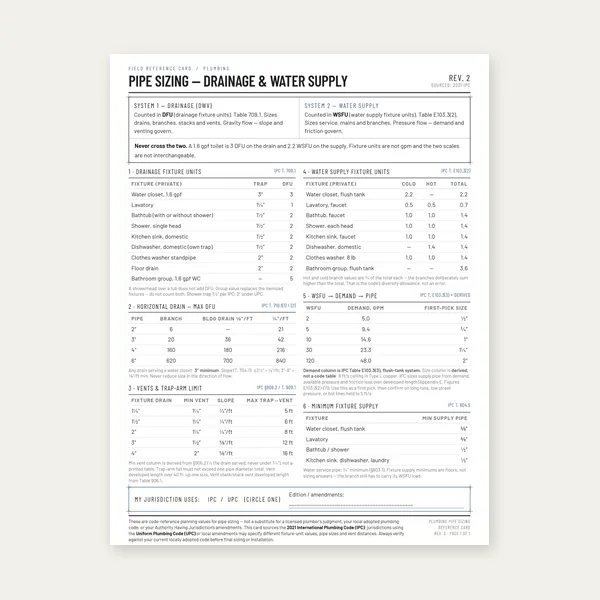
Plumbing Pipe Sizing Card
$3.99
BuyRecommended tank gallons and first-hour rating from household size, bathrooms, peak-hour use, and gas vs electric recovery
Size a standard storage water heater from the people in the house, the bathrooms that can run a shower, the busiest hour you actually have, and whether the replacement is gas or electric. Peak-hour demand follows the U.S. Department of Energy Energy Saver worksheet. That number is the first-hour rating (FHR) to match on the yellow EnergyGuide label. Tank gallons are then the smallest common storage size that can hit that FHR given typical gas vs electric recovery. This is a sizing starting point, not a substitute for a plumber’s assessment of actual fixture demand, especially for unusual household patterns.
Tank size vs FHR, and how to read the existing label: sizing guide. Running out of hot water: troubleshooting. Tank vs tankless is a different sizing problem: tank vs tankless. Plumbing index: plumbing calculators hub.
Basement groundwater is a different worksheet: Sump Pump Sizing Calculator (basin, inflow GPM, total head — starting point, not a named-model pump curve).
Horizontal drain slope on the same plumbing job: Drain Pipe Slope Calculator (IPC 2021 Table 704.1 / UPC 708.1 — prescriptive starting point, not a substitute for local code). Water-supply pipe diameter is a different worksheet (WSFU, not first-hour rating): water supply pipe sizing calculator. Not sure the fixture-unit totals for that house? fixture unit calculator.
Count the people who live here, count the bathrooms that can actually run a shower, pick the busiest hour you really have (not the one you wish you had), and say whether the replacement is gas or electric. The calculator builds a DOE peak-hour demand from those choices, reports that number as the first-hour rating to match, then picks the smallest common storage tank whose estimated FHR clears it given gas or electric recovery.
Tank size vs FHR, and how to read the yellow label on the heater already in the basement: sizing guide. Running out of hot water before you blame the gallon number: troubleshooting. If you are deciding tank vs tankless, sizing is not even the same unit: tank vs tankless.
DOE does not size storage water heaters by “people × 10 gallons.” It sizes them by first-hour rating: how many gallons of hot water the heater can deliver in one hour starting from a full tank. That FHR has to meet your peak-hour demand. Tank gallons are a retail shorthand. A 50-gallon gas heater and a 50-gallon electric heater are not the same first-hour machine, because the gas burner recovers faster.
DOE Energy Saver worksheet gallons as listed in the results. Peak-hour fixture mix from the scenario you picked, with shower count capped by household size and bathrooms. Usable storage treated as 70% of nominal tank volume (a field approximation of mixed water that stays usefully hot). Recovery: ~37 gal/hr gas, ~21 gal/hr electric at a 90°F rise. Standard tank sizes only: 30, 40, 50, 55, 60, 75, 80 gallons. Tankless GPM is a simultaneous-flow starting point using ~2.0 GPM showers, not a manufacturer curve at your groundwater temperature.
Soaking tubs, multiple body-spray showers, a salon or in-law suite that behaves like a second dwelling, recirculation loops that constantly steal recovery, commercial kitchens, and anything a plumber would count in fixture units rather than a residential peak-hour worksheet. Those jobs need measured GPM, temperature rise, and often a different heater family. Treat every number here as a conversation starter, not a purchase order.
Already running out of hot water on a “big enough” tank?Sediment, thermostat, mixing valve, and a failed dip tube fake an undersized heater.
Troubleshooting →$3.99
Buy
$12.99
Buy
$29.00
Buy
$39.00
BuyCheckout opens here — you stay on this page.
Sizing gets you a tank or a tankless spec. Sediment, anodes, mixing valves, and T&P valves are why a “big enough” heater still runs out of hot water.
A spent anode does not shrink the tank, but it lets the steel rust from the inside. Check it before you assume you need more gallons.
View on Amazon →
Store hotter, deliver 120°F at the tap. A mixing valve changes how much usable hot water you actually get from the same tank.
View on Amazon →
Anode, drain valve, and dielectric unions still come apart with a wrench. Sizing math does not replace a drain-and-flush.
View on Amazon →
Safety first. A weeping T&P is not a sizing problem. Replace the valve; do not cap it.
View on Amazon →
Closed municipal systems need somewhere for heated water to go. Expansion tanks are not first-hour rating, but they save the T&P from dripping all winter.
View on Amazon →
Household size, bathrooms, peak scenario, gas or electric. Tank gallons and FHR starting point.
Open Water Heater Sizing Calculator →As an Amazon Associate, TestTalkHQ earns from qualifying purchases.