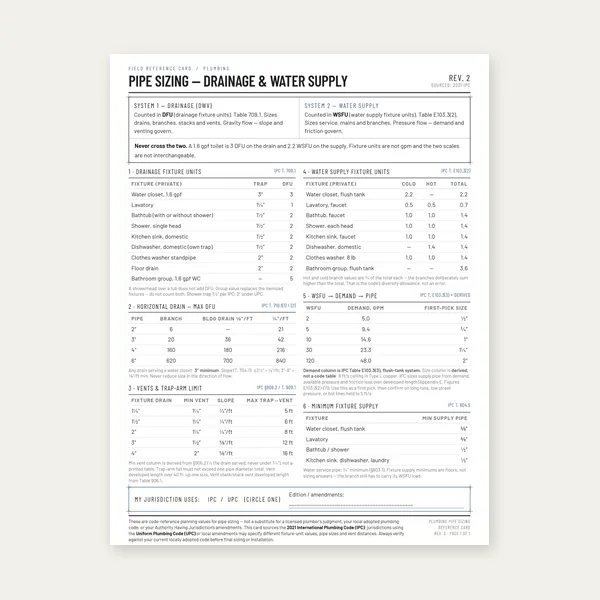
Plumbing Pipe Sizing Card
$3.99
BuyHow tank gallons and first-hour rating relate, why gas recovers faster than electric, and how to read the label on the heater you already own
People buy water heaters by the number painted on the carton: 40 gallon, 50 gallon, 80 gallon. DOE sizes them by first-hour rating — how many gallons of hot water the heater can actually deliver in the busiest hour, starting from a full tank. Those are not the same number. The water heater sizing calculator builds a DOE peak-hour demand, reports that as the FHR to match, then picks a common tank size given gas or electric recovery. This page is the why.
Already running out of hot water: troubleshooting. Deciding tank vs tankless: tank vs tankless. Plumbing index: plumbing calculators hub.
Hard water scales a storage tank from the inside. Size the heater here, then size the ion-exchange bed with the Water Softener Sizing Calculator (grains between regenerations — not first-hour rating).
Closed-main expansion (PRV or backflow preventer) is not first-hour rating: Expansion Tank Sizing Calculator (heater gallons, incoming pressure, PRV, temperature rise — Boyle’s-law starting point, not a hydronic boiler tank). T&P dripping on recovery: expansion tank troubleshooting.
Basement groundwater is a different worksheet: Sump Pump Sizing Calculator (basin, inflow GPM, total head — starting point, not a named-model pump curve).
Horizontal drain slope on the same plumbing job: Drain Pipe Slope Calculator (IPC 2021 Table 704.1 / UPC 708.1 — prescriptive starting point, not a substitute for local code).
Need the tank size and FHR?Household, bathrooms, peak hour, gas or electric. Starting point only.
Open Calculator →Nominal tank volume is how many gallons of water fit in the steel (or glass-lined) cylinder. First-hour rating is how many gallons of hot water you can pull in sixty minutes before the outlet temperature falls off the DOE test. FHR is stored hot water you can actually use, plus whatever the burner or element reheats during that same hour.
A field approximation plumbers have used for decades:
The 70% is not a law. It is a stand-in for the fact that you do not get the whole tank at 120°F. Cold inlet water mixes as you draw. By the time the top of the tank is still useful, the bottom is already diluted. Recovery is the gallons the heat source can raise through a 90°F rise in an hour. Add those two and you are in the neighborhood of the number on the EnergyGuide label. The label is the legal number. The formula is how you see why a 50-gallon gas heater and a 50-gallon electric heater are not twins.
DOE’s published instruction is blunt: pick a storage water heater whose first-hour rating at least matches your peak-hour demand. Do not pick a tank volume and hope. The calculator does the worksheet, then walks the common tank sizes until estimated FHR clears that demand for the fuel you picked.
The public reference is U.S. Department of Energy, Energy Saver, Sizing a New Water Heater (energy.gov/energysaver/sizing-new-water-heater). You identify the hour of the day when the house uses the most hot water. You do not add up the whole day. You count uses in that one hour, multiply by DOE’s average gallons per use, and total them. That total is peak-hour demand. That demand is the FHR you need.
DOE’s worksheet gallons per use:
| Use | Gallons per use |
|---|---|
| Shower | 20 |
| Shaving | 2 |
| Hand dishwashing or food prep | 3 |
| Automatic dishwasher | 7 |
| Clothes washer, H-axis (front-load) | 15 |
| Clothes washer, top-loader | 25 |
DOE’s own example is three showers (60) + one shave (2) + one hand-dish (3) = 66 gallons. That household needs a storage heater with an FHR of 66 or more. Not “a 50-gallon tank because we are a family of four.” A 50-gallon gas unit might clear 66. A 50-gallon electric unit often will not.
The calculator maps peak-usage scenarios onto that same worksheet. “Typical morning (staggered showers)” still counts showers that happen in the same hour even if they are not overlapping. “Shower + dishwasher running simultaneously” adds the dishwasher’s 7 gallons and also raises the tankless GPM line, because now two fixtures are live at once. Bathroom count caps how many showers can overlap; it does not erase sequential volume. One bathroom can still stack three back-to-back showers in sixty minutes. It cannot run two showers at 2.0 GPM at the same time. That distinction is the whole tank vs tankless problem.
Recovery rate is gallons per hour the heater can raise through a given temperature rise. Physics, not marketing:
A 4,500 W electric element is 15,354 Btu/h. Through a 90°F rise that is about 21 gallons per hour. A 40,000 Btu/h gas burner at roughly 70% thermal efficiency is about 28,000 Btu/h into the water, or about 37 gallons per hour at the same 90°F rise. That is the pair the calculator uses, and it is stated in the results so you can disagree with it.
What it means on the truck:
Fuel also changes the install: venting and combustion air for gas, a 30-amp / 240-volt circuit (or more) for electric, condensate and a heat-pump’s cold-air dump for HPWH. None of that is in the gallon number. It is why a plumber still has to walk the mechanical room.
Two labels matter, and they are easy to mix up.
Usually on the side of the jacket. Model number, serial number, nominal tank volume, wattage or Btu/h input, voltage, and often a manufacture date in the serial. This is how you know whether you are looking at a 40-gallon or a 50-gallon tank, whether the electric unit is 4,500 W or 5,500 W, and whether the gas burner is 32,000 or 40,000 Btu/h. Recovery lives here as input, not as FHR.
DOE tells you to size storage heaters from first-hour rating. The Federal Trade Commission requires an EnergyGuide label on new conventional storage water heaters. Top-left of that yellow label is “Capacity (first hour rating)” in gallons. That is the FHR. It is not the tank volume. A 40-gallon gas heater might show 67. A 50-gallon electric might show 62. Compare that number to your peak-hour demand from the calculator.
EnergyGuide is not required on every heat-pump water heater the same way. Manufacturer literature still publishes FHR. If the yellow tag is gone on a 12-year-old tank, you are stuck with tank volume + input from the rating plate and a recovery estimate. That is a starting point. It is not the certified first-hour number.
Also look for the thermostat access panels (electric) or the gas control valve set point. Factory is often 120°F. Cranking to 140°F without a mixing valve is a scald risk. Cranking it down to 110°F to “save energy” is how a correctly sized tank feels undersized. Mixing valves let you store hotter and deliver safer. They change usable first-hour volume. They do not show up on the carton gallon number.
No. Four people with a typical staggered morning and gas fuel often land near a 40–50 gallon tank because FHR, not the carton, is the constraint. The same four people on electric, or a full-house morning with laundry and dishes, can need 60–80 gallons. Run the calculator instead of a hallway rule of thumb.
Energy Star points buyers at efficient equipment and still expects you to match first-hour rating (or tankless GPM) to the house. The public worksheet this tool uses is DOE Energy Saver. EnergyGuide FHR is the FTC label DOE tells you to read. There is not a second official “Energy Star gallon chart” that overrides the peak-hour method.
A soaking tub is often 40–80 gallons by itself, which blows past a residential peak-hour worksheet built on 20-gallon showers. That is plumber territory: measured fill volume, temperature rise, and often a dedicated heater or a much larger FHR. The calculator will not pretend a soaking tub is a shower.
$3.99
Buy
$12.99
Buy
$29.00
Buy
$39.00
BuyCheckout opens here — you stay on this page.
Sizing gets you a tank or a tankless spec. Sediment, anodes, mixing valves, and T&P valves are why a “big enough” heater still runs out of hot water.
A spent anode does not shrink the tank, but it lets the steel rust from the inside. Check it before you assume you need more gallons.
View on Amazon →
Store hotter, deliver 120°F at the tap. A mixing valve changes how much usable hot water you actually get from the same tank.
View on Amazon →
Anode, drain valve, and dielectric unions still come apart with a wrench. Sizing math does not replace a drain-and-flush.
View on Amazon →
Safety first. A weeping T&P is not a sizing problem. Replace the valve; do not cap it.
View on Amazon →
Closed municipal systems need somewhere for heated water to go. Expansion tanks are not first-hour rating, but they save the T&P from dripping all winter.
View on Amazon →
Household size, bathrooms, peak scenario, gas or electric. Tank gallons and FHR starting point.
Open Water Heater Sizing Calculator →As an Amazon Associate, TestTalkHQ earns from qualifying purchases.