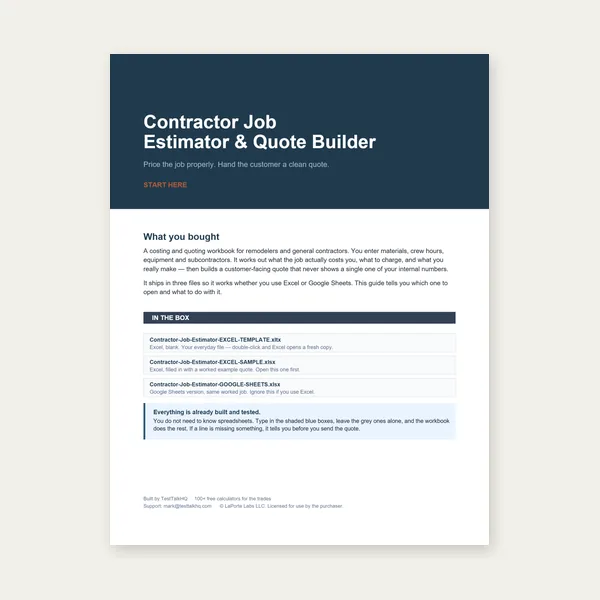
Contractor Job Estimator
Price remodels and GC work, then send a quote with no internal numbers.
Excel or Google Sheets. Best on a computer.
$29.00
Buy10–15% target range from loaded trailer weight — compare a measured reading or estimate from cargo placement
Enter total loaded trailer weight, then a scale reading or a cargo-placement estimate. Results show the target tongue-weight band and flag too-low (sway) or too-high (rear overload). How to measure: guide. On-road symptoms: troubleshooting. WD vs standard hitch: comparison. Related safety tool: stopping distance calculator. Companion GCWR headroom check: towing capacity calculator. Automotive index: automotive calculators hub.
Enter the trailer’s total loaded weight. Choose measured mode if you already have a scale reading, or estimate mode if you are planning where cargo should sit. The results panel shows the 10–15% target range for that weight and flags whether your number is too low (sway risk), in band, or too high (rear overload risk).
Measurement walkthrough: guide. On-road symptoms: troubleshooting. WD hitch thresholds: comparison. Related towing-safety physics: stopping distance calculator. Custom wheels on the tow vehicle: offset & backspacing calculator, offset guide, fitment troubleshooting, and spacers vs different-offset wheels.
Tongue weight is the downward force the coupler puts on the hitch ball. For conventional bumper-pull trailers, industry loading guides put that force at roughly one-tenth to fifteen percent of the trailer’s total loaded weight. Below the band, the trailer becomes a pendulum behind the hitch — classic sway. Above the band, the tow vehicle squats, the front axle unloads, and hitch / payload ratings get eaten.
Bumper-pull percentage band of 10–15% of the loaded trailer weight you enter. Estimate mode treats the axle (or tandem group center) as the fulcrum and ignores spring windup, tire squat, and tongue jack height errors. Fifth-wheel / gooseneck pin weight is typically a higher percentage (often ~15–25%) — do not use this tool’s bumper-pull band for those.
Certifying a hitch class, reconstructing a crash, or sizing a fifth-wheel pin. For those you need manufacturer ratings and measured axle weights. Pair tongue-weight discipline with stopping-distance awareness on the braking calculator.
Need the measurement steps?Bathroom scale + pipe lever, commercial scale, and dedicated tongue scale.
Open Measurement Guide →Price remodels and GC work, then send a quote with no internal numbers.
Excel or Google Sheets. Best on a computer.
$29.00
BuyCheckout opens here — you stay on this page.
The calculator tells you the 10–15% target range and whether a measured reading is too light (sway risk) or too heavy (rear-axle / hitch overload). A dedicated tongue scale replaces bathroom-scale guessing on heavier trailers; wheel chocks keep the trailer from rolling while you measure; a rated extinguisher belongs in any tow kit.
Hydraulic tongue scale with a direct pounds gauge. Measure the loaded coupler on level ground, then compare the reading to the calculator’s 10–15% target band for your gross trailer weight.
View on Amazon →
Chock the trailer wheels before you drop the coupler onto a scale or jack a tongue for cargo moves. A rolling trailer ruins the reading and is a crush hazard.
View on Amazon →
Towing multiplies fire risk (brakes, bearings, electrical). Keep a rated extinguisher reachable in the tow vehicle — not buried behind cargo in the trailer.
View on Amazon →
Target 10–15% band from loaded trailer weight. Compare a scale reading, or estimate from cargo placement ahead/behind the axle.
Open Tongue Weight Calculator →
Trailer sway and wrong tongue weight both stretch stopping distance. Physics estimate from speed, reaction time, and surface mu.
Open Stopping Distance Calculator →
Loaded towing kills mpg. Gallons, total cost, and cost per mile from distance, mpg, and pump price.
Open Trip Fuel Cost Calculator →As an Amazon Associate, TestTalkHQ earns from qualifying purchases.