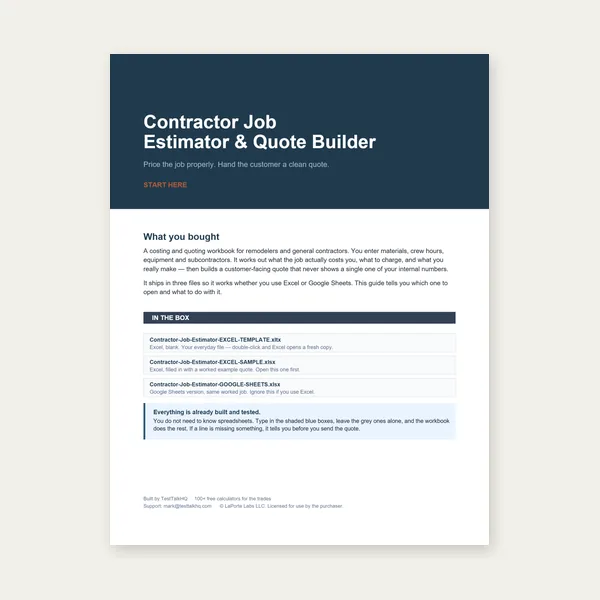
Contractor Job Estimator
Price remodels and GC work, then send a quote with no internal numbers.
Excel or Google Sheets. Best on a computer.
$29.00
BuyEngine RPM at a road speed — or road speed at a target RPM — from tire diameter, axle ratio, and transmission gear
Enter overall tire diameter, the differential (axle) ratio, and the gear you are in. Solve either direction: how fast the engine turns at 65 mph, or how fast you are going at 2,500 RPM. Tire diameter feeds this math directly — get it from the tire size & speedometer error calculator if you only have a size code. This is drivetrain geometry with the published 336 constant — not a dyno or ring-and-pinion setup sheet.
How gearing and tire size share one equation: guide. Lugging or high highway RPM: troubleshooting. Re-gear vs live with the tire change: comparison. Automotive index: automotive calculators hub.
Tire diameter in inches, rear axle (final drive) ratio, and the transmission gear you are in. Switch modes to solve for engine RPM at a road speed, or road speed at a target RPM. Need diameter from a size code? Use the tire size & speedometer error calculator.
Overall height of the tire, not the rim. Example: 225/65R17 ≈ 28.64 in. Don’t know diameter? Run the tire size calculator →
Ring-and-pinion, e.g. 3.73 or 4.10.
Use 1.000 for direct-drive top gear. Overdrive is often 0.70–0.85.
True road speed for the RPM prediction (GPS speed is fine).
Cruise RPM, redline, or a preferred power-band target.
RPM = (mph × transmission gear ratio × axle ratio × 336) / tire diameter (inches). Solving for speed: mph = (RPM × tire diameter) / (gear × axle × 336). The constant 336 is the industry-standard reduced form of 63,360 / (60 × π) ≈ 336.13 documented by MotorTrend’s Pit Stop (Marlan Davis) on the speed/RPM/gear/tire formula; Crawlpedia’s gear calculator uses 336.13 for the same derivation. Assumes zero wheel slip and a locked torque converter / mechanical couple. Automatics below lockup and CVTs need measured RPM, not this geometry. Diameter must be overall tire height — get it from the tire size calculator if you only have a size code. Signs you are geared wrong for the tire: troubleshooting.
Primary published references: MotorTrend / Hot Rod Pit Stop — “Where Does The ‘336’ Come From In The Speed/RPM/Gear-Ratio/Tire-Size Formula?” (Marlan Davis); Crawlpedia Engine RPM / Gear Calculator worked example using 336.13 = 63360 / (60 × π). TestTalkHQ uses the published whole-number constant 336 for shop-matching results.
Enter overall tire diameter in inches, the axle (ring-and-pinion) ratio, and the transmission gear ratio for the gear you care about. Choose Speed → RPM to see engine speed at a road speed, or RPM → Speed to see how fast you are going at a cruise or redline target. If you only know the size code, run the tire size calculator first and copy the overall diameter here.
Why a tire change acts like a gear change: guide. Lugging or screaming on the highway: troubleshooting. Whether to re-gear or live with it: comparison.
Engine RPM, road speed, axle ratio, transmission gear, and tire diameter are one equation. Change any one and the others move. Shops have used the 336 form of that equation for decades because it collapses inches-per-mile, minutes-per-hour, and π into a single constant.
Tire diameter is overall unloaded geometry (same as the tire size calculator). Transmission ratio is the gear you are in, not the final drive alone. Axle ratio is ring teeth ÷ pinion teeth. Zero wheel slip. Automatics are treated as locked; below lockup, real RPM is higher than the calculator for the same road speed.
CVT ratio maps, dual-clutch paddle gears you have not identified, transfer-case low range (multiply it into the gear field if you know it), and race converters that never lock. Those need a scan tool or tach on the car. Use this page for planning a tire size and axle combination before you spend money.
Already living with tall tires and high RPM?Decide whether a re-gear is worth it, or whether the tire change is small enough to keep.
Re-Gear vs Live With It →Price remodels and GC work, then send a quote with no internal numbers.
Excel or Google Sheets. Best on a computer.
$29.00
BuyCheckout opens here — you stay on this page.
When you change tires or re-gear the axle, you need a way to check engine speed, set ring-and-pinion contact, measure backlash, and fill the housing with the right oil. These are the tools that turn the calculator numbers into a driveway job.

Non-contact RPM check on a pulley, harmonic balancer, or marked flywheel. Use it to verify the calculator’s cruise RPM against what the engine is actually turning.
View on Amazon →
Yellow paste for drive and coast tooth patterns after a ring-and-pinion install. Pattern tells you pinion depth and backlash before you button up the cover.
View on Amazon →
Measure ring-gear backlash and runout after a re-gear. Mag base sticks to the housing so you can rock the ring gear and read thousandths without holding the indicator by hand.
View on Amazon →
GL-5 synthetic for hypoid differentials after a ratio change. Fill to the cover plug — not to the brim of the housing — and add the friction modifier your limited-slip needs if it is not already in the bottle.
View on Amazon →
Advance display and tach readout for verifying idle and cruise RPM on engines where the dash tach is wrong or missing. Pair it with the calculator’s predicted RPM at a known road speed.
View on Amazon →
Gear RPM math needs diameter in inches. Decode the size code and get overall diameter from the tire size calculator.
Open Tire Size Calculator →As an Amazon Associate, TestTalkHQ earns from qualifying purchases.