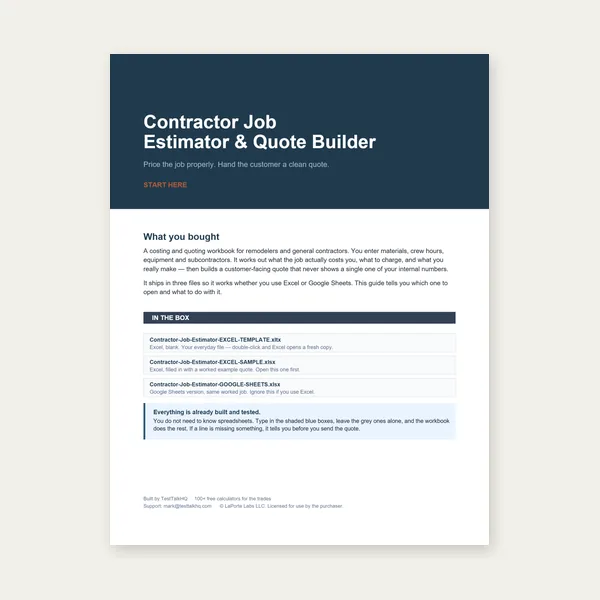
Contractor Job Estimator
$29.00
BuyHorsepower from torque and RPM — or torque from horsepower and RPM — using the published 5,252 constant
Enter torque in lb-ft and engine RPM to get horsepower, or enter horsepower and RPM to get torque. The same math that makes dyno curves cross at 5,252 RPM. Need RPM at a road speed from tire diameter and gearing? Start with the gear ratio & RPM calculator. This is unit-conversion math with the published 5,252 constant — not a dyno or SAE certificate.
What torque and horsepower measure: guide. Peak HP myths and drivetrain loss: troubleshooting. Crank vs wheel numbers: comparison. Stopping distance from speed and surface: braking / stopping distance calculator. Price the miles you actually drive: trip fuel cost calculator. Towing safety check: trailer tongue weight calculator. Automotive index: automotive calculators hub.
Torque in pound-feet (lb-ft) and engine RPM, or horsepower and RPM. Switch modes to solve either direction. Cruise RPM from tire diameter, axle, and gear comes from the gear ratio & RPM calculator.
Pound-feet at the crank (or whatever torque figure you are converting). Not lug-nut wrench torque.
The HP figure you want to convert back to torque at a known RPM.
Engine speed at which that torque or HP applies. Don’t know RPM at cruise? Run the gear ratio calculator →
HP = (Torquelb-ft × RPM) / 5252. Solving for torque: Torque = (HP × 5252) / RPM. The constant 5,252 is the industry-standard reduced form of 33,000 / (2π) from the definition that one horsepower equals 33,000 foot-pounds per minute, documented by EPI Inc.’s “Power and Torque” engineering article (with full derivation) and explained for dyno charts by EngineLabs (“Why Does A Dyno Graph Always Cross At 5,252 RPM?”). At exactly 5,252 RPM, horsepower and torque in lb-ft are numerically equal on a same-scale chart. Need RPM from road speed: gear ratio & RPM calculator. Peak HP myths and drivetrain loss: troubleshooting.
Primary published references: EPI Inc. — “Power and Torque: Understanding the Relationship Between the Two” (HP = Torque × RPM ÷ 5252; derivation 33,000 / 2π ≈ 5252; equality at 5,252 RPM); EngineLabs Tech Talk — “Why Does A Dyno Graph Always Cross At 5,252 RPM?” TestTalkHQ uses the published whole-number constant 5,252.
Choose Torque + RPM → horsepower when you have a torque figure and an engine speed. Choose HP + RPM → torque when you have a horsepower figure and want the matching torque at that RPM. If you only know road speed, tire diameter, and gearing, get RPM from the gear ratio & RPM calculator first, then come back here.
What torque and horsepower actually measure: guide. Peak HP myths and drivetrain loss: troubleshooting. Brochure crank HP vs chassis-dyno wheel HP: comparison.
Torque is rotational force. Horsepower is how fast that force does work. They are locked together by RPM and the constant that comes from defining one horsepower as 33,000 foot-pounds per minute. Dyno shops plot both on the same axes so the curves cross at 5,252 RPM — not because engines magically peak there, but because the units force equality at that speed.
Torque is in pound-feet. Power is mechanical horsepower (the same definition EPI and EngineLabs use with 5,252). RPM is the engine speed that belongs with that torque or HP point. No atmospheric correction, no drivetrain subtraction, no SAE net vs gross distinction.
Guessing brochure horsepower from a phone video, converting metric newton-meters without converting units first, or treating a single peak number as the whole torque curve. For planning cruise RPM after a tire or gear change, use the gear calculator. For reading what a dyno chart is saying, use the guide.
Have road speed but not RPM?Tire diameter, axle, and gear set engine RPM. Feed that RPM into this math.
Open Gear Ratio & RPM Calculator →$29.00
BuyCheckout opens here — you stay on this page.
The calculator turns torque and RPM into horsepower (or the reverse). A tachometer, timing light, and OBD reader help you measure the RPM you plug in. A torque wrench will not read engine torque — it is here for the fastener work that comes with any driveline or accessory job around a performance discussion.

Non-contact RPM on a balancer or marked pulley. Pair the reading with a torque value (or a known HP target) in the calculator.
View on Amazon →
Advance display and tach readout for verifying engine speed when the dash tach is missing or wrong — the RPM half of the HP equation.
View on Amazon →
Live engine RPM and data stream on most 1996+ OBD2 vehicles. Use it to grab the RPM you feed into HP = (T × RPM) / 5252.
View on Amazon →
Not an engine dyno. Use it for lug nuts, axle flanges, and accessory fasteners when you are under the car arguing about power delivery.
View on Amazon →
Gear ratio, tire diameter, and road speed set engine RPM. Feed that RPM into this HP/torque math.
Open Gear Ratio & RPM Calculator →
Overall diameter feeds the gear RPM calculator, which feeds this one. Full automotive performance path.
Open Tire Size Calculator →As an Amazon Associate, TestTalkHQ earns from qualifying purchases.