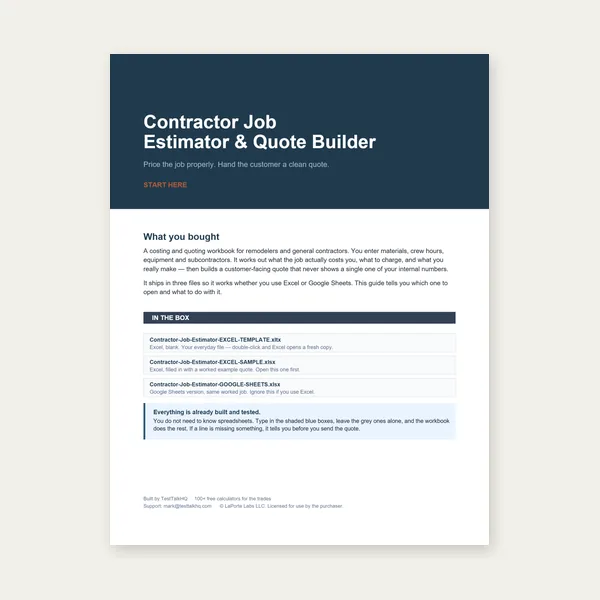
Contractor Job Estimator
$29.00
BuyCommon mistakes — assuming higher peak horsepower always means faster acceleration, ignoring where peak torque sits in the RPM range, and forgetting drivetrain loss between crank and wheel
Peak numbers sell engines. Driveability lives in the curve. Use the horsepower & torque calculator to check any single point, and the gear ratio & RPM calculator to see whether your cruise RPM even sits near the good part of that curve.
What the units mean: guide. Crank vs wheel: comparison.
Check a point on the curve.Torque and RPM in; horsepower out — or the reverse.
Open Calculator →Acceleration depends on torque at the wheels across the RPM band you use in a shift, plus vehicle weight, gearing, and traction. A car with lower peak HP but stronger midrange torque and shorter gearing can beat a peakier engine off a light and through a roll. Peak HP is a single point. The calculator will happily convert that point; it will not tell you the area under the curve.
$29.00
BuyCheckout opens here — you stay on this page.
The calculator turns torque and RPM into horsepower (or the reverse). A tachometer, timing light, and OBD reader help you measure the RPM you plug in. A torque wrench will not read engine torque — it is here for the fastener work that comes with any driveline or accessory job around a performance discussion.

Non-contact RPM on a balancer or marked pulley. Pair the reading with a torque value (or a known HP target) in the calculator.
View on Amazon →
Advance display and tach readout for verifying engine speed when the dash tach is missing or wrong — the RPM half of the HP equation.
View on Amazon →
Live engine RPM and data stream on most 1996+ OBD2 vehicles. Use it to grab the RPM you feed into HP = (T × RPM) / 5252.
View on Amazon →
Not an engine dyno. Use it for lug nuts, axle flanges, and accessory fasteners when you are under the car arguing about power delivery.
View on Amazon →
Gear ratio, tire diameter, and road speed set engine RPM. Feed that RPM into this HP/torque math.
Open Gear Ratio & RPM Calculator →
Overall diameter feeds the gear RPM calculator, which feeds this one. Full automotive performance path.
Open Tire Size Calculator →As an Amazon Associate, TestTalkHQ earns from qualifying purchases.
Peak torque at 2,200 RPM on a diesel towing truck is a different animal from peak torque at 6,500 RPM on a high-revving gas engine. If your highway cruise (from the gear calculator) sits at 1,700 RPM and the torque curve is still climbing hard at 3,000, the truck will feel soft until it downshifts. Match gearing to the curve — do not only chase a brochure peak.
Manufacturer-advertised horsepower is typically an engine (crank) rating. A chassis dyno reports wheel horsepower after the transmission, driveshaft(s), and differential(s) absorb power. MotorTrend / Modified Magazine’s drivetrain-loss article argues there is no universal percentage that fits every vehicle — AWD layouts with more rotating hardware generally lose more than a simple FWD layout, but the exact delta is design-specific. Do not “add 15%” to every dyno sheet and call it factory crank. Details: crank HP vs wheel HP.
Pick points on the curve and convert them with the calculator so the HP and torque labels stay honest. Check cruise RPM with the gear calculator so you know where the engine lives on that curve. Ask which dyno — engine vs chassis, observed vs corrected — before comparing numbers across cars or shops.
No. Modified Magazine (MotorTrend) specifically rejects a universal 15% rule. Loss varies by drivetrain design.
Converter slip changes engine RPM vs road speed. Get measured RPM (tach or scan tool), then convert torque/HP at that RPM.