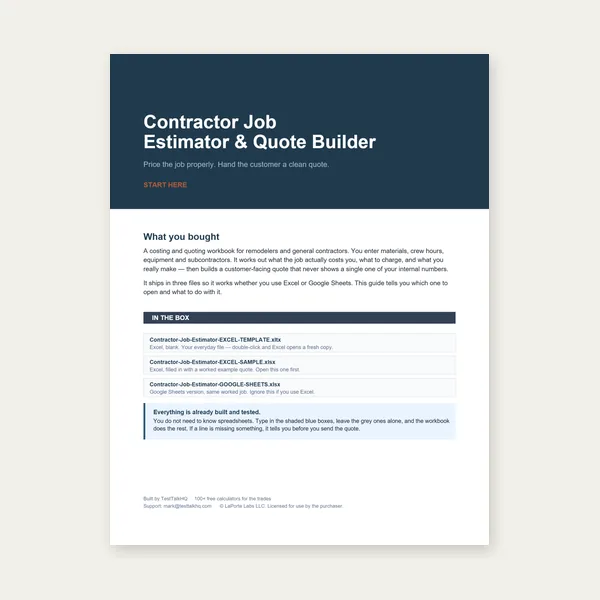
Contractor Job Estimator
Price remodels and GC work, then send a quote with no internal numbers.
Excel or Google Sheets. Best on a computer.
$29.00
BuyWhen tongue weight and trailer weight push you past a plain ball mount into a weight-distribution setup
A standard ball mount transfers tongue weight straight into the rear of the tow vehicle. A weight-distribution (WD) hitch uses spring bars to share that load across the tow-vehicle axles and the trailer axles so the rig sits more level. Start with the tongue weight calculator so you know the force you are asking the hitch to carry. Measurement: guide. On-road symptoms: troubleshooting. Near-capacity leftover trailer budget: towing capacity calculator.
Know the tongue weight first.10–15% band and too-low / too-high flags before you shop hardware.
Open Tongue Weight Calculator → Open Towing Capacity Calculator →Simple, light, and fine for modest tongue weights that leave the tow vehicle nearly level and well inside hitch / payload ratings. If tongue weight is in the 10–15% band, squat is mild, and every rating has margin, a quality ball mount may be enough.
Price remodels and GC work, then send a quote with no internal numbers.
Excel or Google Sheets. Best on a computer.
$29.00
BuyCheckout opens here — you stay on this page.
The calculator tells you the 10–15% target range and whether a measured reading is too light (sway risk) or too heavy (rear-axle / hitch overload). A dedicated tongue scale replaces bathroom-scale guessing on heavier trailers; wheel chocks keep the trailer from rolling while you measure; a rated extinguisher belongs in any tow kit.
Hydraulic tongue scale with a direct pounds gauge. Measure the loaded coupler on level ground, then compare the reading to the calculator’s 10–15% target band for your gross trailer weight.
View on Amazon →
Chock the trailer wheels before you drop the coupler onto a scale or jack a tongue for cargo moves. A rolling trailer ruins the reading and is a crush hazard.
View on Amazon →
Towing multiplies fire risk (brakes, bearings, electrical). Keep a rated extinguisher reachable in the tow vehicle — not buried behind cargo in the trailer.
View on Amazon →
Target 10–15% band from loaded trailer weight. Compare a scale reading, or estimate from cargo placement ahead/behind the axle.
Open Tongue Weight Calculator →
Trailer sway and wrong tongue weight both stretch stopping distance. Physics estimate from speed, reaction time, and surface mu.
Open Stopping Distance Calculator →
Loaded towing kills mpg. Gallons, total cost, and cost per mile from distance, mpg, and pump price.
Open Trip Fuel Cost Calculator →As an Amazon Associate, TestTalkHQ earns from qualifying purchases.
Spring bars apply leverage that restores front-axle load and reduces extreme rear squat. Many WD systems add sway-control features. You still measure tongue weight the same way; WD redistributes axle loads — it does not erase the coupler force from hitch and payload math.
Practical thresholds used across hitch makers and towing guides (always verify against your receiver’s WD rating sticker):
If the calculator puts you near the top of the 10–15% band on a heavy trailer, check whether your receiver has a separate (often higher) WD tongue rating and whether the owner’s manual demands WD hardware. If the truck is also near GCWR, confirm leftover trailer budget with the towing capacity calculator before you shop a WD hitch — hardware does not invent combined-weight capacity.
“WD raises my tow rating.” No. It may allow you to use the receiver’s WD-rated tongue capacity and sit more level; payload and GAWR still limit you.
“If squat looks OK, tongue weight is fine.” Soft springs can hide a heavy tongue; stiff springs can look high with a light tongue. Measure.
“Stopping distance does not change when towing.” It does. See the stopping distance calculator.
Often no, if tongue weight is in band, squat is mild, and ratings have margin. Measure anyway.
Often yes — tongue weight alone may be 700–1,050 lb at 10–15%, which is WD territory for many half-ton setups. Check the stickers.
Weigh or estimate tongue weight in the calculator, read the receiver WD rating, then decide hardware.