Contractor Job Estimator
Price remodels and GC work, then send a quote with no internal numbers.
Excel or Google Sheets. Best on a computer.
$29.00
BuyThe nameplate CFM is quoted at 100 psig, 100°F inlet and 100°F ambient. Your shop in August is none of those.
Price remodels and GC work, then send a quote with no internal numbers.
Excel or Google Sheets. Best on a computer.
$29.00
BuyCheckout opens in a new tab.
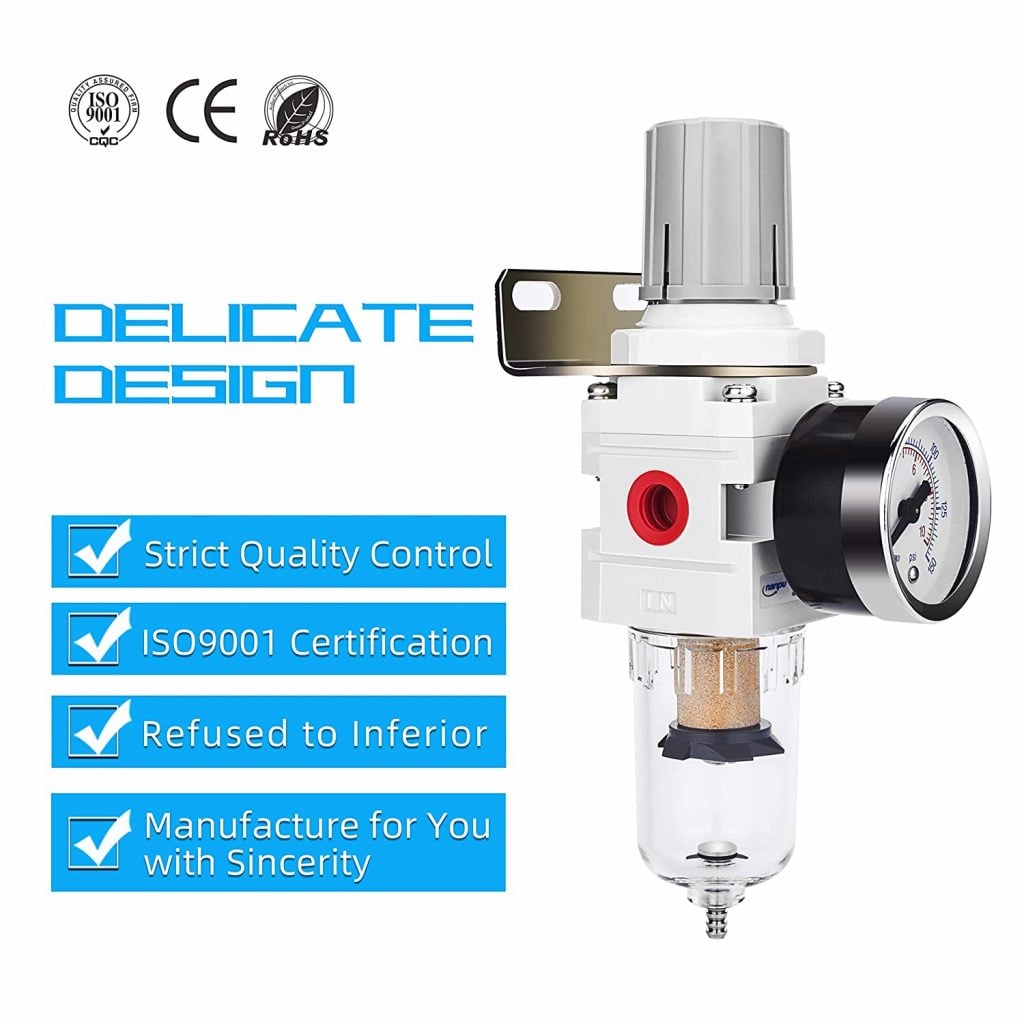
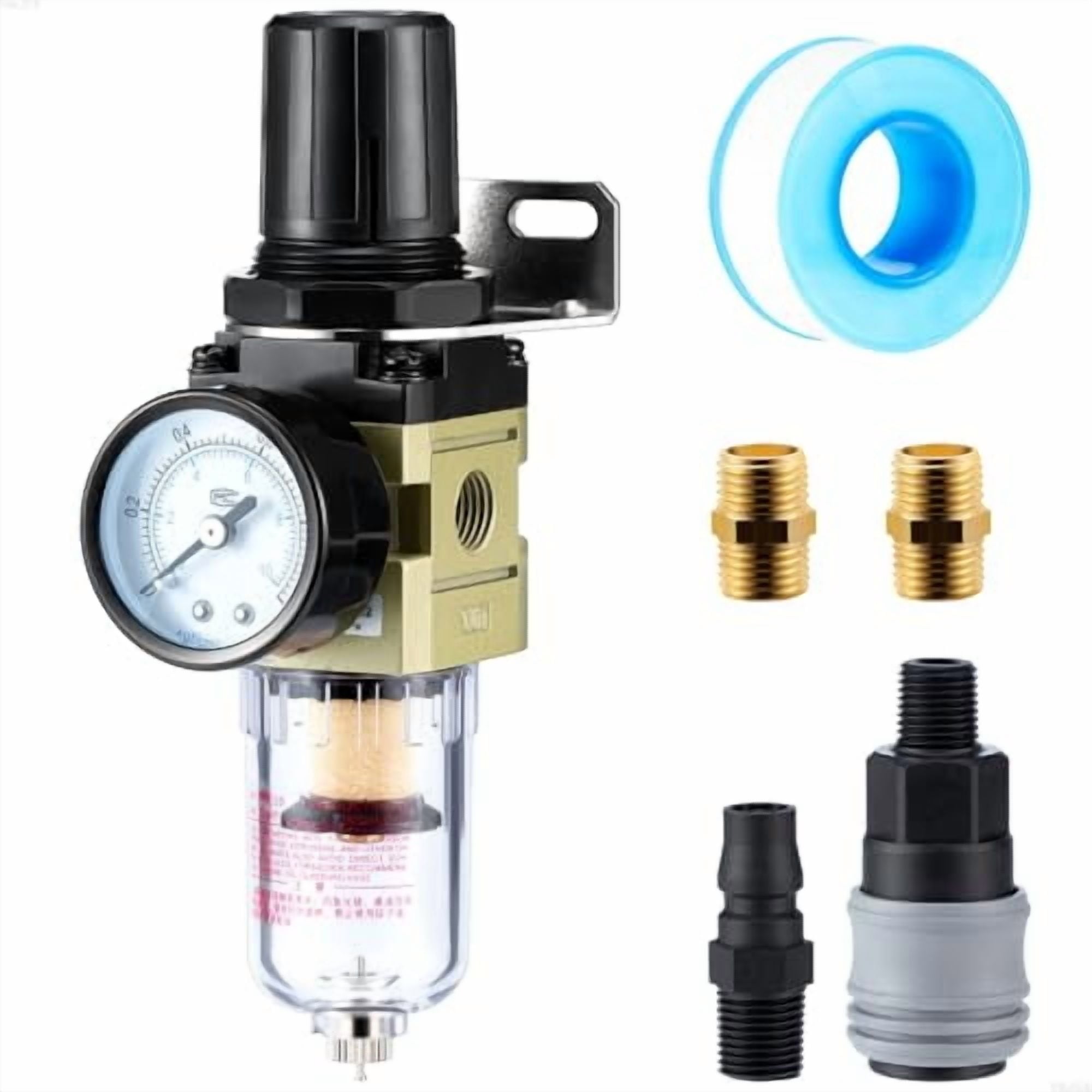
We do not have a verified affiliate link for a refrigerated or desiccant dryer, so there is no dryer on this list and we are not going to invent one. What is here is the rest of the chain, and it matters more than people expect: a coalescing filter ahead of the dryer is what keeps oil off a desiccant bed, a drain that actually drains is what stops slugs of water arriving at the inlet, and the inlet temperature your aftercooler delivers moves the sizing answer above further than any other single number on the page.
As an Amazon Associate, TestTalkHQ earns from qualifying purchases. Prices and availability can change.
Dryer sizing looks like a lookup and is actually a division. Every manufacturer rates its dryers at one fixed set of conditions, publishes multipliers for being somewhere else, and then sizes by dividing:
| Direction | Formula | What you use it for |
|---|---|---|
| Sizing | Rating needed = flow ÷ (Fpress,temp × Fambient × Fdewpoint) | You know the flow and want to know which model to order |
| Checking | Real capacity = rating × (Fpress,temp × Fambient × Fdewpoint) | You already own a dryer and want to know what it is good for |
SMC prints the division form verbatim in the Model Selection pages of its IDFA catalogue — “Corrected air flow capacity = Air flow rate ÷ (Correction factor A × B × C)” — and Kaeser and Deltech both print the multiplication and then divide in their own worked examples. There is no disagreement about the arithmetic anywhere. The disagreement is entirely about the numbers you put into it.
Here is the uncomfortable part. These correction factors are published, they are not secret, and they do not agree. Take one ordinary off-rating condition — 80 PSIG at the dryer with 110°F air arriving — and read it off three published US tables:
| Published source | Factor at 80 PSIG / 110°F | What a 1,000 SCFM dryer really handles |
|---|---|---|
| Kaeser SECOTEC | 0.68 | 680 SCFM |
| Deltech | 0.79 | 790 SCFM |
| Best-Aire RGD | 0.82 | 820 SCFM |
That is a 21 percent spread on the same question, and none of the three is wrong. A correction factor is not a property of air — it is a property of that machine. It bundles up how the evaporator behaves at reduced load, how much surface the heat exchanger has, how the condenser copes with a warm room, and how conservatively the maker wants to be quoted. A dryer with a generously sized exchanger genuinely holds its capacity better in the heat than one built to a price.
When you genuinely have no data sheet — pricing a job, or sizing before you have chosen a brand — use the most pessimistic of the published tables and treat the answer as a floor. Being one model size generous on a dryer is cheap. Finding out in August that you are 20 percent short is not.
The three conditions are not equally important, and understanding why stops you spending money in the wrong place.
Inlet temperature is the big one. Warm air holds dramatically more water vapour, and the relationship is not linear — Kaeser's rule of thumb is that “every 20°F rise in inlet air temperature may double the water load on a dryer.” Look at what that does on a published table: on the Deltech figures at 100 PSIG, going from 100°F to 120°F at the dryer inlet takes the factor from 1.00 to 0.70. You lost 30 percent of your dryer by letting the aftercooler fall behind.
Pressure works the other way, and this one catches people out. Higher pressure helps. Squeeze air harder and you wring water out of it mechanically before it ever reaches the dryer, so each standard cubic foot arriving at a high pressure carries less moisture to remove. On the Deltech table at 100°F, dropping from 100 PSIG to 50 PSIG takes the factor from 1.00 to 0.84. That is why the lowest pressure the dryer sees is the one you size on — it is the worst case, not the best.
Ambient temperature is the smallest of the three and the most misunderstood. It has nothing to do with the moisture in the air. It is about the dryer's own refrigeration circuit rejecting heat into the room. A hot compressor room hurts the condenser, which raises the evaporating temperature, which raises the dew point the dryer can hold. The published US corrections are modest — around 0.92 to 0.94 at a 110°F ambient — which tells you the makers do not consider it the dominant term either.
Dryer type is not a preference. It is set by one number: the pressure dew point you actually need. The DOE and Compressed Air Challenge system sourcebook states the boundary without qualification — “Where a pressure dew point of less than 35°F is required, a refrigerant-type dryer cannot be used.” A refrigerated dryer works by chilling air to just above freezing and draining what falls out; push it colder and the evaporator ices up and blocks. That is a physical limit, not a model range.
| Type | Pressure dew point | Purge air | All-in power |
|---|---|---|---|
| Refrigerant | 35 to 39°F | None | 0.79 kW / 100 CFM |
| Twin-tower heatless (pressure swing) | Typically −40°F | 10 to 18 percent of rating | 3 to 4 kW / 100 CFM |
| Heated blower purge | Typically −40°F | None, plus a little for cooling | 2.0 to 3.0 kW / 100 CFM |
| Heat of compression | Typically −40°F | None beyond cooling purge | About 0.8 kW / 100 CFM |
| Single-tower deliquescent | 15 to 50°F below inlet | None | About 0.2 kW / 100 CFM, plus desiccant |
All of those figures are the Sourcebook's, and they are all-in: each already contains the dryer's pressure drop, and the desiccant rows already contain the purge air. That is worth saying twice, because the easiest way to overstate a dryer's running cost by half is to take the headline kW and then add the pressure drop and the purge on top.
Look at the gap. A heatless desiccant dryer costs four to five times what a refrigerated one costs to run on the same flow, and gives away another 10 to 18 percent of its rating as purge air that never reaches a tool. That is the price of a −40°F dew point, and it is worth paying when you need it. It is a lot of money to pay by accident because somebody specified “dry air” without a number.
One figure in those sources is misquoted constantly and worth pinning down: the 15 to 20 percent purge loss belongs to membrane dryers, which the Sourcebook describes as “limited to low-capacity systems”. The desiccant figure is 10 to 18 percent. They are different numbers for different machines, they sit a paragraph apart, and swapping them inflates a desiccant purge estimate by about a fifth.
The Sourcebook's sizing instruction is one sentence and it is easy to read past: “Dryers must be sized by taking into account worst case operating inlet temperature, system pressure and ambient temperature.” All three. Simultaneously. Not the annual averages, and not the day you happened to take readings.
What that looks like in practice:
Those three worst cases arrive together, which is the point — a hot day is simultaneously a hot room, a hot aftercooler and a busy plant pulling the pressure down. The factors multiply, so a 0.90, a 0.93 and a 0.96 that each look harmless on their own come to 0.80, and a fifth of your dryer is gone.
A dryer is not free to pass air through. The Sourcebook's typical figure is 3 to 5 psid across a dryer, and more once you count the coalescing filter in front of it and the particulate filter behind it, both of which rise as their elements load up.
That matters because the pressure has to be made back somewhere, and the somewhere is the compressor. The same source gives the conversion: “for every 2 psi increase in discharge pressure, energy consumption will increase by approximately 1 percent at full output flow.” So 4 psid across your dryer and filters is roughly 2 percent on the compressor's bill, forever. On a 75 kW machine running 4,000 hours at 14 cents, that is about $840 a year to push air through a dryer.
And it gets worse if the system is not tightly regulated, because higher header pressure also inflates every unregulated end use. The Sourcebook puts that combined effect at “about 1.6 to 2 percent for every 2 psi” where 30 to 50 percent of usage is unregulated, which is most shops.
The model is the manufacturers' published capacity-correction procedure and nothing more. Three things follow from that.
How do you size a compressed air dryer? Take the maximum flow that will pass through it, then divide by the product of three published correction factors — one for your worst-case pressure and dryer inlet temperature, one for the ambient temperature around the dryer, and one for the dew point you need if the maker publishes it. The result is the rated capacity you have to buy at that maker's own reference conditions, which in the US are almost always 100 PSIG, 100°F inlet and 100°F ambient.
Why is my air dryer rated 500 CFM but only drying 350? Because 500 is the rating at the reference conditions and your room is not at them. A 500 SCFM dryer at 125 PSIG with 120°F air arriving and a 110°F ambient reads 0.74 × 0.94 on the Deltech table, which is 348 SCFM — that is Deltech's own published worked example, not an estimate. Nothing is broken; the nameplate was always conditional.
What are standard air dryer rating conditions? In the US, 100 PSIG inlet pressure, 100°F inlet air temperature, 100°F ambient temperature and a 38 to 40°F pressure dew point. The SI convention is different and not interchangeable: SMC's IDFA catalogue rates at 0.7 MPa, 35°C inlet, 25°C ambient and a 3°C dew point — a 77°F reference ambient against the American 100°F, which is why a SI-rated dryer's factors look so much harsher in the same room.
Does a higher pressure help or hurt a dryer? It helps. Higher pressure squeezes water out of the air mechanically, so each standard cubic foot arrives with less moisture to remove and the dryer's capacity goes up. Every published table shows the factor rising with pressure. That is why you size on the lowest pressure the dryer will see, not the highest.
How much does inlet temperature matter? More than anything else on the page. The rule of thumb is that every 20°F rise in inlet air temperature can double the water load. On a published table at 100 PSIG, moving from 100°F to 120°F takes the correction factor from 1.00 to 0.70 — you have thrown away 30 percent of the dryer. Fixing the aftercooler is nearly always cheaper than buying the next size up.
Can a refrigerated dryer reach a −40°F dew point? No. The DOE and Compressed Air Challenge sourcebook states that where a pressure dew point below 35°F is required, a refrigerant-type dryer cannot be used; it works by chilling air to just above freezing, and colder than that ices the evaporator. Sub-freezing dew points need a desiccant dryer, which typically delivers −40°F and can reach −100°F.
How much air does a desiccant dryer waste as purge? On a twin-tower pressure-swing (heatless) dryer, the Sourcebook gives 10 to 18 percent of the dryer's rating, depending on type. Heated blower-purge and heat-of-compression dryers use essentially none beyond a small cooling purge. The commonly quoted 15 to 20 percent figure in those same sources belongs to membrane dryers, not desiccant ones.
How much does it cost to dry compressed air? From the Sourcebook's all-in figures: about 0.79 kW per 100 CFM for a refrigerated dryer, 2.0 to 3.0 for heated blower purge, about 0.8 for heat of compression and 3 to 4 for heatless desiccant. Those already include the dryer's pressure drop and the purge air, so do not add them again. At 500 CFM, 4,000 hours and 14 cents, a refrigerated dryer is roughly $2,200 a year and a heatless desiccant roughly $9,800.
Should I add a margin on top of the correction factors? A modest one on the flow, for measurement error and growth. But margin and correction are different mistakes: margin covers the flow being wrong, the correction factors cover the conditions being wrong. Padding the flow does not excuse sizing at average conditions instead of worst case, and sizing at worst case does not excuse guessing the flow.
Where should the dryer go, before or after the receiver? After, in most systems — the Sourcebook notes the receiver will usually be located just after the dryer, but also that some systems use one receiver before the dryer and one closer to intermittent points of use. A receiver ahead of the dryer lets the air cool and drop water out first, which lowers the inlet temperature the dryer sees, and on this page that is worth real money.