
Every compressor is an accidental dehumidifier, and the water it wrings out of the atmosphere has to end up somewhere. In a system that was thought through it ends up in a drain. In a system that was not, it ends up in a paint job, a plasma consumable, an air motor or the bottom of a length of black iron that is quietly rusting from the inside. This is the order the water leaves in, what each stage is really doing, and the two numbers — pressure dew point and condensate rate — that decide whether the chain works.
Why compressed air is always wet, and why heat is a red herring
Air holds water as invisible vapour. How much it can hold depends almost entirely on temperature: the saturation pressure of water roughly doubles every 20°F. Relative humidity is just the fraction of that ceiling you are currently using, which is why a 90°F day at 50% humidity carries far more water than a 60°F day at 90%.
A compressor does not remove any of that water. It takes in the vapour and the dry air together, and it squeezes both. What changes is the ceiling. At 100 psig the absolute pressure is nearly eight times atmospheric, so the same partial pressure of vapour is now a much smaller share of the total — and the air is holding far more water than it can carry once you cool it back down. That is the whole mechanism. Compression makes the air able to hold less water per pound; cooling is what makes it let go.
Two practical consequences fall straight out of that:
- Nothing downstream can un-condense water. Once liquid exists in a pipe it stays liquid unless you heat the air back up. Filters catch it, drains remove it, dryers prevent more of it — but no device turns it back into vapour.
- The coldest metal in your system sets the standard. Air will condense wherever it is cooled below its dew point, and not before. The compressor room is almost never the coldest place.
The removal chain, stage by stage
Every properly built compressed air system removes the water in the same sequence, and each stage has a job that the next one cannot do for it.
1. The aftercooler — where most of the gallons go
An aftercooler is a heat exchanger immediately after the compression stage. Its job is to take the discharge air, which may be 250°F or more, back down to within 15 to 20°F of the cooling medium — ambient air on an air-cooled machine, water temperature on a water-cooled one. That gap is called the approach, and it is the single most important number in the whole chain.
Cooling the air at full line pressure is what condenses the bulk of the water. Run the numbers in the calculator: with a healthy 15 to 20°F approach, the aftercooler and the separator behind it remove roughly 70 to 80 percent of the water in the air. Let the approach slip to 35°F — a dirty core, a failing fan, a compressor room that has crept up to 105°F — and that share falls into the forties, with every one of those gallons handed downstream to a dryer that was never sized for them.
2. The moisture separator — where the liquid is caught
Cooling makes the water liquid; it does not get it out of the air stream. A separator does that mechanically, usually with a centrifugal swirl or a demister element, and it needs a drain that works. A good separator is quoted at something like 99% removal of liquid at its rated flow — which also means it does essentially nothing at a flow far below its rating, because there is not enough velocity to swirl. Undersizing and oversizing both hurt.
3. The air receiver — the stage nobody counts
A receiver is not sold as moisture equipment and it does a surprising amount of moisture work. Air slows down dramatically inside it, so droplets fall out; and a large steel tank in a cooler part of the building is a heat exchanger whether you meant it to be or not, so the air leaves cooler than it entered and condenses more on the way. None of that changes the dew point of the air leaving — that is set by temperature and pressure — but it moves more of the liquid to somewhere with a drain on it. Sizing the receiver for storage usually gets you this for free.
4. The dryer — where the dew point is set
Everything above is temperature and gravity. The dryer is the only stage that actually changes what the air can hold: it takes the air down to a specified pressure dew point and holds it there. Refrigerated dryers do it by chilling the air near freezing and draining what falls out; desiccant dryers do it by adsorbing the vapour onto a bed of activated alumina or molecular sieve and then regenerating that bed.
In gallons the dryer is the small stage — typically 20 to 30 percent of the total condensate. In consequence it is the entire stage, because it is the only one that decides whether the air rains again further down the pipe.
5. Filters — the last line, not the plan
Coalescing filters merge fine aerosol into droplets that drain; particulate filters catch rust and desiccant fines. They belong in a specific order: a coalescing filter before a desiccant dryer to protect the bed from oil, and a particulate filter after it to catch dust. A general-purpose filter/regulator at the drop is the last line of defence, not a substitute for any of the above. A bowl that is permanently full is telling you a stage upstream has failed.
6. Piping — where a good system gets undone
If the air leaves treatment at a 38°F pressure dew point and every pipe it touches is above 55°F, nothing more condenses and the distribution system has no moisture job to do. If a single run crosses an unheated bay in January, that run condenses regardless of how good the dryer is. Layout practice — taking off from the top of the main, dropping past the take-off into a capped drip leg, sloping toward a drain — is covered properly in the compressed air pipe sizing guide, and this article will not repeat it.
The parts of the chain we have verified links for
Point-of-use filtration, regulation and a receiver with a working drain. Refrigerated and desiccant dryers, oil/water separators and zero-loss demand drains are discussed throughout this article but are not linked, because TestTalkHQ does not carry sourced affiliate links for them yet.
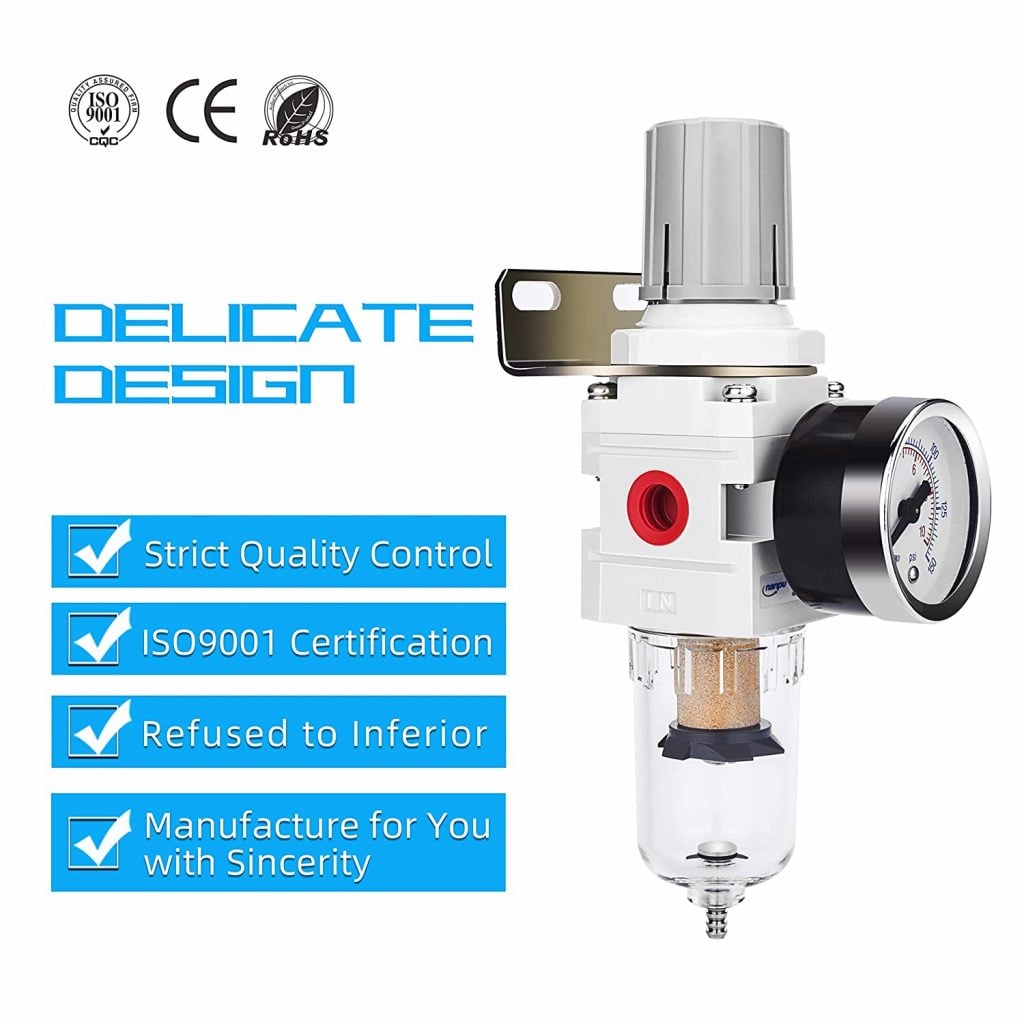
Hromee AW2000-02 Filter / Regulator
- Catches free water the upstream drains missed
- The bowl tells you how bad the problem really is
- Belongs at the drop, not back at the compressor
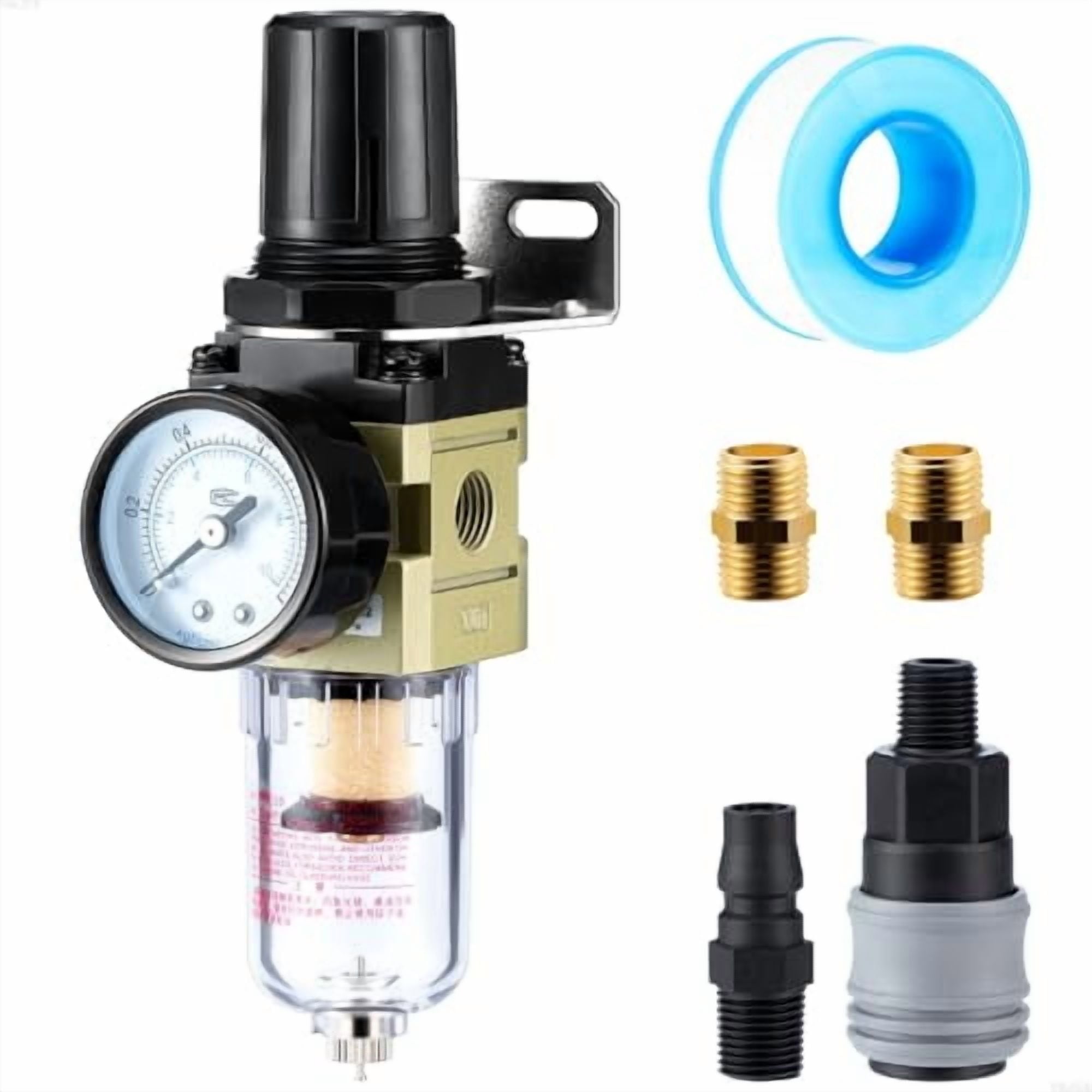
Hromee 1/4" Filter / Regulator
- One per bench beats one for the whole shop
- Every drop sees a different pipe temperature
- Cheap enough to fit everywhere water matters

LE LEMATEC Regulator 0–150 PSI
- Line pressure sets how much water the air can hold
- Holds the pressure the dew point was specified at
- Gauge reads against the local atmosphere
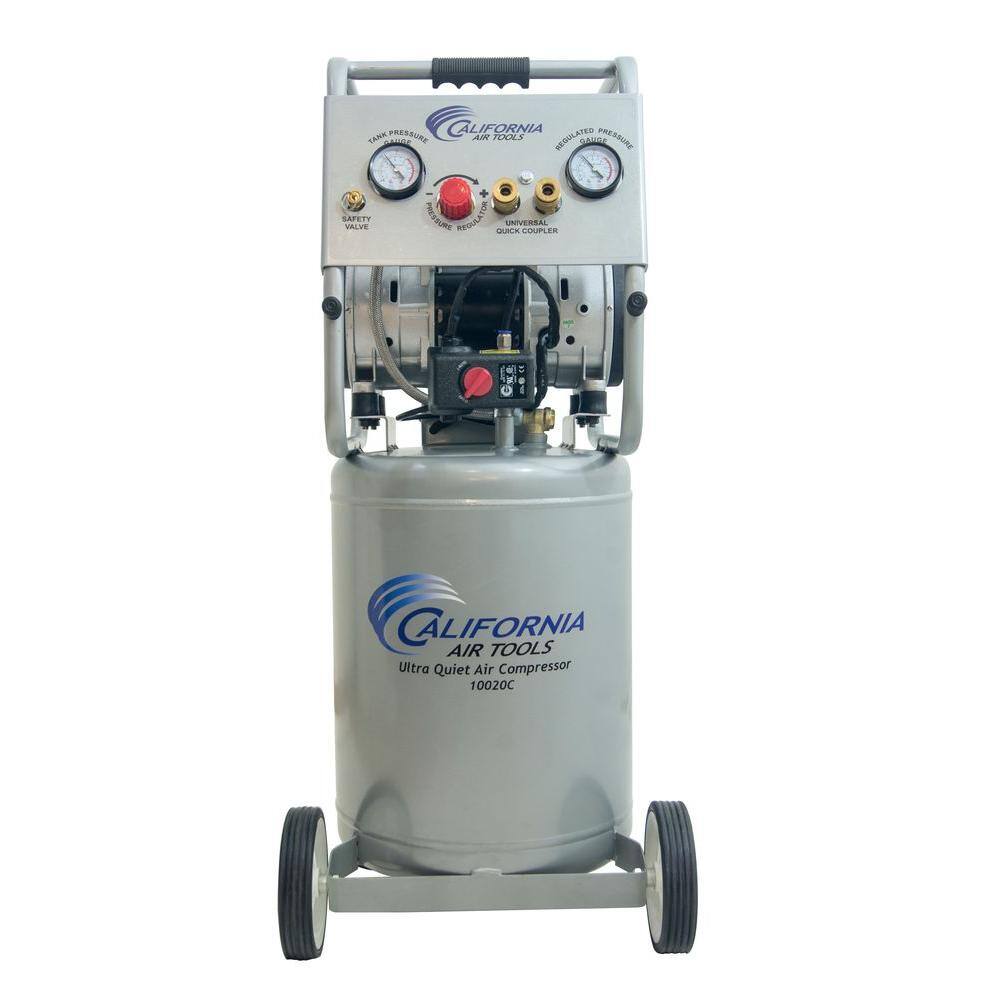
California Air Tools 10020CAD Auto Drain
- Condensate leaves without anyone remembering
- A forgotten manual drain rusts tanks from inside
- Oil-free, so the condensate is far less troublesome
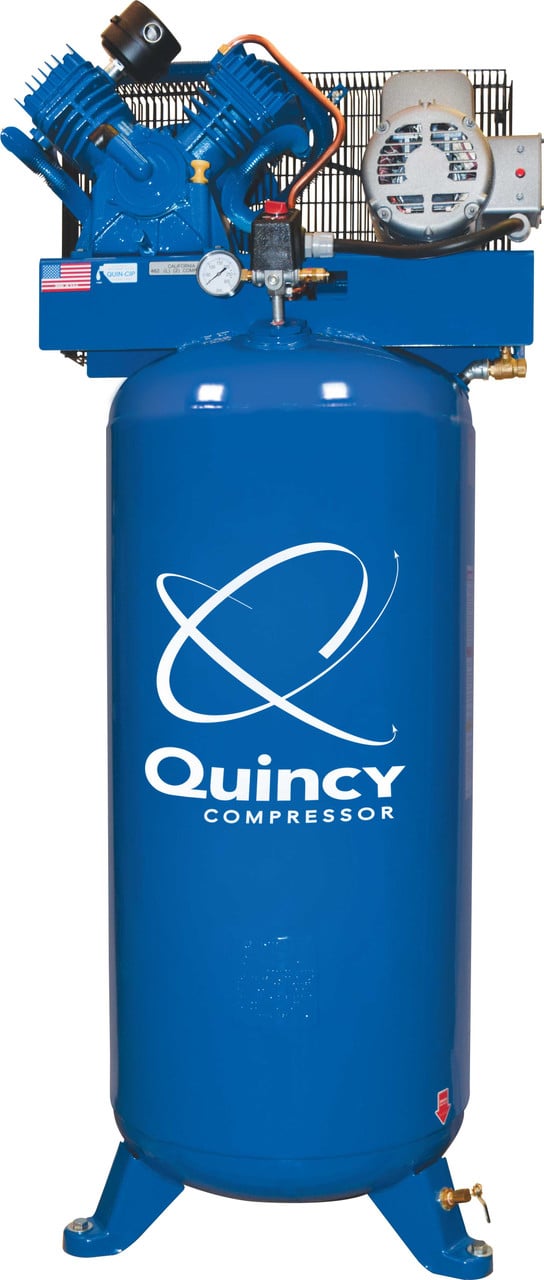
Quincy QT-54 5 HP 60-Gallon
- A big receiver is the shop’s first real separator
- Air slows, cools and drops water before the mains
- Drain it daily or it becomes a water tank
As an Amazon Associate, TestTalkHQ earns from qualifying purchases. Prices and availability can change.
Choosing a pressure dew point
This is the only specification decision in the whole exercise, and it is decided by one question: what is the coldest metal the air will ever touch? Take that temperature and subtract 15 to 20°F of margin. That is your required pressure dew point.
| Where the air goes | Coldest metal, realistically | Pressure dew point to specify | What that means in hardware |
|---|---|---|---|
| Heated shop, all pipe indoors | 55–60°F | 38°F | Standard refrigerated dryer |
| Shop with an unheated store or bay | 40°F | Below freezing | Refrigerated will not do it — desiccant, or heat-trace the run |
| Any outdoor or rooftop run | Local winter design temperature | −40°F | Desiccant dryer |
| Buried line | Ground temperature, often 45–55°F year round | Below the ground temperature with margin | Depends on the site; measure before you assume |
| Instrument air | Whatever the instruments sit in | Set by the instrument standard, commonly −40°F | Desiccant, with redundancy |
| Breathing air, food contact, medical | Not a judgement call | Governed by the applicable standard | Specified equipment plus monitoring — get specialist advice |
ISO 8573-1 puts numbers on these as humidity classes, all quoted as pressure dew points: class 4 is +3°C (about 37°F), class 3 is −20°C, class 2 is −40°C and class 1 is −70°C. When a supplier quotes you "Class 1.4.1 air" the middle digit is the humidity class, and that is the number this decision produces.
Why the dryer nameplate is optimistic
Dryers are rated at a defined set of conditions — commonly a 100°F inlet, 100 psig and a 100°F ambient under the ISO 7183 rating conditions used across the industry. Every one of those is a best case, and moving away from any of them reduces real capacity:
- Hotter inlet air. A hot inlet carries far more water into the dryer, so a unit at its rated flow but 20°F over its rated inlet is well over capacity on water. This is the single most common reason a correctly sized dryer passes water.
- Lower line pressure. The same mass of air occupies more volume at lower pressure, so it moves faster through the dryer and has less contact time. Running a dryer rated at 100 psig on an 80 psig system costs real capacity.
- Hotter ambient. A refrigerated dryer rejects heat to the room. Put it in the same hot corner as the compressor and its condenser cannot do its job.
- Higher flow. The obvious one, and the one people actually check.
Manufacturers publish correction factors for each of these. Multiply them together, apply them to the nameplate, and specify against the result — not against the headline number. The correction factors are specific to the model, so use the data sheet for the unit you are buying rather than a generic table.
Sizing drains by rate, not by day
The gallons-per-day figure is what gets quoted and it is not what a drain has to survive. Take the gallons per hour from the condensate calculator and think about what the drain is actually asked to do.
A timed solenoid drain set to open for five seconds every ten minutes is open for thirty seconds in an hour. In those thirty seconds it must pass an entire hour’s condensate through its orifice, against full line pressure, along with whatever rust and oily sludge came with it. Set the timer short and it backs up; set it long and it blows expensive compressed air down the drain for the rest of the cycle. That is the fundamental problem with timed drains, and it is why the two failure modes are so often seen in the same shop.
| Drain type | How it decides to open | Air loss | Where it fits |
|---|---|---|---|
| Manual ball valve | Somebody remembers | Whatever the operator lets out | Small shop receiver, as a backup on anything larger |
| Timed solenoid | A clock, regardless of how much water there is | Real and continuous — it opens on empty too | Budget option; needs seasonal re-timing |
| Float / mechanical | Liquid level | Near zero when working | Common on separators; fouls on oily condensate |
| Zero-loss demand (electronic level) | Capacitive or level sensor, opens only when full | Effectively none | Anything beyond a small shop machine; the usual right answer |
Whichever you fit, put one at every point where water can collect: aftercooler, separator, receiver, dryer, every filter bowl, and the bottom of every drip leg. A chain is only as good as the drain that failed.
Commissioning: seven checks that prove the chain works
- Measure the aftercooler approach. Air temperature leaving the aftercooler minus the cooling air temperature entering it. Anything much over 20°F on an air-cooled machine means a dirty core, a weak fan or a starved compressor room, and it will overload everything downstream.
- Watch every drain cycle once. Stand there. A drain that has never been observed is a drain that is assumed to work.
- Read the dryer’s own dew point, not its nameplate. Most refrigerated dryers have an evaporator temperature gauge with a green band; desiccant units usually have a dew point transmitter. Read it at full flow on a hot afternoon, not at 8am with nothing running.
- Find the coldest metal. Walk the whole distribution system with an infrared thermometer on the coldest morning you can arrange. Compare the coldest reading to the dew point you specified. This is the check nobody does and it is the one that catches the problem.
- Check the filter order. Coalescing before a desiccant dryer, particulate after it. A dryer fed unfiltered oil aerosol has a short life.
- Check the dryer bypass. Many installations have one, and many of them are cracked open because somebody chased a pressure drop last year and never closed it.
- Repeat in August. A system commissioned in March has proved nothing. Inlet water load can more than double between a mild spring day and the worst week of summer — run both cases through the calculator before you accept the system.