
The dew point is fine, the dryer is in rating, and it is still quietly taking a few thousand dollars a year

Most dryer troubleshooting starts with wet air. This page is about the other failure, the one with no symptom: the dryer works, the dew point is where it should be, nobody has complained, and it is costing several thousand dollars a year more than it should. Nothing alarms, nothing trips, and it can run like that for a decade.
Start here: this is the other half
If your air is wet, this is the wrong page. Icing evaporators, blocked condensers, failed internal drains, open bypasses, flooded desiccant beds and switching valves that will not switch are all in dryer not holding dew point, and the whole water-removal chain either side of the dryer is in getting the water out of compressed air.
What follows assumes the dew point is acceptable and asks a different question: is this dryer costing what it should?
The symptom, when there is one at all
There is usually only one, and it is indirect: somebody has turned the compressor up. The header set point used to be 100 PSIG and it is now 110, and nobody remembers deciding that. Each individual increase was a reasonable response to a tool that seemed slow, and the cumulative result is a system running ten pounds harder than it was designed to.
That is the tell, because the usual reason a system creeps up is pressure being lost somewhere downstream of the compressor, and the dryer and its filters are one of the two places that reliably happens. The sourcebook’s conversion from that creep to money is direct: “for every 2 psi increase in discharge pressure, energy consumption will increase by approximately 1 percent at full output flow.”
4 psid across the dryer and filters = 4 ÷ 2 = 2 percent
75 × 0.02 = 1.5 kW × 4,000 h × $0.14 = $840 a year
And that is the healthy case. The sourcebook’s typical dryer pressure drop is 3 to 5 psid. A dryer whose differential has crept to 10 psid because nobody changed a filter is costing $2,100 a year to deliver exactly the same air. If much of your usage is unregulated, which it is in most shops, the same source puts the combined effect at “about 1.6 to 2 percent for every 2 psi”, because higher header pressure also inflates every unregulated end use.
Measuring it: two gauges and five minutes
You cannot diagnose any of this without a differential. One gauge tells you nothing; you need the pressure before the pre-filter and after the after-filter, read at the same time, under real flow.
| Where to read | Healthy | What a high reading means |
|---|---|---|
| Across the dryer alone | 3 to 5 psid | Internal restriction, or flow well above rating |
| Across the coalescing pre-filter | Starts around 1 to 2 psid when new | Element loaded — a consumable, not a fault |
| Across the particulate after-filter | Low when new | On a desiccant dryer, loading fast means desiccant fines are migrating |
| Whole treatment skid, end to end | Under about 6 psid | Above 10 and the system has almost certainly been turned up to compensate |
Read it at peak flow, not on a quiet morning. Pressure drop rises steeply with flow, so a skid that reads 3 psid at breakfast can be at 8 by mid-afternoon, and the afternoon figure is the one the compressor is set for.
Fault 1 — the filter elements that were never changed
By a wide margin the most common one, and the cheapest to fix. Coalescing elements load up continuously; their pressure drop rises continuously; nothing in the system reports it. Unless somebody is watching a differential gauge, the first indication is a tool running slowly two years later.
The sourcebook’s maintenance rule is specific: elements should be replaced “as indicated by pressure differential, and at least annually, to minimize pressure drop and energy consumption.” Annually is the backstop, not the schedule. On a dirty intake or a compressor carrying oil, six months is more realistic.
Two things go wrong around this even when people do change them. Fitting a finer element than the application needs adds pressure drop permanently for no benefit — the three filter types do different jobs and a coalescing filter is not a particulate filter. And fitting an undersized housing because it was what was on the shelf guarantees a high differential from day one; the sourcebook’s guidance is that filters “should be sized for the maximum anticipated rate of flow at the anticipated minimum operating pressure”, which is the same worst-case rule the dryer itself is sized on.
Fault 2 — the dryer is at or past its real capacity
A dryer running right at the edge of what it can do in your room generally still holds dew point — and runs its pressure drop up, because pressure drop climbs with flow.
The check is the capacity correction, not the nameplate. Multiply the rated capacity by the pressure, ambient and dew point factors from its own data sheet at your worst-case conditions, and compare with the flow actually going through it. A dryer sold as 500 CFM that corrects to 348 CFM in a hot room on a 125 PSIG, 120°F duty — which is Deltech’s own published example — is being asked for 44 percent more than it has. It may well still make dew point on a cool morning. It will have a high differential all the time.
Run the correction on the dryer sizing calculator, and if you want the procedure explained rather than executed, the sizing guide walks it.
Any trade
Contractor Job Estimator
Price remodels and GC work, then send a quote with no internal numbers.
Excel or Google Sheets. Best on a computer.
$29.00
BuyCheckout opens in a new tab.
The parts of the chain we have verified links for
There is no dryer on this list, because we do not have a verified affiliate link for a refrigerated or desiccant dryer and we are not going to invent one. What is here is everything either side of it — and on a sizing question the upstream half genuinely matters more, because the temperature of the air arriving at the dryer moves the answer further than any other number.
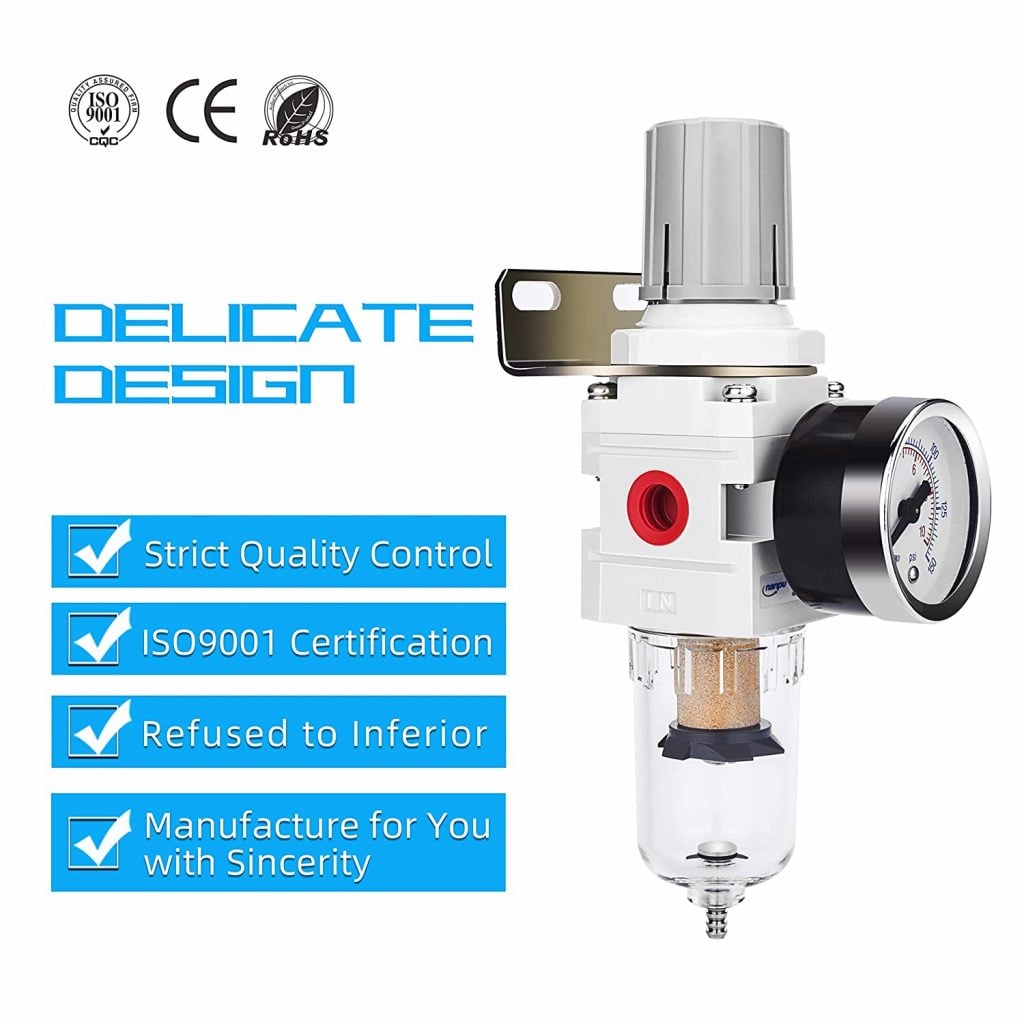
Hromee AW2000‑02 Filter / Regulator
- A coalescing filter before a desiccant bed is a Sourcebook recommendation, not an option
- Filter pressure drop is part of the PSID the compressor has to make back
- Change elements on differential pressure, and at least once a year
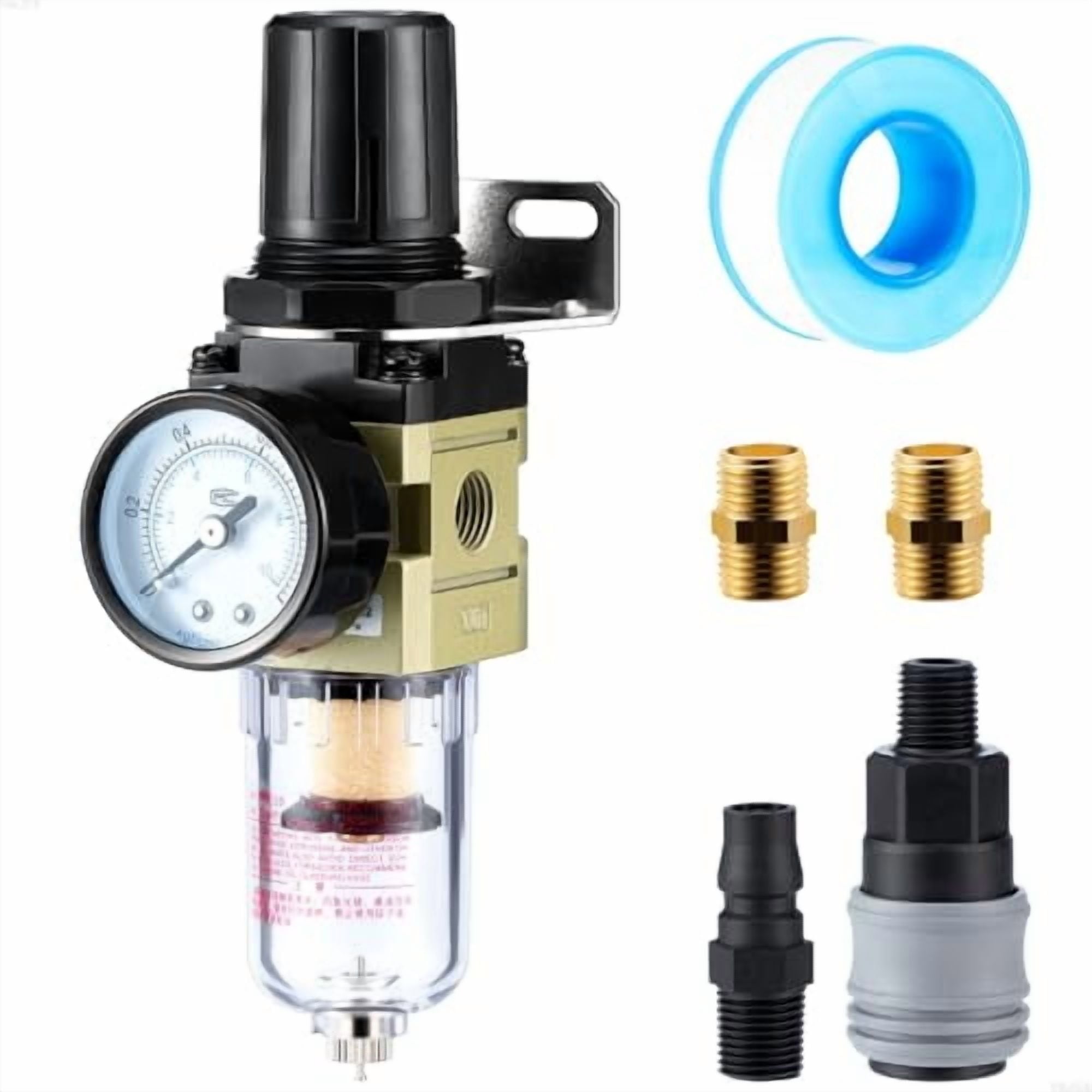
Hromee 1/4" Filter / Regulator
- Treating one dry drop beats drying the whole plant to that standard
- The Sourcebook’s own advice is to group equipment by the air quality it needs
- A one micron after-filter keeps desiccant fines out of the line

LE LEMATEC Regulator & Gauge 0‑150 PSI
- The lowest pressure the dryer sees is the one you size on
- Deltech’s table drops to 0.84 at 50 PSIG against 1.00 at 100
- Creeping the header up to cover a dryer costs 1 percent per 2 PSI, forever
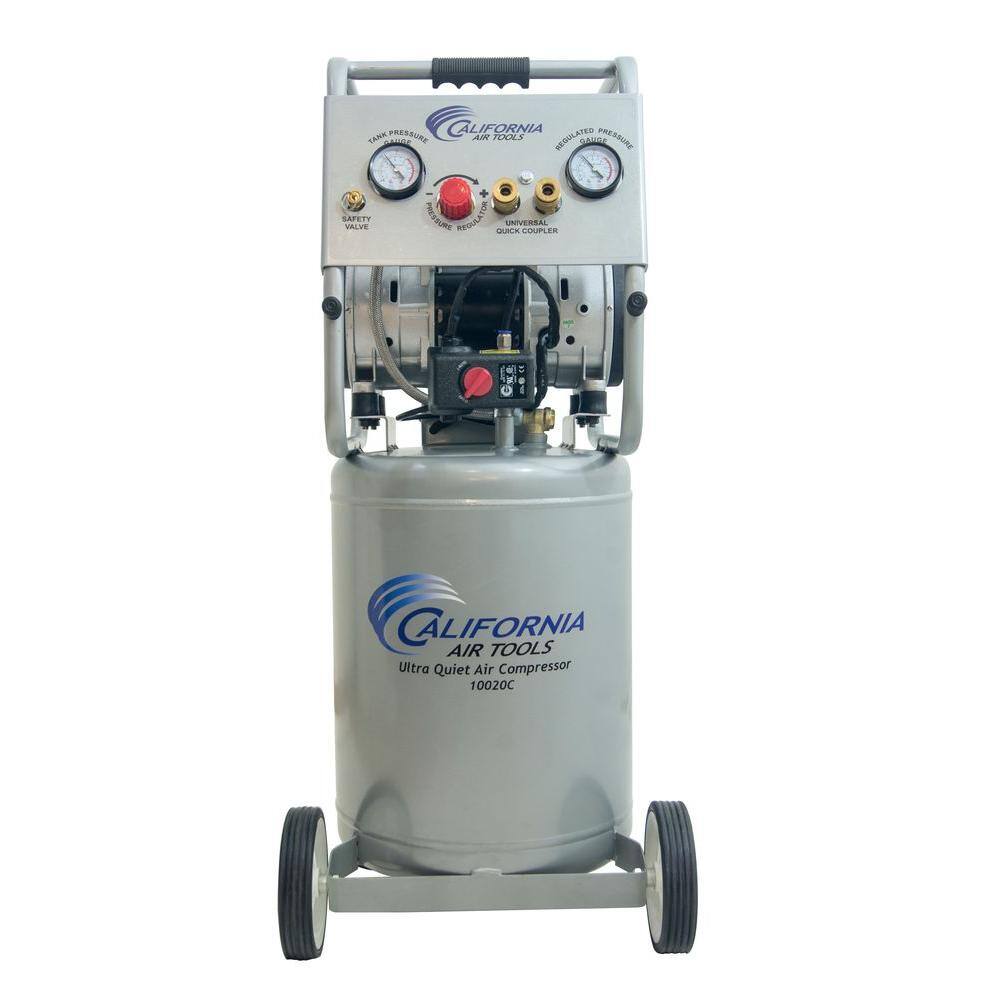
California Air Tools 10020CAD Auto Drain
- No dryer copes with liquid water arriving at the inlet in slugs
- An automatic drain is the upstream part that works while nobody watches
- Condensate volume belongs to the condensate calculator
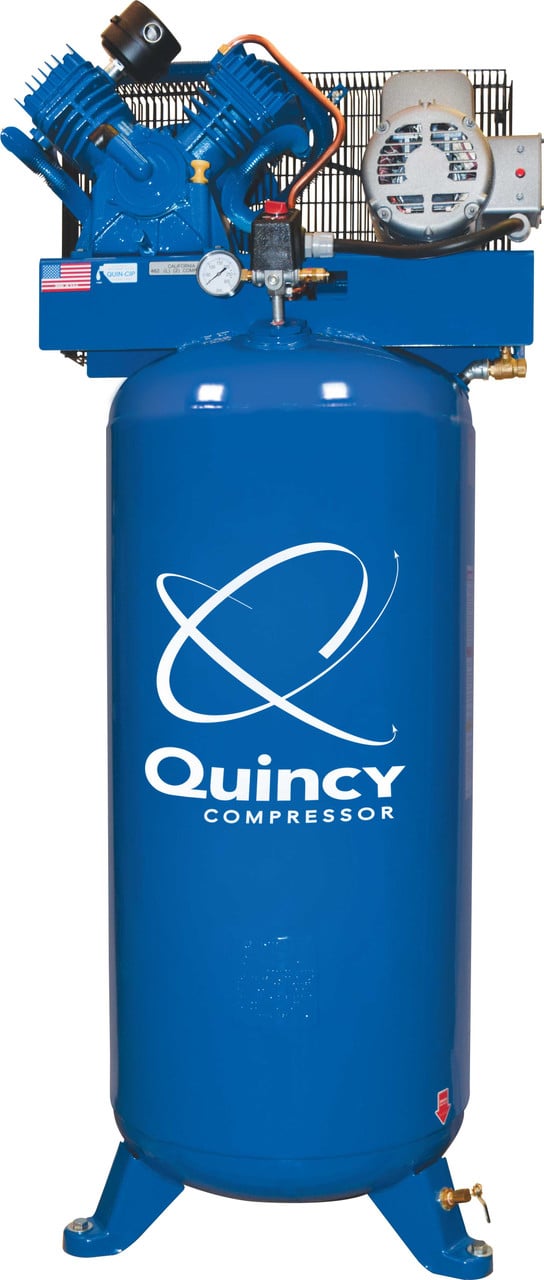
Quincy QT‑54 5 HP 60 Gallon Two‑Stage
- The aftercooler sets the dryer inlet temperature, the strongest input of all
- 20°F hotter inlet can double the water load the dryer must handle
- A receiver before the dryer cools the air and drops water out first
As an Amazon Associate, TestTalkHQ earns from qualifying purchases. Prices and availability can change.
Fault 3 — purge air, on a desiccant dryer
Purge is a cost that exists by design, and the design figure is large. For a twin-tower pressure-swing (heatless) dryer the sourcebook gives a purge requirement of “10 to 18 percent of the dryer’s rating, depending on the type of dryer.” On a 600 SCFM dryer that is 60 to 108 SCFM the compressor makes and then throws away, every hour it is running. At a typical 20 kW per 100 CFM of specific power, the top of that range is about 21 kW of pure loss.
Three ways it goes wrong beyond the design figure:
- A purge valve that does not reseat. It sounds like continuous purging rather than a cycle, and the compressor runs loaded when the plant is idle. A desiccant dryer should be audibly cycling, not audibly blowing. This is the one worth walking out and listening to.
- Timers set for the worst case and left there. A fixed-cycle dryer purges on the clock regardless of how wet the incoming air is, so a dryer sized and timed for August is still purging for August in February.
- Dew point control fitted but never commissioned. Demand-based controls skip regeneration cycles when the bed is not loaded, and on a plant with variable demand that is a large saving. It is also a feature that routinely gets switched to timer mode during a service call and never switched back.
Fault 4 — the dryer runs when the plant does not
A refrigerated dryer left energised over a weekend on a shut-down system is drawing power to dry nothing. A heatless desiccant dryer left pressurised and cycling is worse — it is purging air a compressor has to make.
This is almost never a fault in the engineering sense. It is a sequencing gap: the compressor gets shut down or put on a schedule, and the dryer, being a separate box with a separate switch, does not. Check it by walking the plant when nothing is running and listening, which takes two minutes and sometimes finds thousands of dollars.
The counterweight is real, though: a dryer brought up cold from a dead stop takes time to reach dew point, and a desiccant bed that has sat wet needs a full regeneration. Sequencing the dryer to start ahead of the compressor matters more than switching it off saves.
Fault 5 — overdrying, which has no symptom whatsoever
The most expensive fault on this page, and the only one that will never generate a complaint, because its result is air that is better than it needs to be.
The numbers are stark. From the sourcebook’s all-in figures, on the same flow:
| Dryer type | All-in kW / 100 CFM | 500 CFM, 4,000 h, $0.14 |
|---|---|---|
| Refrigerated | 0.79 | about $2,200 a year |
| Heat of compression | about 0.8 | about $2,200 a year |
| Heated blower purge | 2.0 to 3.0 | about $5,600 to $8,400 |
| Heatless desiccant | 3 to 4 | about $8,400 to $11,200 |
A plant running a heatless desiccant dryer on a duty that only ever needed 38°F is paying roughly four times what it needs to, forever, and everything works perfectly. Nobody will ever report it.
The audit is one question: what is the coldest temperature any part of this air system ever reaches? If the answer is “it is all indoors and heated”, you need a refrigerated dryer’s dew point and anything beyond it is money. If there is an outside run, a loading bay or an unheated store, you do not, and the desiccant dryer is doing a job. The case either way is worked through in refrigerated vs desiccant.
A short order of work
- Read the differential across the whole treatment skid at peak flow. Over about 6 psid, keep going.
- Change the filter elements if they are not on a schedule, and read the differential again. This is cheap and it is usually most of the problem.
- Run the capacity correction on the dryer’s own data sheet at worst-case conditions. If the flow is near or past the corrected capacity, no amount of maintenance fixes the pressure drop.
- Listen to a desiccant dryer through a full cycle with the plant idle. Continuous blowing is a valve. Cycling on a timer when the air is dry is a control setting.
- Ask what dew point the plant actually needs, from the coldest line, not from the spec sheet. This is the one with the largest number attached to it.
- Then, and only then, look at the header set point. If the system was turned up to cover a pressure drop you have now removed, turn it back down — that is where the saving is actually banked.