The five-step selection procedure the manufacturers publish, and the three places people get it wrong

Dryer selection is five steps and one division. It is not difficult. It goes wrong anyway, consistently, in three specific places: people size on the compressor’s flow instead of the dryer’s, they use today’s conditions instead of the worst case, and they mix a correction factor from one brochure with a rated capacity from another. Here is the whole procedure, with each of those three traps marked as you reach it.
Why the nameplate is a conditional statement
A dryer’s rated capacity is not a capability. It is a measurement, taken at one fixed set of conditions, and the manufacturer publishes it alongside the multipliers that tell you what happens everywhere else. In the United States those conditions are nearly always the same three numbers: 100 PSIG inlet pressure, 100°F inlet air temperature and a 100°F ambient, with a pressure dew point of 38 to 40°F. Kaeser states it for its SECOTEC range; Deltech states the same point with a 38°F dew point attached.
Your compressor room is not at those conditions and never will be. Which means the first honest thing to say about any dryer you are looking at is that you do not yet know what it does. The published correction factors are how you find out, and the DOE and Compressed Air Challenge system sourcebook does not treat using them as optional: “Dryers must be sized by taking into account worst case operating inlet temperature, system pressure and ambient temperature.”
Step 1 — the flow that actually passes through the dryer
Not the compressor’s nameplate. Not the sum of every tool in the building. The maximum flow that will physically go through this dryer, which is a different number if part of the plant runs on untreated air or if a second compressor feeds a different header.
DOE Tip Sheet #12 is direct about which flow figure: dryers “should be sized for the maximum anticipated rate of flow.” Maximum, not average. A dryer sized on an annual average is underwater every busy afternoon, and “the air goes wet when the shop gets busy” is one of the most common complaints there is.
Three things worth checking before you commit to a number:
- Is it SCFM or ACFM? Correction factor tables are written in standard cubic feet per minute. A capacity quoted at inlet conditions is a different quantity, and at altitude the gap is large. If you are not sure which one you have, that distinction is worked through on the altitude derate calculator.
- Does it include leakage? Leaks are flow, they run every hour the system is pressurised, and they pass through the dryer like anything else. Put a figure on them with the leak calculator rather than guessing.
- Is the plant growing? A dryer typically outlives two compressors. A modest margin on the flow — ten percent is common — is cheap insurance, and it is not the same thing as the condition correction that comes later. Margin covers the flow being wrong. The factors cover the conditions being wrong. Neither excuses the other.
Step 2 — all three worst cases, at the same time
This is trap number two, and it is the expensive one. The sourcebook asks for worst case on three conditions, and the three of them arrive together: a hot day is simultaneously a hot compressor room, a hot aftercooler outlet and a busy plant dragging the header pressure down. The factors multiply, so three individually harmless penalties compound.
| Condition | Which extreme is the bad one | Where to actually get it |
|---|---|---|
| Dryer inlet air temperature | The highest | Surface thermometer on the pipe at the dryer inlet, on a hot afternoon, compressor fully loaded. Not the commissioning sheet. |
| Inlet pressure | The lowest | Gauge at the dryer at peak demand. On a load/unload machine that is the unload setting, which is usually 10 PSI below the load setting. |
| Ambient temperature | The highest | In the compressor room, in August, at the dryer — not outside air, and not the thermostat in the office. |
Worth knowing which way round each one cuts, because one of them surprises people. Hot inlet air is bad, which everybody expects. A hot room is bad, which everybody expects. But low pressure is the bad case for pressure, not high — compressing air harder squeezes water out of it mechanically, so each standard cubic foot arriving at a high pressure has less moisture in it to remove. Every published table shows the correction factor rising with pressure. Size on the lowest the dryer will see.
Step 3 — the dew point you need, and the line you cannot cross
Pressure dew point is the temperature, measured at line pressure, at which water starts coming back out of the air. The requirement is set by one thing: the coldest temperature any part of the air line ever reaches. Not the plant floor — the unheated bay, the roof run, the trailer dock. If the dew point is above that temperature, water drops out there, and no amount of dryer fixes it.
That number then settles the dryer type, because there is a hard physical line in the middle of the range. The sourcebook states it without qualification: “Where a pressure dew point of less than 35°F is required, a refrigerant-type dryer cannot be used.” A refrigerated dryer chills air to just above freezing and drains what falls out; take it colder and the evaporator ices up and blocks.
| Dew point you need | What you are buying | All-in energy |
|---|---|---|
| Above 35°F — indoor, heated plant | Refrigerated | 0.79 kW / 100 CFM |
| Below 35°F — outdoor runs, unheated space, instrument air | Desiccant, typically rated −40°F | 0.8 to 4 kW / 100 CFM depending on how it regenerates |
Do not reflexively ask for the driest number on the list. The sourcebook’s instruction is that air “should be dried only where necessary and only to the pressure dew point required”, and Tip Sheet #12 puts it in three words: “Overdrying wastes energy.” A heatless desiccant dryer costs four to five times what a refrigerated one costs to run on the same flow, and gives away another 10 to 18 percent of its rating as purge air that never reaches a tool. That is worth paying when you need −40°F. It is a lot to pay because somebody wrote “dry air” on a spec without a number.
Which side of the line you are on, and the cases where it is genuinely not obvious, is the subject of refrigerated vs desiccant. The dew point your coldest line actually demands comes out of the condensate calculator.
Any trade
Contractor Job Estimator
Price remodels and GC work, then send a quote with no internal numbers.
Excel or Google Sheets. Best on a computer.
$29.00
BuyCheckout opens in a new tab.
The parts of the chain we have verified links for
There is no dryer on this list, because we do not have a verified affiliate link for a refrigerated or desiccant dryer and we are not going to invent one. What is here is everything either side of it — and on a sizing question the upstream half genuinely matters more, because the temperature of the air arriving at the dryer moves the answer further than any other number.
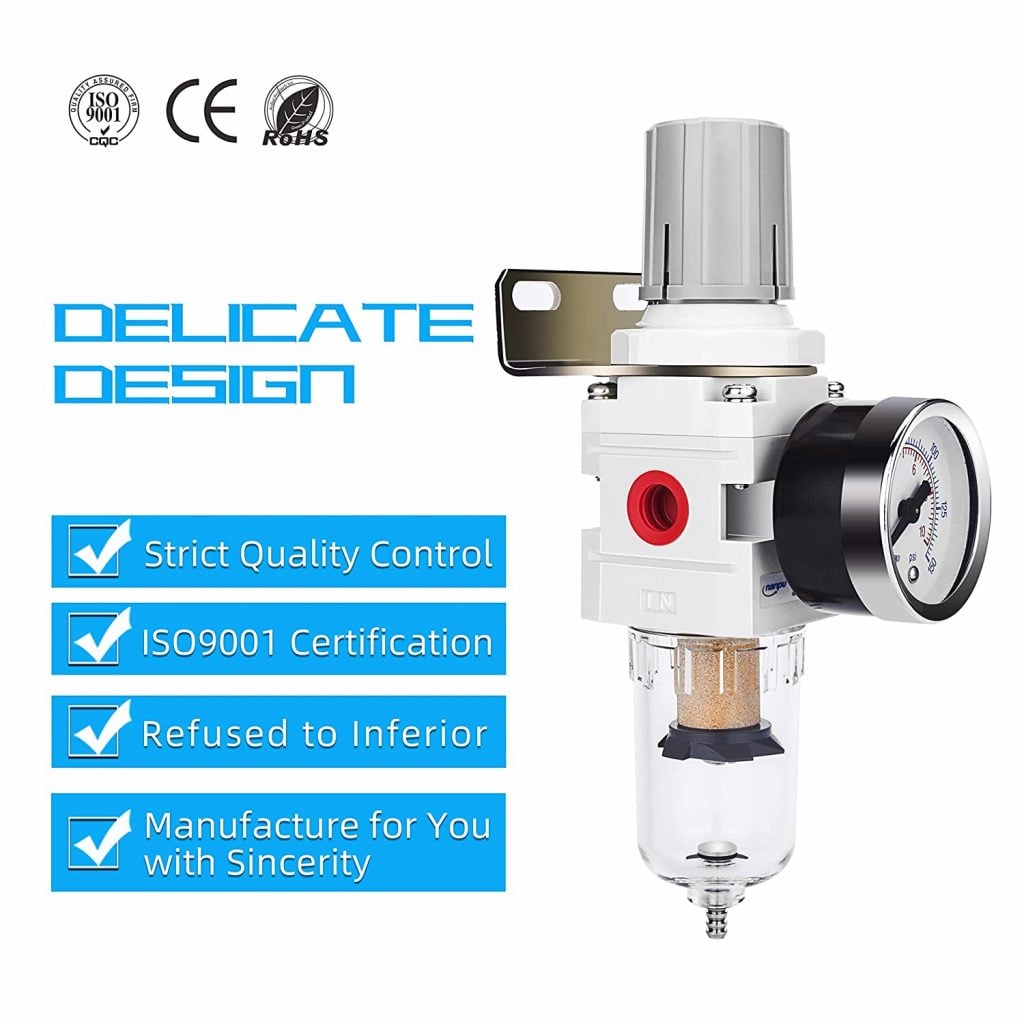
Hromee AW2000‑02 Filter / Regulator
- A coalescing filter before a desiccant bed is a Sourcebook recommendation, not an option
- Filter pressure drop is part of the PSID the compressor has to make back
- Change elements on differential pressure, and at least once a year
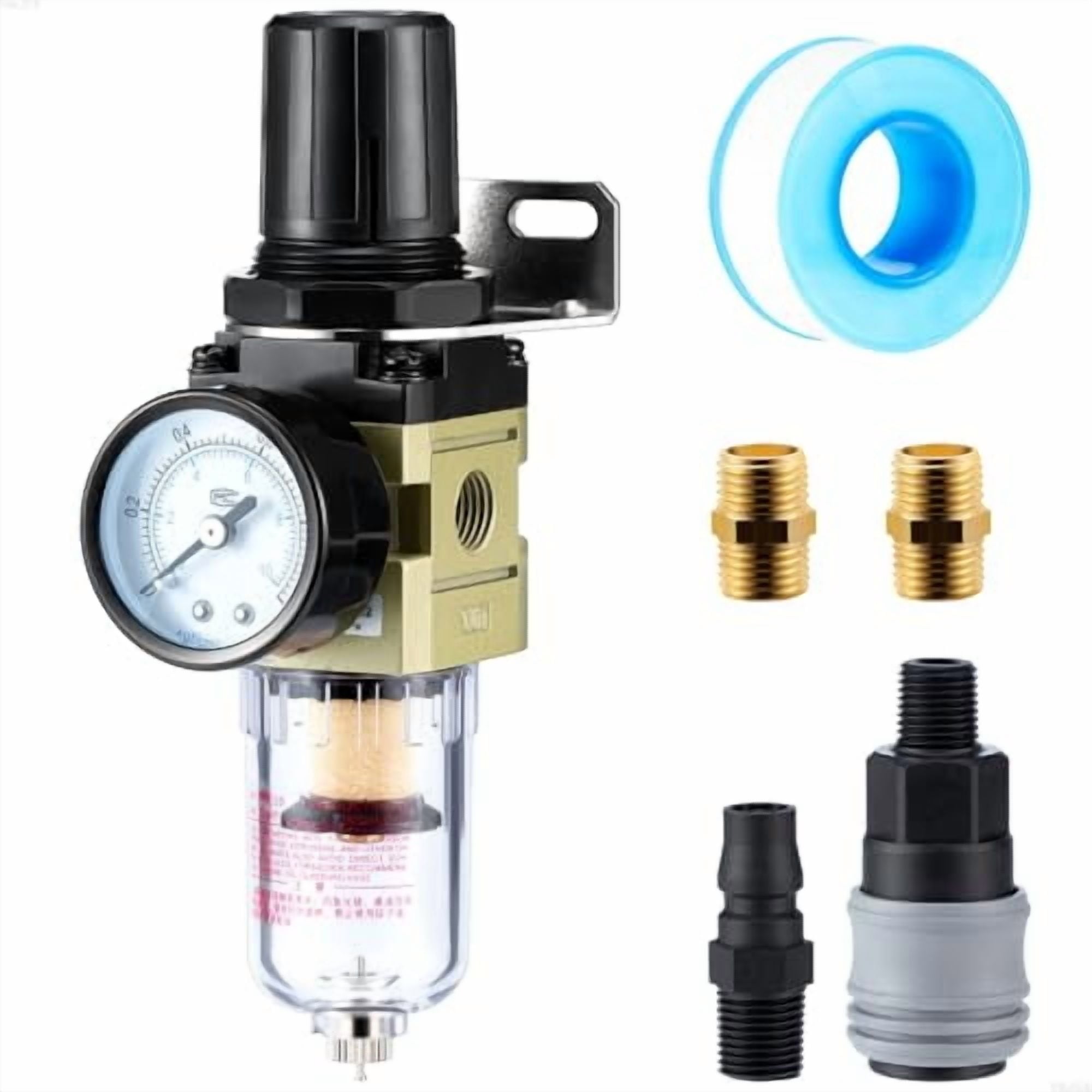
Hromee 1/4" Filter / Regulator
- Treating one dry drop beats drying the whole plant to that standard
- The Sourcebook’s own advice is to group equipment by the air quality it needs
- A one micron after-filter keeps desiccant fines out of the line

LE LEMATEC Regulator & Gauge 0‑150 PSI
- The lowest pressure the dryer sees is the one you size on
- Deltech’s table drops to 0.84 at 50 PSIG against 1.00 at 100
- Creeping the header up to cover a dryer costs 1 percent per 2 PSI, forever
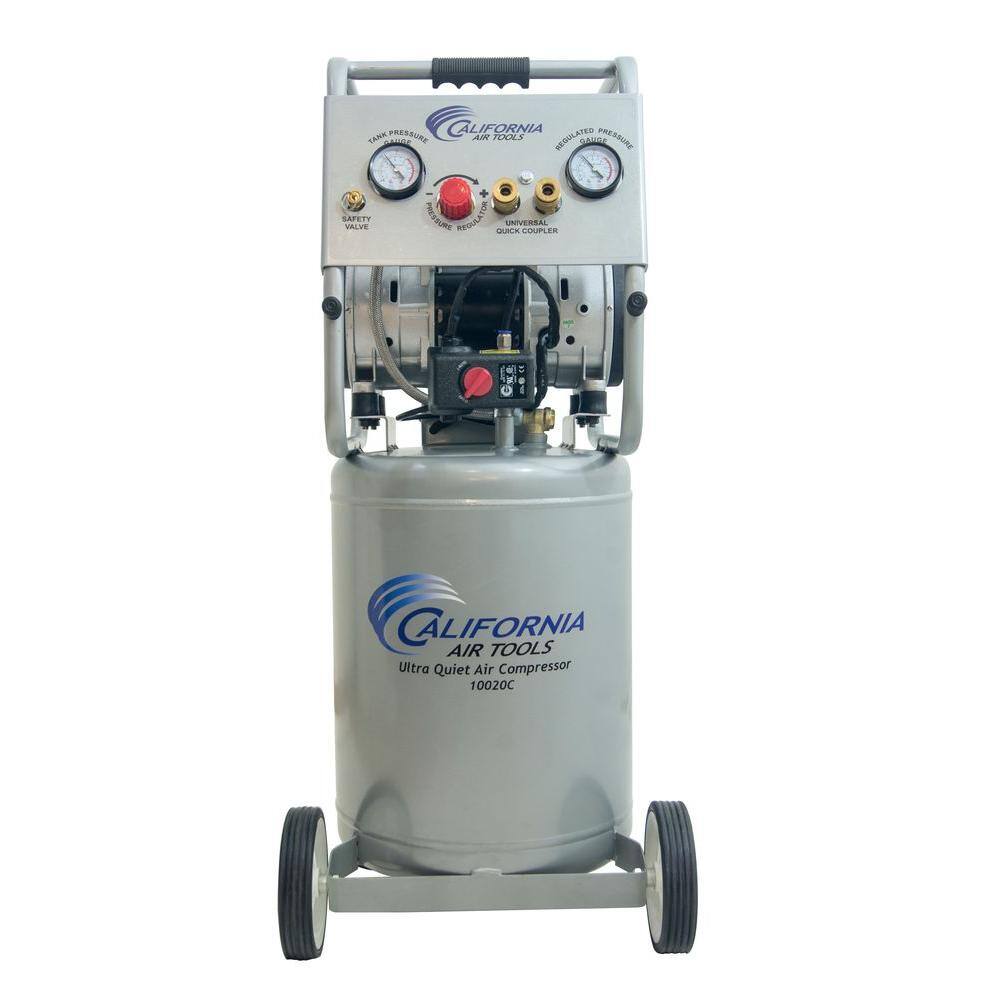
California Air Tools 10020CAD Auto Drain
- No dryer copes with liquid water arriving at the inlet in slugs
- An automatic drain is the upstream part that works while nobody watches
- Condensate volume belongs to the condensate calculator
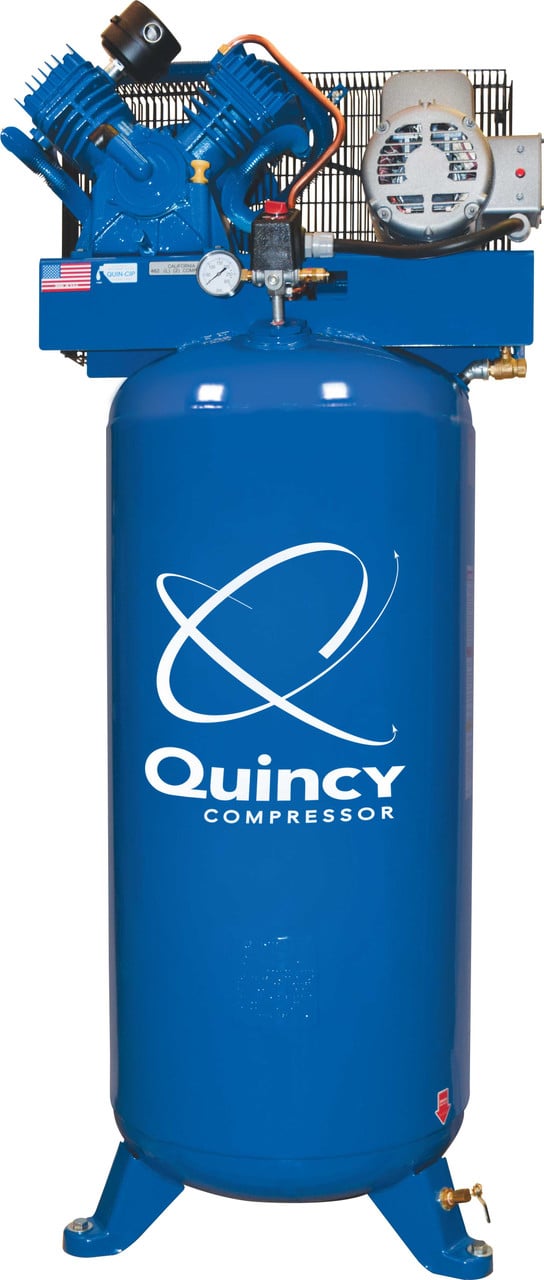
Quincy QT‑54 5 HP 60 Gallon Two‑Stage
- The aftercooler sets the dryer inlet temperature, the strongest input of all
- 20°F hotter inlet can double the water load the dryer must handle
- A receiver before the dryer cools the air and drops water out first
As an Amazon Associate, TestTalkHQ earns from qualifying purchases. Prices and availability can change.
Step 4 — read three factors, multiply, divide
Now the arithmetic, which is the easy part. SMC prints the formula verbatim in its IDFA catalogue:
Kaeser and Deltech print the multiplication and divide in their worked examples. Nobody disagrees about the arithmetic. The three factors are:
- Pressure and inlet temperature. Usually a single joint grid with pressure down the side and inlet temperature across the top, because the two interact. Kaeser’s runs 60 to 230 PSIG against 90 to 130°F; Deltech’s runs 50 to 200 PSIG against 80 to 120°F.
- Ambient temperature. A separate one-row table. This one is about the dryer’s own condenser rejecting heat into the room, not about moisture. The published US corrections are modest — roughly 0.92 to 0.94 at a 110°F ambient — which tells you the makers do not consider it the dominant term either.
- Dew point. A credit for not needing the tightest dew point. Many data sheets do not publish one; Deltech does, at 38°F = 1.0, 40°F = 1.1, 45°F = 1.2 and 50°F = 1.3. Where it is absent, leave it at 1.00 rather than inventing one.
Here is Deltech’s own published example, start to finish. 500 CFM to dry, 125 PSIG at the dryer, 120°F inlet air, a 110°F ambient, 38°F dew point required:
Ambient factor at 110°F = 0.94
Dew point factor at 38°F = 1.0
Combined = 0.74 × 0.94 × 1.0 = 0.6956
Sizing instead: 500 ÷ 0.6956 = 719 SCFM of rating required.
The next model up is 750 SCFM, which in this room delivers 750 × 0.6956 = 521 SCFM. That is the right dryer.
Note what just happened. A dryer sold as “500 CFM” was 30 percent short of a 500 CFM duty, and the correct selection was one and a half times the nameplate you would have reached for. None of that is a safety factor or a rule of thumb — it is the manufacturer’s own published procedure on its own published numbers.
Step 5 — and the trap that makes all of it worthless
Trap number three. The correction factor and the rated capacity have to come from the same data sheet.
Correction factors are not a property of air. They are a property of a particular machine — how its evaporator behaves at reduced load, how much heat exchanger surface it has, how well its condenser copes with a warm room, how conservatively its maker chooses to be quoted. Take one ordinary off-rating condition, 80 PSIG with 110°F air arriving, and read it off three published US tables:
| Published table | Factor at 80 PSIG / 110°F | What a 1,000 SCFM rating really gives |
|---|---|---|
| Kaeser SECOTEC | 0.68 | 680 SCFM |
| Deltech | 0.79 | 790 SCFM |
| Best-Aire RGD | 0.82 | 820 SCFM |
A 21 percent spread on the same question, and none of the three is wrong. A dryer with a generously sized exchanger genuinely holds its capacity better in the heat than one built to a price. Reading 0.82 off one brochure and applying it to another brand’s 1,000 SCFM rating is not a conservative estimate — it is an arithmetic error that happens to produce a plausible-looking number.
When there is no data sheet at all
Pricing a job, or sizing before a brand has been chosen, is a real situation and “get the data sheet” is not an answer. Two things work:
Use the most pessimistic published table and treat the result as a floor. If the three US tables read 0.68, 0.79 and 0.82 at your conditions, size on 0.68. Being one model generous on a dryer costs a few hundred dollars once. Being 20 percent short costs you every summer.
Then write the conditions into the enquiry, not the capacity. Instead of asking for a 500 CFM dryer, ask for a dryer that will deliver a 38°F pressure dew point at 500 SCFM, 100 PSIG, 110°F inlet and a 100°F ambient. That moves the correction onto the supplier, who has the real tables, and it gives you something to hold them to afterwards. It also surfaces the honest suppliers immediately, because the ones who ask what your ambient is are the ones doing the calculation.
Checking a dryer you already own
Same three factors, run the other way. Multiply the nameplate by the combined factor and compare it with the flow actually going through it. This is the calculation that explains the most common dryer complaint there is — one that worked for years and then did not.
Nothing failed. The plant got busier, so the flow went up and the header pressure came down. The compressor room got hotter, or the aftercooler got dirtier, so the inlet temperature went up. Each change is small; they multiply. A dryer that was at 0.95 of its rating on a 480 CFM duty is at 0.75 of it on a 560 CFM duty, and the second one does not work.
If the capacity check says the dryer is comfortably inside its rating and the air is still wet, then it is a mechanical fault rather than a sizing one, and the diagnosis path is dryer not holding dew point. If the dew point is fine but the energy bill is not, that is pressure drop and purge troubleshooting.
Is oversizing free?
Nearly, but not quite, and the exception is worth knowing.
A refrigerated dryer running far below its rating is not operating at its best point. The sourcebook notes that some refrigerant dryers “have the ability to efficiently cycle on and off at lower than rated flows, which may save energy” and that cylinder-head-unloading dryers “offer improved part-load performance over conventional refrigerated dryers” — both of which are statements that a conventional one does not do well at part load. It also says plainly that where average loading is below the dryer rating, units with good part-load control through efficient control can save energy.
Desiccant dryers are worse at it. Heatless dryers on a fixed timer purge the same amount of air regardless of how much moisture is actually arriving, so an oversized one on a light load wastes purge continuously. That is what dew point control exists to fix, and on a large desiccant dryer it pays for itself quickly.
What to put on the purchase order
Five lines, and they are not the ones most enquiries carry:
- Flow, in SCFM, stated as the maximum, with whatever margin you have chosen already included and labelled as such.
- Required pressure dew point, as a number, with the coldest line temperature it was derived from written next to it.
- All three worst-case conditions: lowest inlet pressure, highest dryer inlet temperature, highest ambient.
- Maximum allowable pressure drop across the dryer and its filters, because the typical figure is 3 to 5 psid and you are paying for every one of them forever.
- Part-load control, explicitly — cycling or dew point control, if the duty varies at all.
A quotation that comes back with a corrected capacity and the factors used is from somebody who did the sum. One that comes back with a model number and a nameplate CFM is not.