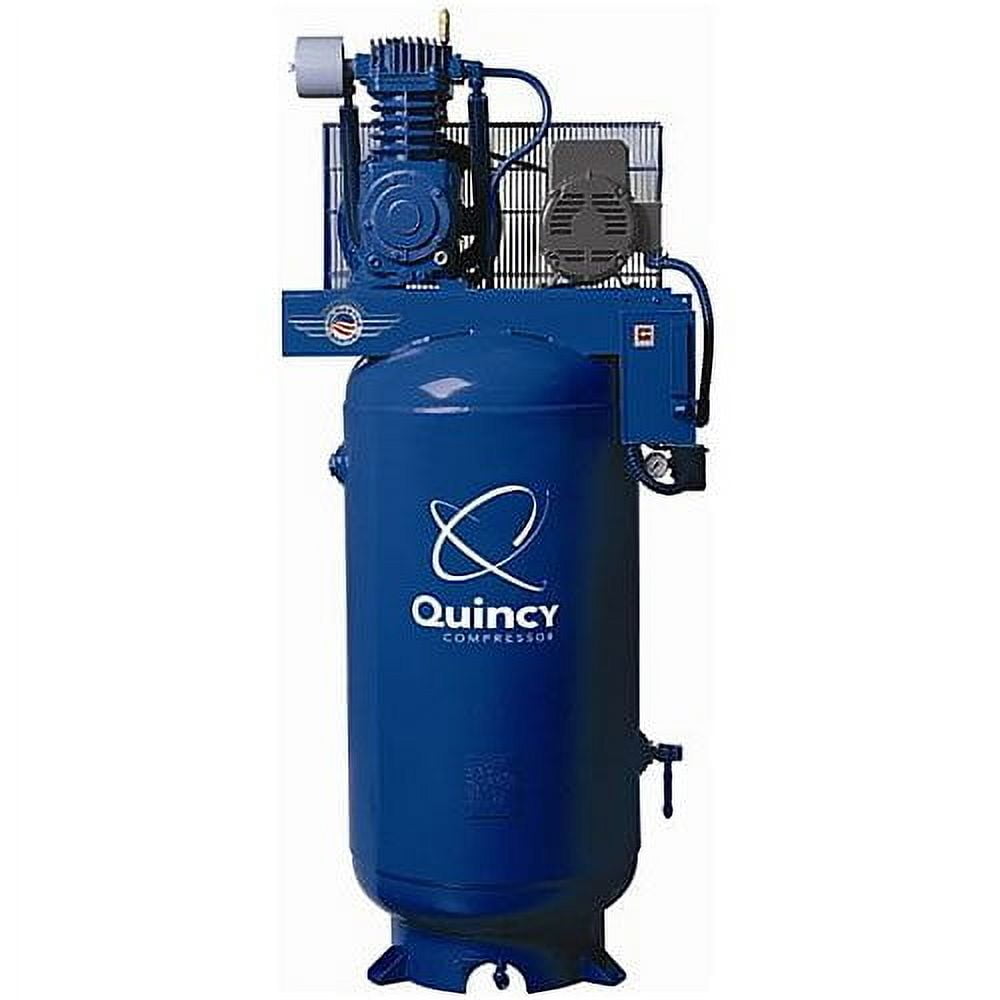
Quincy QT-7.5 7.5 HP 80-Gallon
- The usual answer at elevation is simply a size up
- Large receiver covers peaks the thinner air cannot
- Two-stage, so the higher pressure ratio is shared
What your compressor really delivers once you take it up the mountain
A compressor nameplate is a sea-level promise. Move the same machine to a shop in Denver, Flagstaff or Laramie and the pump still swallows the same number of cubic feet per stroke — but each of those cubic feet now holds noticeably less air. Nothing is broken, and no gauge on the machine will tell you. Enter your elevation, inlet temperature and humidity to get the barometric pressure at your site, the SCFM the compressor can actually deliver there, how much capacity you lost, what it does to the compression ratio, and the sea-level rating you would have to buy to get the air you need.

There is no altitude kit for a compressor. The answers are capacity you specified knowing the derate, a drive that copes with thin air, and instruments honest enough to show you the shortfall.

As an Amazon Associate, TestTalkHQ earns from qualifying purchases. Prices and availability can change.
There is no manufacturer lookup table behind this tool and no rule of thumb. Altitude derate is one of the few compressed air numbers that falls straight out of the gas laws, so the whole calculation is four steps you can repeat on a phone calculator.
Air pressure falls with height in a way that is standardised and well behaved. The tool uses the US Standard Atmosphere relation, published in ASHRAE Fundamentals Chapter 1 as Equation 3:
At sea level that returns 14.696 psia. At 5,280 ft it returns 12.10 psia; at 10,000 ft, 10.11 psia. Those match the standard atmosphere tables to within the rounding they are printed at.
Only the dry air fraction carries the mass a compressor is rated on. Water vapour occupies part of the inlet pressure and does no useful work, so by Dalton's law of partial pressures it comes off the top. Saturation pressure is from the Buck equation, which matches steam tables to about a tenth of a percent across shop temperatures:
At 68°F the saturation pressure is only 0.339 psia, so humidity is a rounding error. At 100°F it is 0.950 psia, and a humid afternoon is suddenly eating six percent of a Denver inlet. This is why the summer complaint at altitude is always worse than the winter one.
A piston or rotary screw compressor is a positive-displacement machine. It sweeps the same volume per revolution no matter where you put it, so the volume it draws barely changes with elevation — what changes is how much air is inside that volume. Applying the ideal gas law to the dry air fraction gives the ratio directly:
This is the same relation as the standard ACFM conversion, turned around. The widely published form is ACFM = SCFM × (Pstd / (Pact − ΦPsat)) × (Tact / Tstd), and running it on the textbook example — 100 SCFM at 5,000 ft, 80°F, 80% RH — returns 129.1 ACFM, which is exactly what this engine produces.
The second altitude effect is the one nobody warns you about. Your gauge reads pressure above the local atmosphere, so holding the same 90 psig at altitude means squeezing the air through a bigger ratio:
At sea level, 90 psig is a ratio of 7.12 : 1. In Denver the same 90 psig is 8.44 : 1, an 18 percent harder squeeze. That costs more work per pound of air delivered, pushes the discharge temperature up, and does it in air that is itself less able to carry heat away from the cooling fins. A machine that ran warm at sea level runs hot at altitude, and that is a normal consequence of physics rather than a fault.
Three reference conditions are in common use and they are not interchangeable. The tool lets you pick because a data sheet comparison done across two different bases is simply wrong:
| Basis | Pressure | Temperature | Humidity | Where you meet it |
|---|---|---|---|---|
| ISO 1217 / CAGI / PNEUROP | 14.504 psia (1 bar) | 68°F (20°C) | 0% RH | Industrial compressor data sheets |
| ASME standard air | 14.696 psia | 68°F | 36% RH | Older US literature, fan and blower work |
| US gas-industry SCFM | 14.696 psia | 60°F | 0% RH | Gas flow, instrumentation, some tool specs |
The first two land remarkably close together — taking 36 percent humidity off 14.696 psia at 68°F leaves 14.574 psia of dry air, within half a percent of the ISO figure. The gas-industry basis is the odd one out, because its colder 60°F reference makes the same machine read about 1.5 percent smaller. That is small, but it is the same order as the differences people argue about between two brands.
Close to three percent per thousand feet through the range most shops live in, but that shortcut hides the temperature and humidity terms which are often just as large. At 5,280 ft on a 90°F day with moderate humidity the true loss is about 22 percent, not the 16 percent the rule of thumb suggests, because hot thin air is thinner still. Use the rule for a sanity check and the calculation for a purchase.
SCFM. ACFM is an actual volume measured at the inlet, and a positive-displacement pump sweeps the same volume wherever it is. SCFM is a mass expressed as a volume at reference conditions, so it falls with the air density. That is exactly why a machine quoted in ACFM looks unaffected by altitude and one quoted in SCFM looks crippled — the machine is the same, the units are not.
The pressure will be the same, the flow will not. A gauge reading 90 psig at 8,000 ft means the same force behind an impact hammer as 90 psig at sea level, so short bursts feel normal. The difference shows up on sustained work: the tank empties faster than the compressor can refill it, so the pressure sags sooner and recovers slower. Grinders and sanders, which draw continuously, suffer first.
If your demand is unchanged, yes — divide the air you need by the derate factor to get the sea-level rating you must buy. There is no adjustment, kit or setting that recovers the capacity, because nothing is wrong with the machine. The only levers are more displacement, more speed, or reducing demand.
Two reasons at once. Holding the same gauge pressure against a lower atmosphere is a higher compression ratio, which puts more heat into the air; and the thinner cooling air over the fins and intercooler carries less of that heat away. Longer run times to refill the tank compound both. Check that the discharge temperature is still inside the manufacturer's limit before assuming it is acceptable.
It depends almost entirely on temperature. At 60°F, saturated air still only gives up about 1.7 percent of the inlet pressure to water vapour. At 100°F that figure is over six percent at sea level and worse at altitude, where the same vapour pressure is a larger share of a smaller total. Cold climates can ignore it; hot ones cannot.