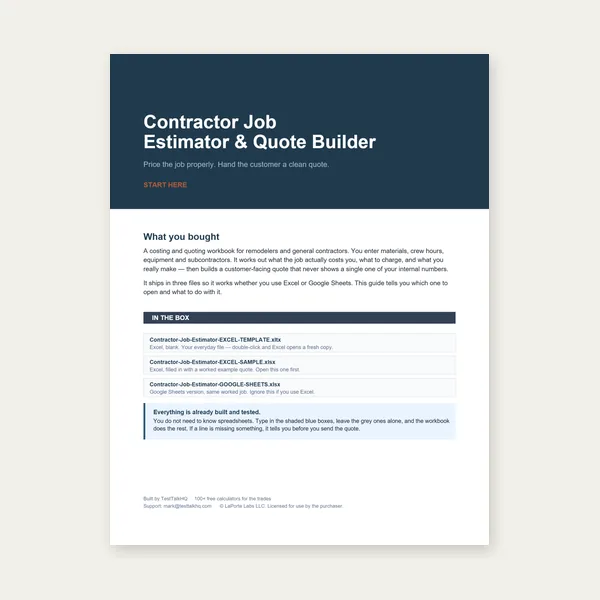
Contractor Job Estimator
Price remodels and GC work, then send a quote with no internal numbers.
Excel or Google Sheets. Best on a computer.
$29.00
BuyFour published formulas, one motor-start limit, and the number your pressure switch is actually producing
Price remodels and GC work, then send a quote with no internal numbers.
Excel or Google Sheets. Best on a computer.
$29.00
BuyCheckout opens in a new tab.
CAGI's three fixes are storage, pressure band and alternation. Two of those are hardware you can buy; the third is a switch setting you should verify with a gauge before you trust it. Everything else on a short-cycling compressor is leak hunting, which is cheaper than all of them.
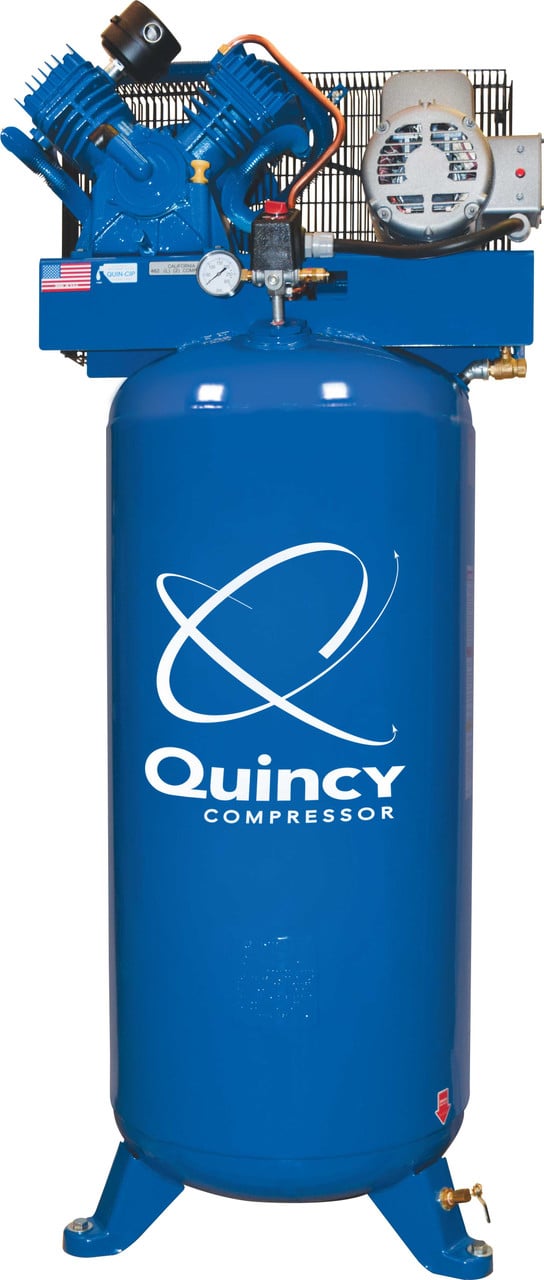
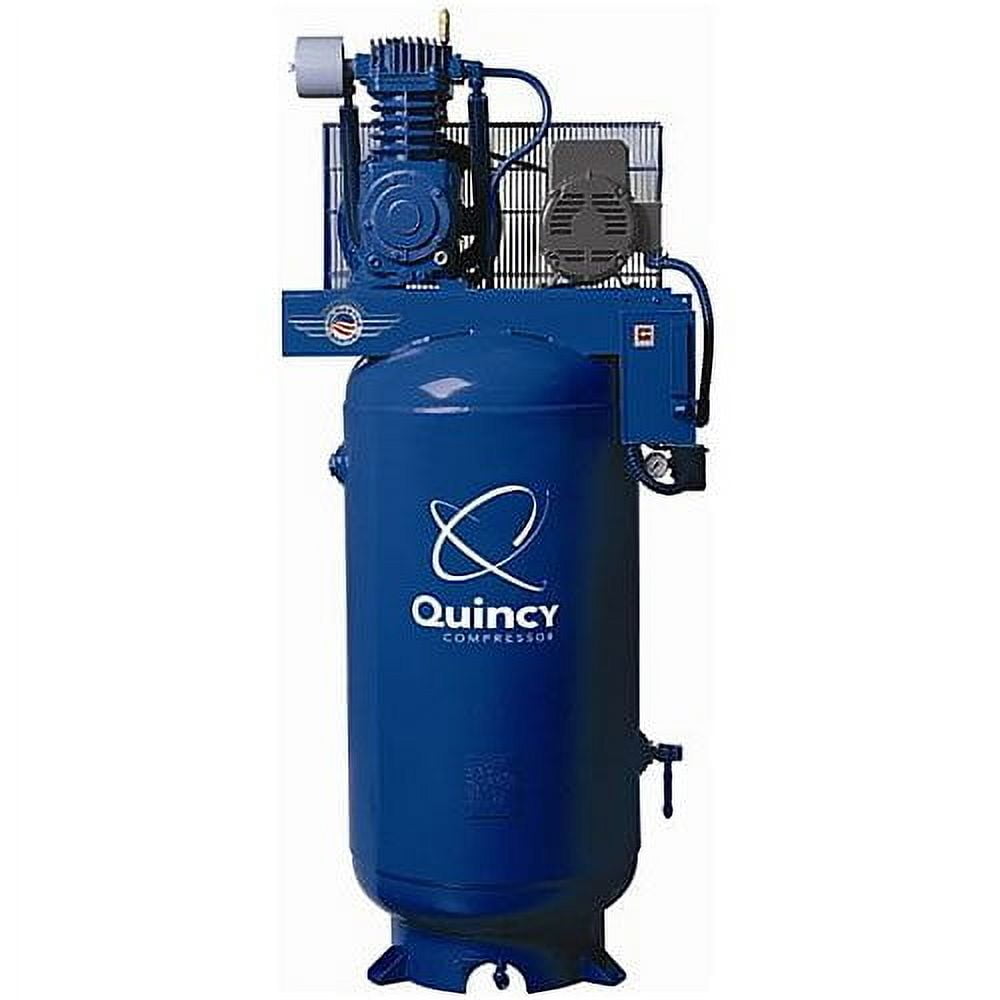

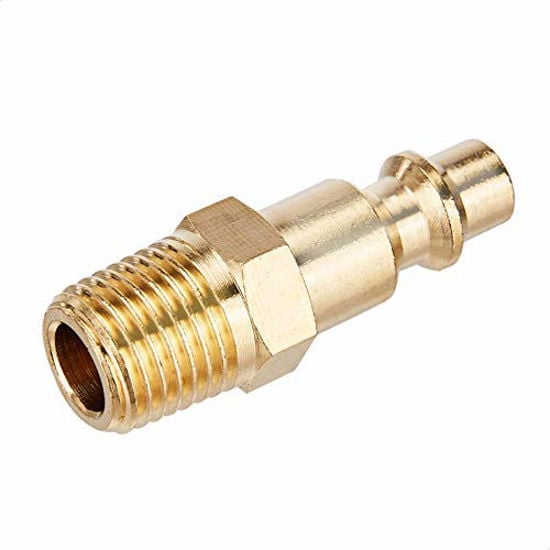
As an Amazon Associate, TestTalkHQ earns from qualifying purchases. Prices and availability can change.
Everything on this page comes out of one short technical paper — Using Air Storage to Balance Capacity in a Reciprocating Compressor Installation, published by the Compressed Air & Gas Institute in March 2024. It is worth seeing the chain written out, because each step is trivial and the useful part is only visible once they are stacked.
| Step | Formula as published | What it is |
|---|---|---|
| Volume | Gallons ÷ 7.48 = Cubic Feet | Tank nameplate into the units the rest of the chain uses |
| Storage | Added Storage = CF × ΔP ÷ 14.7 | Free air held between cut-in and cut-out. CF is tank plus air pipe; 14.7 is atmospheric pressure at sea level |
| Drawdown | Drawdown = Added Storage ÷ Demand | How long the motor gets to stay off |
| Pump up | Pump Up = Added Storage ÷ (Capacity − Demand) | How long the motor has to run. Demand keeps drawing while it pumps, which is why it is capacity minus demand |
Add the last two and you have the cycle time. Divide sixty by it and you have starts per hour. That is the whole model, and CAGI's paper works it twice: a 35 CFM compressor against 10 CFM of demand with 18 cubic feet of storage and a 150/125 switch gives 3.06 minutes of drawdown, 1.22 minutes of pump-up, a 4.28 minute cycle and 14.02 starts per hour.
Starts per hour matters because of what happens electrically and thermally in the first second of each start, not because of anything that happens while the compressor runs. CAGI puts it plainly: “due to the brief starting load placed on an electric motor, it is commonly recommended that the motor start no more than seven times per hour.”
The same Institute's buyer's guide frames the identical number as a control decision rather than a pass/fail line. Its rule of thumb: “if the compressor starts more than six to eight times per hour, you should operate constant speed control or choose a larger compressor. If the compressor starts less than six times per hour, start/stop control should be sufficient.” So six to eight starts an hour is not a cliff — it is the band where the right answer stops being start/stop.
| Starts per hour, per motor | What CAGI points to | Why |
|---|---|---|
| Under 6 | Start/stop control is sufficient | Enough off-time between starts for the motor and pump to cool |
| 6 to 8 | Borderline — constant speed or dual control | This is the band CAGI names; 7 is the figure the storage paper settles on |
| Over 8 | Constant speed control, or a larger compressor | The motor keeps paying the starting load before it has recovered from the last one |
Two cautions on that table. First, it is general guidance for reciprocating shop compressors — if your motor or compressor manufacturer publishes a figure for your specific machine, theirs governs and you should put it in the limit field above. Second, the band is about starts, which is a different failure mode from running too much of the hour. That second one is the duty cycle, and it behaves nothing like you would expect.
This is the single most useful thing that falls out of CAGI's four formulas, and it is not stated anywhere in the paper — it drops out of the algebra. The duty cycle is the fraction of the cycle the motor spends running:
duty = pump up ÷ (pump up + drawdown)
Substitute CAGI's two expressions. Pump-up is S ÷ (C − D) and drawdown is S ÷ D, where S is the storage, C the capacity and D the demand. The storage S is a common factor in both, so it cancels completely, and what is left is:
duty = D ÷ C
Exactly. No storage term, no pressure band, no tank size. A compressor delivering 15 CFM against 5 CFM of average demand runs one third of the hour whether it is sitting on a 20 gallon tank or a 240 gallon tank. All the tank changes is whether that third of an hour arrives as four long runs or forty short ones.
Here is the second thing the algebra gives you, and it is genuinely counter-intuitive. Starts per hour as a function of demand is:
N = 60 × D × (C − D) ÷ (S × C)
That is a downward parabola in D. It is zero at D = 0, because nothing drains the tank. It falls back toward zero as D approaches C, because the pump-up time stretches out toward infinity and the motor simply stops stopping. In between it peaks, and it peaks precisely at:
D = C ÷ 2, where N = 15 × C ÷ S
Half of capacity is the worst demand your shop can hand a start/stop compressor. Light demand does not cycle it much. Heavy demand does not cycle it much either — it just runs. The damage happens in the middle, which is where an ordinary busy shop afternoon actually sits.
This matters when you size storage, because sizing it for today's average leaves you exposed if demand drifts up toward that midpoint. The calculator above prints both figures: the starts per hour at the demand you entered, and the starts per hour at the worst-case demand along with the storage it would take to survive it. If you can afford the receiver for the worst case, you never have to think about it again.
The storage paper does not leave you with a diagnosis. It names three remedies and works two of them numerically, and the calculator above runs all three on your own machine.
| Fix | CAGI's worked example | What it costs you elsewhere |
|---|---|---|
| Add storage | Doubling 16 CF of tank to 32 CF took 14.02 starts/hr down to 7.42 | Floor space, money, and a longer pump-up on a cold start. Nothing operational. This is the clean fix. |
| Widen the pressure band | Going from 150/125 to 175/120 took 14.02 down to 6.37 on the original tank | Bounded hard at the top by the pump's rated pressure, the relief valve and the switch's own adjustment range. Higher pressure also means more leakage and more energy per CFM. |
| Alternate a second machine | “The load on each individual compressor motor is limited to about seven starts per hour” | Two machines to maintain, and it only works if the alternation actually happens. It does nothing for the system cycle — it shares the starts. |
There is a fourth lever CAGI does not put in that list, and it is usually the first one to pull: reduce demand. Leaks run every hour the system is pressurised, and they move both the duty cycle and the starts per hour at once. A system leaking 30 percent — which CAGI says is “not uncommon” — is cycling a compressor around the clock for nothing. Quantify it with the leak calculator before you buy a tank.
CAGI counts the distribution piping in the storage term explicitly — “the capacity of compressed air piping also contributes to the total capacity of the air storage system” — and its worked example carries two cubic feet of pipe alongside a 16 cubic foot receiver. That is an eleven percent addition, and it lands directly on the cycle time.
It is worth knowing roughly what a shop main holds, because on a long run it stops being trivial:
| Nominal pipe size | Internal volume per 100 ft | Equivalent receiver |
|---|---|---|
| 1/2 in | about 0.11 CF | under 1 gallon |
| 3/4 in | about 0.21 CF | about 1.5 gallons |
| 1 in | about 0.37 CF | about 2.8 gallons |
| 1-1/2 in | about 0.78 CF | about 5.8 gallons |
| 2 in | about 1.4 CF | about 10.5 gallons |
Those are approximate internal volumes for ordinary pipe at those nominal sizes, offered to help you put a sensible figure in the piping field rather than as a substitute for measuring your own run. Only count pipe that stays pressurised with the receiver — anything isolated behind a closed valve or a check valve is not storage. And note the compounding benefit: a generously sized main is both more storage and less pressure drop, which is why sizing the main properly keeps paying.
The model is a start/stop compressor: the motor runs only while the pump is making air, and it stops at cut-out. That is how virtually every reciprocating shop compressor works, and it is the machine CAGI's paper is about.
It does not describe a constant speed machine, where the motor keeps turning and the pump cycles between compressing and free-wheeling. On that control scheme the starts-per-hour figure is close to meaningless, because the point of constant speed control is precisely to stop the motor starting — CAGI notes it “prevents premature motor failure and minimizes operating costs associated with high amp-draw.” The duty cycle still tells you something there, but the cycling does not. Nor does the model fit a variable speed machine, which modulates output to track demand and may not cycle at all.
Three further assumptions worth stating:
How many times per hour should an air compressor start? CAGI's figure is no more than about seven, “due to the brief starting load placed on an electric motor.” Its buyer's guide frames the same number as a band: over six to eight starts an hour, move to constant speed control or a larger compressor; under six, start/stop is sufficient. If your manufacturer publishes a figure, use that one instead.
Will a bigger tank reduce my duty cycle? No — and this is the most common misconception about compressors. Duty cycle is exactly demand divided by capacity, which the storage term cancels out of completely. A bigger tank reduces how often the motor starts without changing what fraction of the hour it runs. For the duty cycle you need either more delivered CFM or less demand.
Why does my compressor short-cycle even though the tank is the right size? Usually because demand is nearer half of capacity than you think, which is exactly where cycling peaks, and usually because leakage is part of that demand. A narrow pressure switch differential will do it too. Work through the symptoms on air compressor troubleshooting, then put numbers on the cycle here.
Does the piping really count as storage? Yes, and CAGI counts it explicitly. On a short run it is a couple of percent; on a long 2 in main it can be worth ten gallons or more of receiver. Only count pipe that stays pressurised with the tank.
Is it safe to widen the pressure switch differential? Within the switch's rated adjustment range and the pump's rated discharge pressure, yes, and CAGI lists it as one of three fixes. Above those ratings, no — and the safety relief valve is never part of the adjustment. Dropping cut-in is bounded by the lowest pressure your tools can still work at after every line loss is taken off.
What if demand is higher than capacity? Then there is no cycle to calculate. The motor runs continuously and system pressure keeps falling below cut-in, and no amount of storage or pressure band closes a deficit that never closes. That is a capacity problem, and the first thing to rule out is a large leak.