
When the tank is the right size on paper and the motor still trips, cooks or hammers

Start from the measured cycle, not from the symptom
Short-cycling is a symptom with at least six causes, and arguing about which one you have is faster if you measure the cycle first. Two numbers off a stopwatch narrow it down immediately: the pump-up time with the motor running, and the drawdown time with it off.
The reason that works is that the two halves of the cycle fail for different reasons. Drawdown is set by storage and demand. Pump-up is set by storage and the gap between capacity and demand. Whichever half is short tells you which side to look at.
| What the stopwatch shows | What it points at | First check |
|---|---|---|
| Drawdown short, pump-up normal | Demand is higher than you think — usually leakage | Shut every outlet, then watch the gauge with the compressor off |
| Pump-up short, drawdown short, both | Storage or pressure band is too small for the load | Read the real cut-in and cut-out off the gauge; check tank gallons |
| Pump-up long, drawdown normal | The pump is not delivering its rated air | Valves, rings, intake filter, belt slip, and the temperature of the pump |
| Pump-up long and getting longer, never reaches cut-out | Capacity shortfall or a leak big enough to be one | Isolate at the tank outlet; if it still will not build, it is the pump |
| Both halves normal but the overload trips | Electrical or thermal, not pneumatic | Supply voltage under load, motor temperature, start capacitor, cool-down time |
| Motor never stops at all | Not a cycling fault — demand is at or above capacity | Re-total demand honestly including leaks, then compare with delivered ACFM |
This page is about the cycle and the motor. For the wider symptom set — moisture in the lines, pressure collapsing at the tool, condensate management — air compressor troubleshooting already covers that ground and this page does not repeat it.
Why a correctly sized tank still short-cycles
The most common version of this complaint is “I used a tank size calculator, the tank is right, and it still kicks on every ninety seconds.” There are four reasons, and three of them are input errors rather than equipment faults.
1. Demand is nearer half your capacity than you think
Starts per hour peaks at a demand of exactly half the compressor’s delivered capacity — that is where D × (C − D) is largest. A machine that behaves perfectly at light load and perfectly at heavy load can cycle badly in the middle. If you sized the storage for a quiet average and the shop has got busier, you may have walked into the peak rather than away from it.
2. The pressure band is narrower than the label says
Storage is CF × ΔP ÷ 14.7, so the free air per cycle is directly proportional to the differential. A switch labelled 150/120 that has drifted to 150/135 has lost 40 percent of its usable air and will cycle 40 percent more often on identical hardware. Read both pressures off the gauge at the instant the switch trips. This is the single most common free fix.
3. The capacity figure was piston displacement
If you sized from a displacement number, your real pump-up times are longer than planned and your real cycle is faster. CAGI is explicit that displacement “PD” always exceeds delivered “ACFM” because of blow-by, and that ACFM “is the true measure of the volume of air available to operate pneumatic devices and/or tools.”
4. Leaks are counted as zero
Leakage is demand that never stops. CAGI’s sizing brief targets under 10 percent of supply for a well-maintained system and notes systems over 30 percent are “not uncommon”. At 30 percent, a compressor cycles all night for nothing, and no tank size fixes it.
Telling the three upstream leaks apart
If the tank will not hold pressure with the outlet closed, there are three usual culprits and they are distinguishable without tools.
| Component | Signature | Why it causes cycling |
|---|---|---|
| Check valve | Air hissing back out of the unloader or intake after shutdown; pressure falls fast at first then slows | Tank bleeds back through the pump every time the motor stops, so the drawdown is artificial |
| Unloader valve | Continuous hiss at the pressure switch while the tank is up and the motor is off | A continuous leak the size of the unloader orifice, which is not small |
| Tank drain | Steady hiss or spray at the bottom fitting; usually worst after it has been left open once | Same as any leak, except it is the one nobody looks at because it is underneath |
A failed check valve is worth calling out separately because of how it presents: the motor labours on every start, because it is restarting against tank pressure that leaked back into the cylinder instead of starting unloaded. That shows up as both excessive cycling and overload trips, which sends people looking for an electrical fault that is not there.
Any trade

Contractor Job Estimator
Price remodels and GC work, then send a quote with no internal numbers.
Excel or Google Sheets. Best on a computer.
$29.00
BuyCheckout opens in a new tab.
What the three fixes actually cost
Storage and pressure band are the two fixes you can buy; the third is a switch setting you verify with a gauge. Leak hunting is cheaper than all of them and moves the duty cycle as well as the cycling.
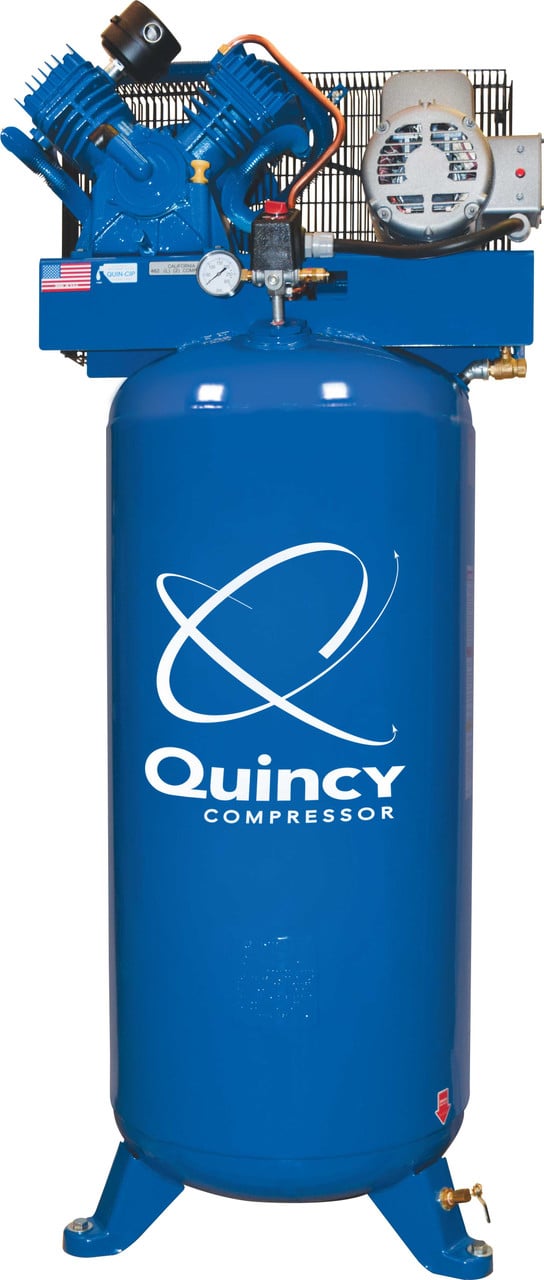
Quincy QT‑54 5 HP 60 Gallon Two‑Stage
- 60 gallons is 8.02 CF of receiver before any piping is counted
- Two-stage pumps run a wider pressure band, which is fix two built in
- Pressure-lubricated pumps are the ones rated for long loaded runs
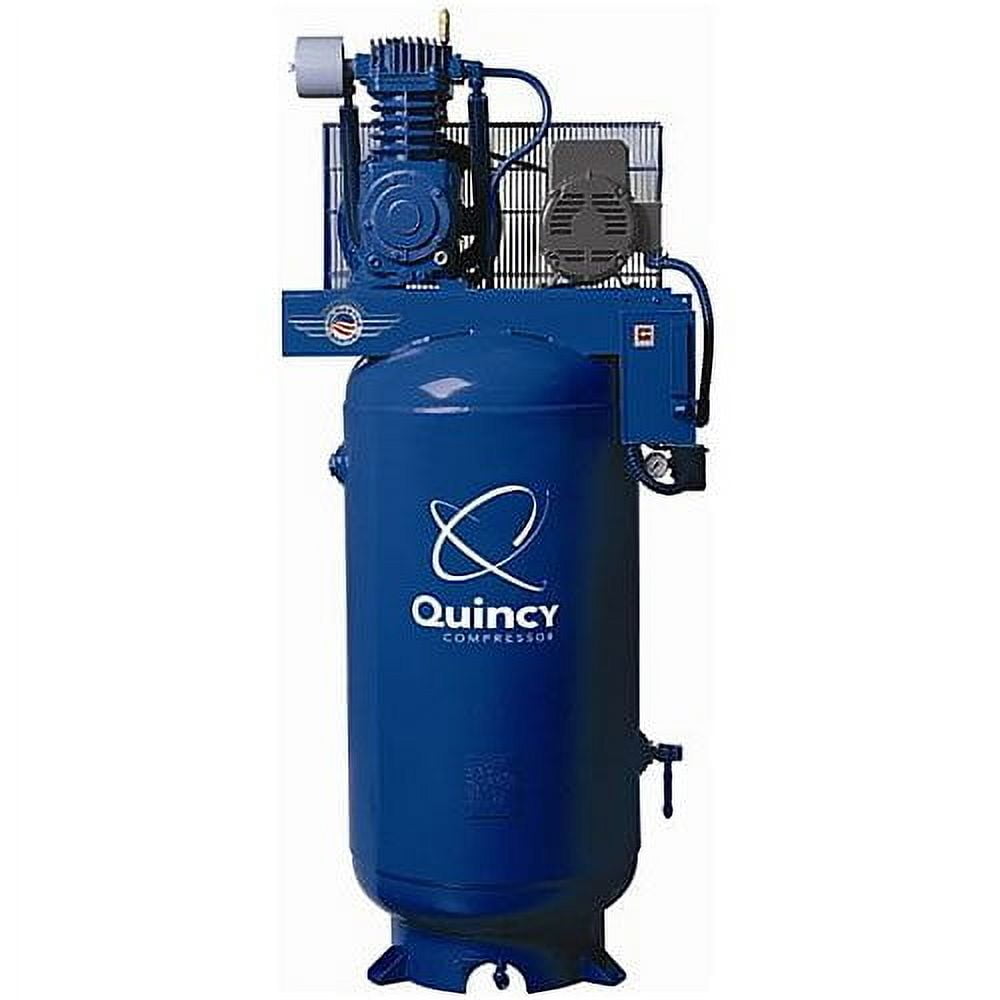
Quincy QT‑7.5 7.5 HP 80 Gallon
- 80 gallons is 10.70 CF — a third more free air per cycle than a 60
- More delivered CFM moves the worst-case demand point up with it
- Where demand has outgrown the pump, storage alone will not save it

LE LEMATEC Regulator & Gauge 0‑150 PSI
- Every cycle figure hangs on the actual cut-in and cut-out, not the label
- A drifted differential is a short-cycle you can often fix for free
- Set the regulator to what the tool needs, not to what the tank holds
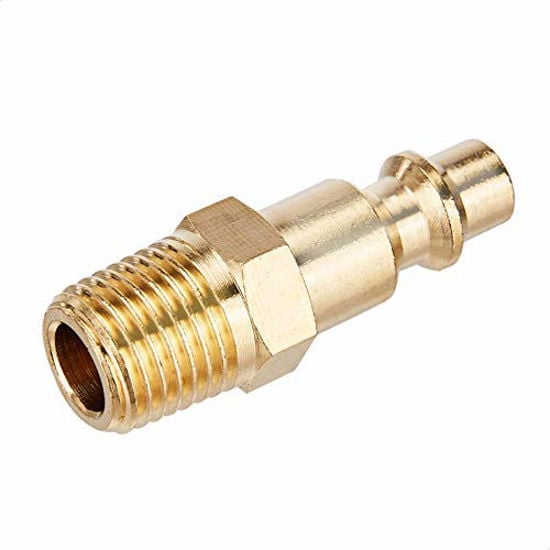
Quick‑Connect Brass Coupler & Plug Kit
- Leaks are demand, and demand sets both the duty cycle and the cycling
- Worn couplers are the most common hidden CFM on any shop air system
- CAGI calls under 10 percent leakage well maintained, over 30 percent common
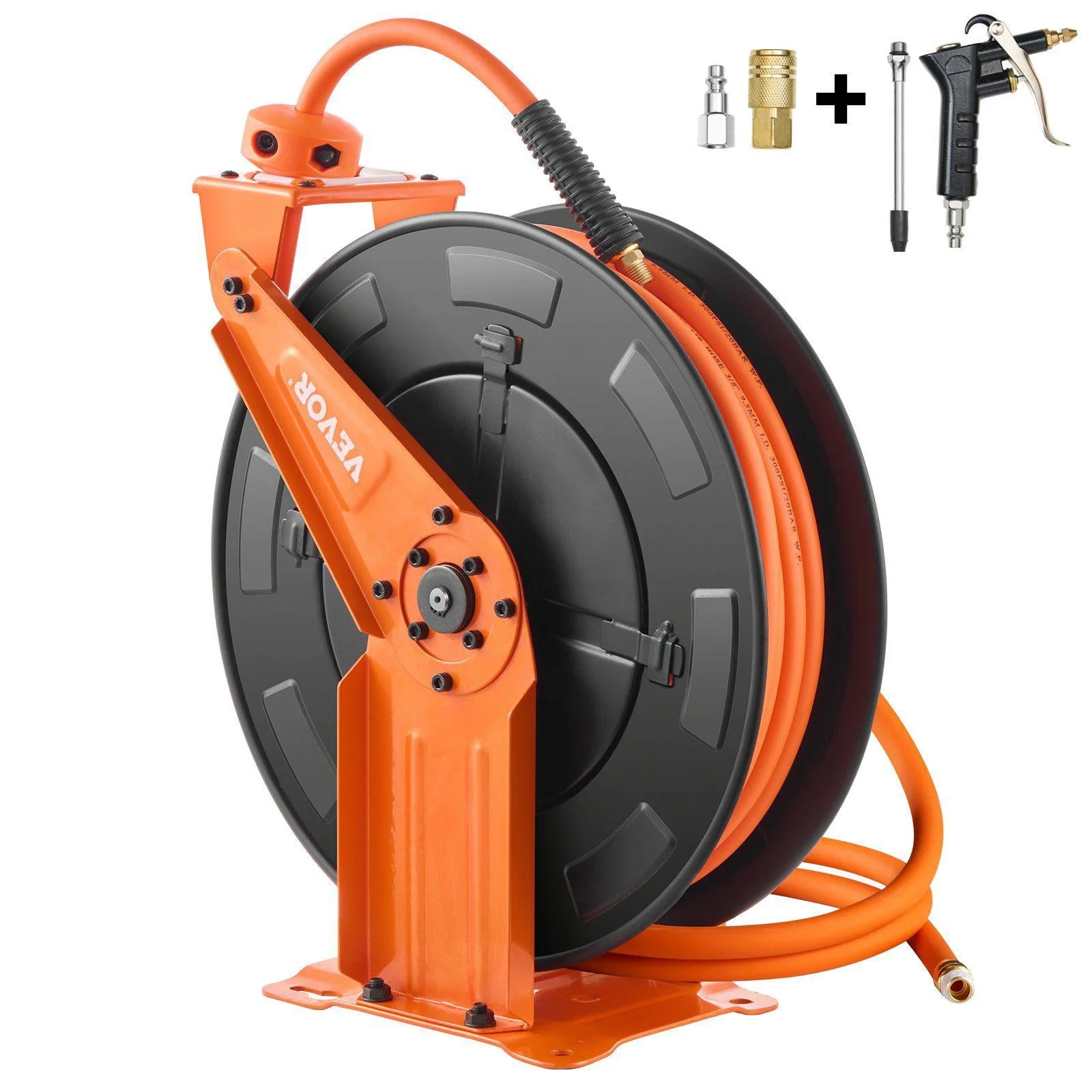
Relhost Retractable Air Hose Reel 65 ft x 3/8 in
- CAGI counts piping as storage — a long fat main genuinely lengthens the cycle
- Undersized hose is pressure drop, which pushes the regulator and switch up
- Storage near a heavy intermittent user is CAGI’s fix for demand gulps
As an Amazon Associate, TestTalkHQ earns from qualifying purchases. Prices and availability can change.
When the overload trips but the cycle looks fine
If the measured cycle is inside your limit and the motor still cuts out, the problem has moved from pneumatic to thermal or electrical. Three things to separate.
Starts, not run time. Each start draws a brief heavy current, and CAGI’s reasoning for the seven-per-hour recommendation is exactly this — “the brief starting load placed on an electric motor.” A motor can sit happily at a low duty cycle and still cook if the starts are bunched. Twelve starts spread evenly across an hour is a different thermal load from twelve starts in ten minutes, and an average hides that. Watch it during the busiest ten minutes, not across a quiet shift.
Cool-down between starts. This is why CAGI ties receiver size to thermal life rather than just to convenience: a larger receiver “helps reduce the amount of starts per hour, thus provides a longer cool-down period; a consideration for piston compressors in commercial or industrial applications.” If the trips only happen late in a busy run, you are watching heat accumulate.
Supply voltage under load. Measure it at the compressor while the motor is starting, not at the panel while it is idle. CAGI’s buyer’s guide is worth reading on the voltage side: standard household 110 V “will only operate compressors up to three horsepower”, and it lists the available combinations as three-phase 60 Hz at 200/208/230/460 V and single-phase 60 Hz at 115/208/230 V. A long undersized branch circuit sags on every start and the motor pays for it in heat.
If the amp draw itself is the anomaly rather than the cycling, compressor power draw troubleshooting works that angle. If the compressor is simply in a hot room, heat removal is a sizing problem of its own — see compressor room overheating and the room ventilation calculator.
The duty cycle is telling you something the starts count is not
Two machines can both start seven times an hour and be in completely different trouble, because starts per hour says nothing about how long each run lasts.
The duty cycle does, and it reduces to something very simple. Because pump-up is S ÷ (C − D) and drawdown is S ÷ D, the storage cancels out of the ratio entirely and what is left is duty = D ÷ C. Demand over capacity. No tank term.
So when you measure the cycle, read both numbers:
| Starts/hr | Duty cycle | What you have | Where to spend |
|---|---|---|---|
| High | Low | A storage problem, pure and simple | Receiver gallons or pressure band |
| High | High | Demand near half of capacity, with the machine working hard | Cut demand first — leaks — then storage |
| Low | High | Capacity problem. Long runs, few starts, no headroom | More delivered CFM, or less demand. A tank will not help |
| Low | Low | Nothing wrong. Go and look at something else | — |
The third row is the one that gets misdiagnosed most, because “it runs all the time” feels like a cycling complaint and is not one. If that row is yours, the decision is bigger tank vs more CFM, and the answer is the CFM.
Two cases where the arithmetic says to stop
Demand is at or above capacity
Then there is no cycle. The receiver can never refill, the motor runs continuously, and system pressure falls below cut-in and keeps going. Storage only buys time, and a deficit that never closes cannot be bought time out of. This is a capacity problem wearing a cycling costume, and the first thing to rule out is one large leak — because a single failed fitting can produce exactly this picture on a machine that was adequate last week.
The cycling is driven by one big intermittent user
A blow-off, a bag house, a large cylinder, a cabinet blow-down: one user that takes air in gulps will cycle a compressor that is comfortably sized for everything else. Averaging that user into total demand gives a number that describes neither state.
CAGI’s recommendation here is not a bigger compressor. It is a dedicated receiver near the heavy user, refilled through a needle valve during the user’s off time — “metered recovery” — which “allows for the compressed air equipment to be sized for average use instead of peak demand.” Its paper also flags the failure mode you get without it: if the piping or a coupler between the receiver and that user cannot pass the flow, “the stored air that is available in the system may not flow to the application when needed,” and you see a pressure collapse at the tool while the tank gauge looks healthy. That is a distribution fault, not a compressor fault, and it belongs in pressure drop troubleshooting.