Compressed Air Pressure Drop Troubleshooting
Locate the psi before you repipe anything
The receiver reads 120 psi and the sander still bogs down. Rather than guessing, this walks the measurement that tells you which segment of the system is actually eating your pressure — and which of the usual suspects to fix first.
Quick answer
If the tool is weak but the receiver gauge looks fine, the pressure is being lost somewhere between the two, and guessing which component is doing it is how shops end up repiping a main that was never the problem. The fix is a pressure map: measure at four or five points along the path while the tool is running, and let the gradient tell you which segment is eating the psi.
Static pressure tells you nothing. Pressure drop only exists when air is moving, so every measurement in this article is taken under load with the tool actually running.
Build the pressure map first
You need one gauge you trust and a way to tee it in at several points, or a handful of cheap gauges left in place. Run the worst-offending tool continuously and record the pressure at each station while it runs.
| # | Measure here | What a drop across this segment means |
|---|---|---|
| 1 | At the receiver, under load | Baseline. If this sags badly the problem is supply, not distribution. |
| 2 | Far end of the main, before the drop | Loss here is the hard-piped run: diameter, length, fittings, or scale. |
| 3 | After the filter / regulator / lubricator | A large step here is a loaded filter element or an undersized regulator. |
| 4 | End of the hose, before the coupler | Hose bore and length. Often the biggest single number on the sheet. |
| 5 | At the tool inlet | Whatever is left is the coupler and whip. |
Compare the measured step across the hard-piped main against what it should be. The pipe size calculator gives the expected drop for your diameter, flow, pressure and fitting count — if the measured loss is close to predicted, the main is behaving correctly and you should stop looking at it.
1. The main loses far more than calculated
When the measured drop across the hard pipe is well above the calculated figure, the pipe is not the pipe you think it is.
- Scale and corrosion in old black iron. Internal rust roughens the wall and narrows the bore, and pressure drop rises steeply as diameter falls. A 1 inch line scaled down to an effective 7/8 inch loses roughly half again as much pressure at the same flow.
- Uncounted fittings. Recount them. Branch tees are worth three times a run tee, and a run that looked like four fittings is frequently a dozen once you follow the pipe properly.
- A hidden reducer. A single 1/2 inch nipple, coupling or valve buried in a 1 inch run sets the pressure drop for the whole line.
- A partially closed valve. A ball valve at 45 degrees is not a ball valve; its resistance rises by orders of magnitude off full open.
- Flow you did not account for. Another drop open elsewhere, or a large leak upstream of your measurement, raises the flow through the segment and therefore the drop.
2. A big step across the filter, regulator or lubricator
An FRL is a consumable restriction. A clean filter element might cost one to three psi at rated flow; the same element loaded with rust, oil and dust can cost ten or more, and it degrades slowly enough that nobody notices the day it crossed over.
- Check the element, not the bowl. A clear bowl with no visible water says nothing about a loaded element.
- Check the regulator's flow rating, not just its pressure rating. A 1/4 inch regulator feeding a 15 SCFM sander will drop pressure badly no matter how it is adjusted, because the restriction is the port, not the setting.
- Watch the gauge while the tool runs. A regulator that reads 90 psi at rest and 55 psi under load is undersized for the flow, not faulty.
Size the FRL to the flow of the largest tool that will use that drop. It is common to find a correctly sized main feeding a correctly sized drop through a regulator meant for a blowgun.
Gear that decides whether your pipe size survives contact with the shop
The main is only one link. These are the parts that most often become the new restriction once the pipe itself is right.
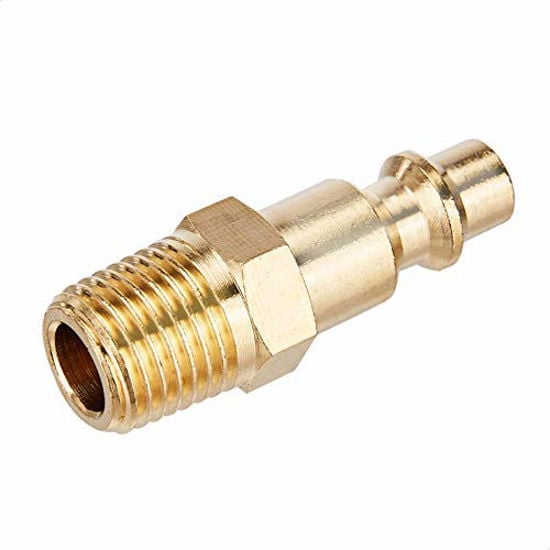
Quick Connect Brass Coupler Kit
Industrial-interchange couplers with a decent bore, so the last two inches of the system are not the biggest restriction in it.
View on Amazon
Regulator & Flow Control 0-150 PSI
Lets you set pressure at the point of use instead of raising header pressure to paper over distribution losses.
View on Amazon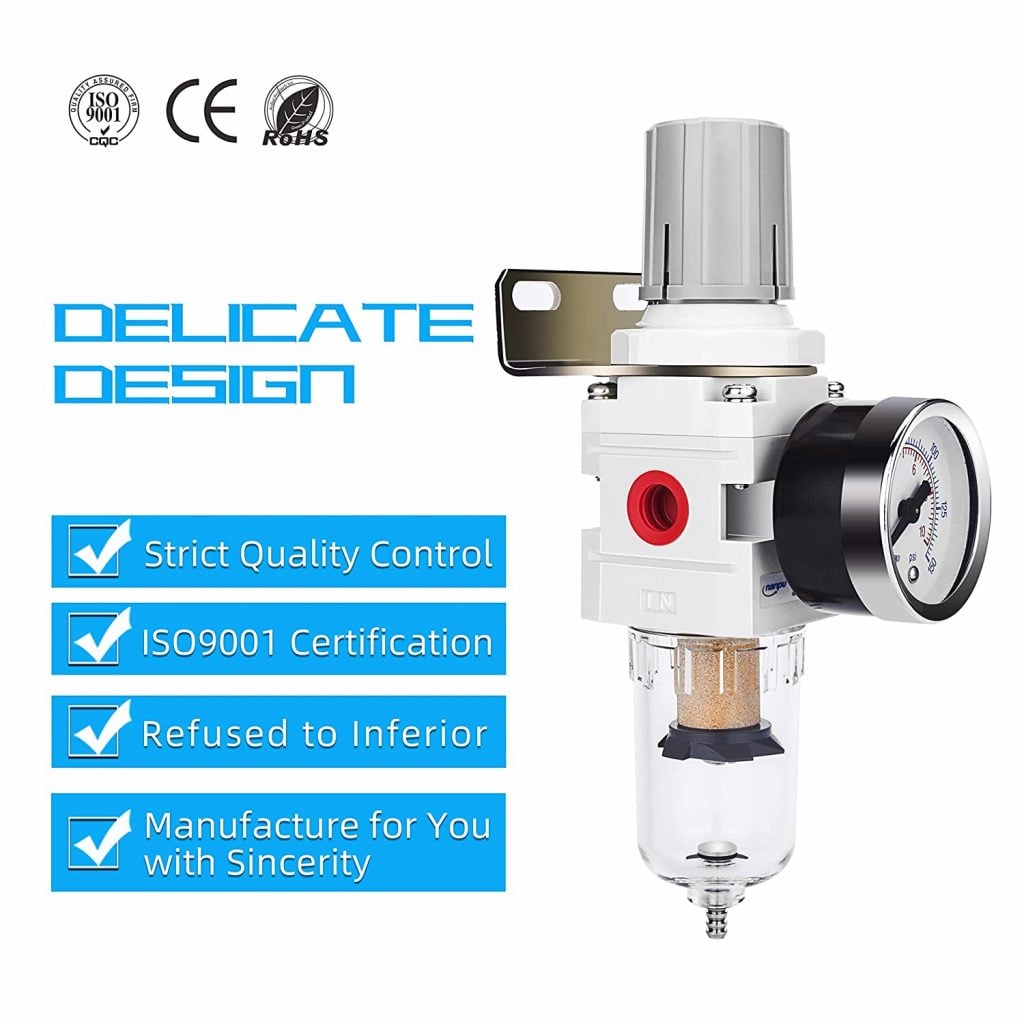
Filter / Regulator Combo
Water and scale in the bore raise real pressure drop over time. A filter at each drop keeps the pipe you sized behaving like the pipe you sized.
View on Amazon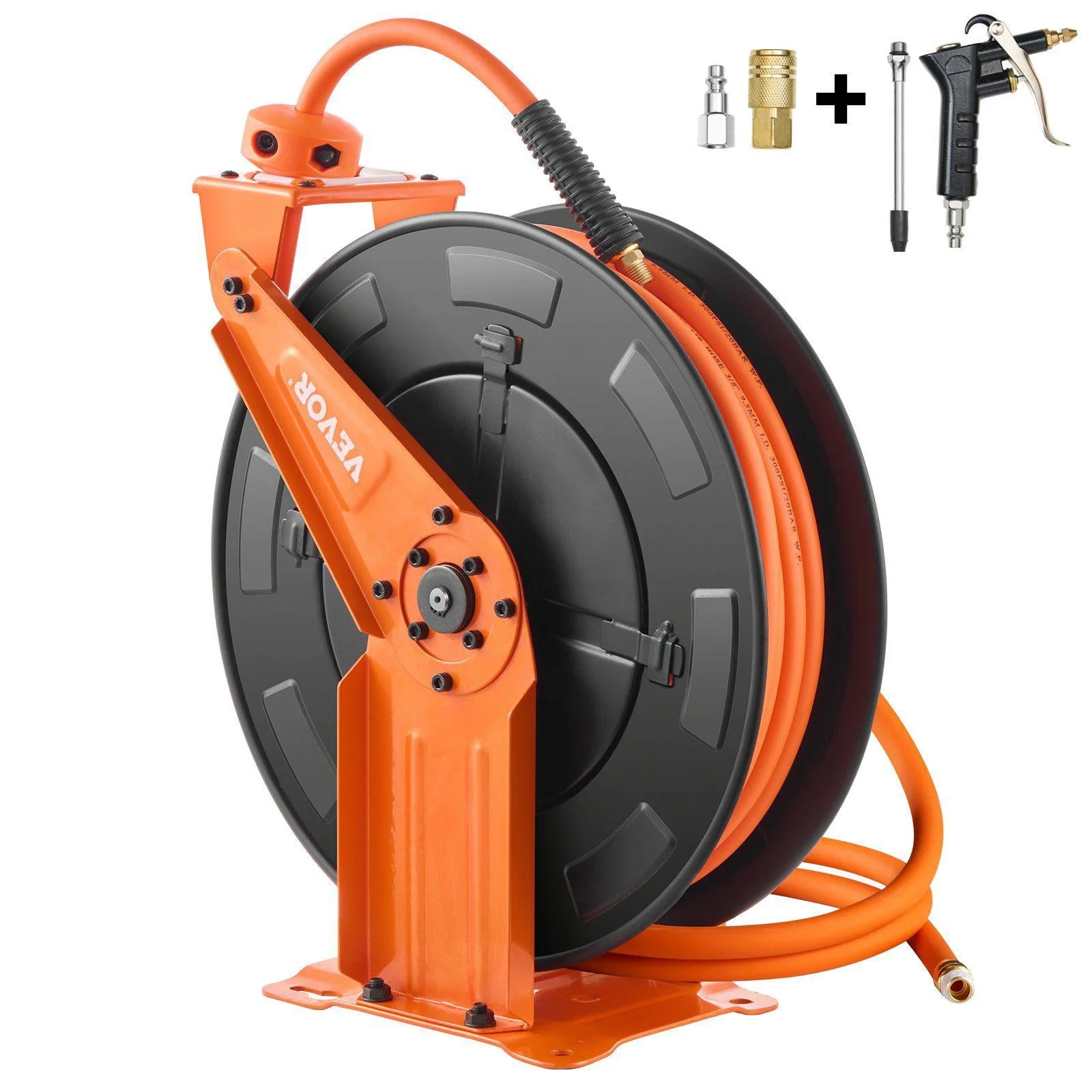
Relhost 65ft Retractable Reel
A 3/8 in bore instead of 1/4 in is frequently worth more real psi at the tool than one step up in hard pipe.
View on Amazon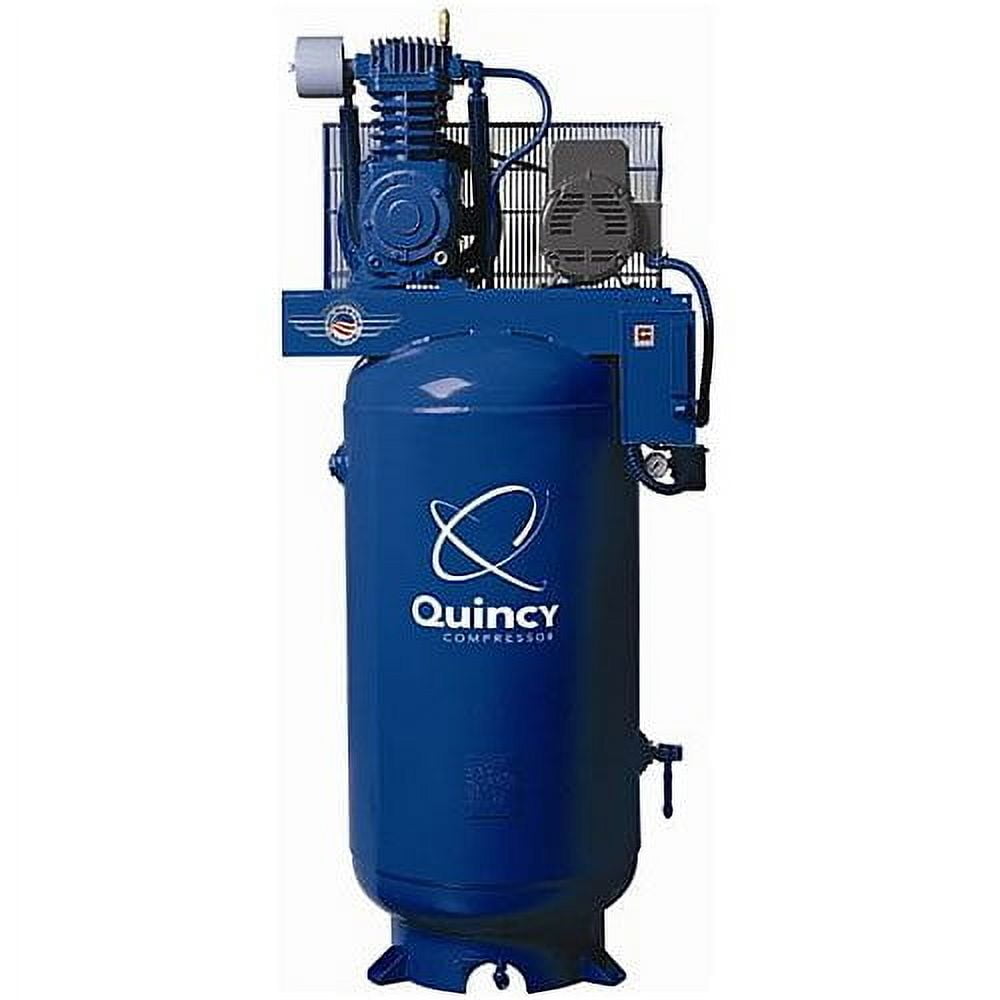
Quincy QT-7.5 80-Gallon
Receiver volume smooths the peak draws that a steady-flow pipe calculation assumes away.
View on AmazonAs an Amazon Associate, TestTalkHQ earns from qualifying purchases. Prices and availability can change.
3. The hose is the main — and usually the culprit
This is the single most common finding, and it is the one most likely to survive a full repipe because nobody measures it. Hose has a far smaller bore than the pipe feeding it, and pressure drop scales with roughly the fifth power of diameter, so the swing between 1/4 inch and 3/8 inch hose is not marginal — it is the difference between a tool that works and one that does not.
- Bore first. Moving a continuous tool from 1/4 inch to 3/8 inch hose is frequently worth more real psi at the tool than one step up in hard pipe.
- Length second. Drop is proportional to length. Two 25 ft hoses coupled together are the same loss as one 50 ft run, plus the coupler in the middle.
- Coiled hose is worse than it looks. A recoil hose is long, small-bore and full of bends, all three of which work against you.
- Leave the reel out of the equation when testing. Measure with a short known-good hose to see what the tool does when it is actually fed.
4. Quick-couplers strangle the last two inches
Quick-connect couplers vary enormously in flow capacity between interchange styles that look identical and physically mate. An inexpensive coupler with a small internal bore can cost several psi on its own at the flows a sander or grinder draws, and a tool fed through two of them — one at the reel, one at the whip — pays twice.
- Standardise on one higher-flow interchange across the shop rather than mixing whatever was in the bin.
- Delete redundant couplers. Every disconnect in the path is a restriction; many exist only because that is how the hose came.
- Feed genuinely high-flow tools directly where practical, or step the fitting size up at that station.
5. When it is not the distribution at all
If the receiver gauge itself sags under load, the problem is upstream of everything in this article and no amount of repiping will fix it. Symptoms such as a compressor that will not build to cut-out, short-cycling, runtime that falls short of calculation, or persistent moisture are compressor-side and are covered separately in the air compressor troubleshooting guide — start there rather than duplicating the diagnosis here.
Likewise, if the real complaint is that the system costs too much to run rather than that the tools are weak, leak load and duty-cycle assumptions are the place to look; the compressed air cost troubleshooting guide works that angle in detail.
Run your own numbersThe pipe size calculator gives pressure drop and velocity for every common size at your flow, pressure, run length and fitting count.
Open the calculatorClose the loop after the fix
Re-run the same pressure map after every change, one change at a time. Two fixes applied together tell you the total improvement but not which one earned it, and the one that did nothing will be repeated on the next system.
- Record the numbers at each station before and after. Memory is generous about how bad things used to be.
- Verify at the tool under load, not at the receiver at rest.
- Drop header pressure back down once the losses are gone. If you raised discharge pressure to compensate, leaving it raised keeps paying about 1 percent more power for every 2 psi.
Frequently asked questions
Why does my air tool bog down when the gauge reads 90 psi?
Because the gauge is reading static pressure at the receiver with no flow. Pressure drop only appears when air is moving. Measure at the tool inlet while the tool is actually running and the real number will be much lower.
How do I find where compressed air pressure is being lost?
Build a pressure map. Measure under load at the receiver, at the far end of the main, after the filter and regulator, at the end of the hose, and at the tool. The segment with the largest step is the one to fix, and the calculated drop for your pipe tells you whether the hard piping is behaving normally.
Can old black iron pipe cause pressure drop?
Yes. Internal rust roughens the wall and narrows the bore, and pressure drop rises steeply as effective diameter falls, so an old line can lose considerably more than the same nominal size did when new.
Does hose diameter really matter that much?
Enormously. Pressure drop scales with roughly the fifth power of diameter, so moving a continuous tool from 1/4 inch to 3/8 inch hose is often worth more psi at the tool than stepping the hard pipe up a size.
Should I just raise the compressor pressure to compensate?
It works and it is expensive. Every extra 2 psi of discharge pressure costs roughly 1 percent more compressor power for as long as the system runs, so it is a permanent charge for a problem that usually has a one-time fix.
Related calculators & guides
The receiver reads 120 psi and the sander still bogs down. Rather than guessing, this walks the measurement that tells you which segment of the system is actually eating your pressure — and which of the usual suspects to fix first.
Quick answer
If the tool is weak but the receiver gauge looks fine, the pressure is being lost somewhere between the two, and guessing which component is doing it is how shops end up repiping a main that was never the problem. The fix is a pressure map: measure at four or five points along the path while the tool is running, and let the gradient tell you which segment is eating the psi.
Static pressure tells you nothing. Pressure drop only exists when air is moving, so every measurement in this article is taken under load with the tool actually running.
Build the pressure map first
You need one gauge you trust and a way to tee it in at several points, or a handful of cheap gauges left in place. Run the worst-offending tool continuously and record the pressure at each station while it runs.
| # | Measure here | What a drop across this segment means |
|---|---|---|
| 1 | At the receiver, under load | Baseline. If this sags badly the problem is supply, not distribution. |
| 2 | Far end of the main, before the drop | Loss here is the hard-piped run: diameter, length, fittings, or scale. |
| 3 | After the filter / regulator / lubricator | A large step here is a loaded filter element or an undersized regulator. |
| 4 | End of the hose, before the coupler | Hose bore and length. Often the biggest single number on the sheet. |
| 5 | At the tool inlet | Whatever is left is the coupler and whip. |
Compare the measured step across the hard-piped main against what it should be. The pipe size calculator gives the expected drop for your diameter, flow, pressure and fitting count — if the measured loss is close to predicted, the main is behaving correctly and you should stop looking at it.
1. The main loses far more than calculated
When the measured drop across the hard pipe is well above the calculated figure, the pipe is not the pipe you think it is.
- Scale and corrosion in old black iron. Internal rust roughens the wall and narrows the bore, and pressure drop rises steeply as diameter falls. A 1 inch line scaled down to an effective 7/8 inch loses roughly half again as much pressure at the same flow.
- Uncounted fittings. Recount them. Branch tees are worth three times a run tee, and a run that looked like four fittings is frequently a dozen once you follow the pipe properly.
- A hidden reducer. A single 1/2 inch nipple, coupling or valve buried in a 1 inch run sets the pressure drop for the whole line.
- A partially closed valve. A ball valve at 45 degrees is not a ball valve; its resistance rises by orders of magnitude off full open.
- Flow you did not account for. Another drop open elsewhere, or a large leak upstream of your measurement, raises the flow through the segment and therefore the drop.
2. A big step across the filter, regulator or lubricator
An FRL is a consumable restriction. A clean filter element might cost one to three psi at rated flow; the same element loaded with rust, oil and dust can cost ten or more, and it degrades slowly enough that nobody notices the day it crossed over.
- Check the element, not the bowl. A clear bowl with no visible water says nothing about a loaded element.
- Check the regulator's flow rating, not just its pressure rating. A 1/4 inch regulator feeding a 15 SCFM sander will drop pressure badly no matter how it is adjusted, because the restriction is the port, not the setting.
- Watch the gauge while the tool runs. A regulator that reads 90 psi at rest and 55 psi under load is undersized for the flow, not faulty.
Size the FRL to the flow of the largest tool that will use that drop. It is common to find a correctly sized main feeding a correctly sized drop through a regulator meant for a blowgun.
Gear that decides whether your pipe size survives contact with the shop
The main is only one link. These are the parts that most often become the new restriction once the pipe itself is right.
Quick Connect Brass Coupler Kit
Industrial-interchange couplers with a decent bore, so the last two inches of the system are not the biggest restriction in it.
Regulator & Flow Control 0-150 PSI
Lets you set pressure at the point of use instead of raising header pressure to paper over distribution losses.
Filter / Regulator Combo
Water and scale in the bore raise real pressure drop over time. A filter at each drop keeps the pipe you sized behaving like the pipe you sized.
Relhost 65ft Retractable Reel
A 3/8 in bore instead of 1/4 in is frequently worth more real psi at the tool than one step up in hard pipe.
Quincy QT-7.5 80-Gallon
Receiver volume smooths the peak draws that a steady-flow pipe calculation assumes away.
As an Amazon Associate, TestTalkHQ earns from qualifying purchases. Prices and availability can change.
3. The hose is the main — and usually the culprit
This is the single most common finding, and it is the one most likely to survive a full repipe because nobody measures it. Hose has a far smaller bore than the pipe feeding it, and pressure drop scales with roughly the fifth power of diameter, so the swing between 1/4 inch and 3/8 inch hose is not marginal — it is the difference between a tool that works and one that does not.
- Bore first. Moving a continuous tool from 1/4 inch to 3/8 inch hose is frequently worth more real psi at the tool than one step up in hard pipe.
- Length second. Drop is proportional to length. Two 25 ft hoses coupled together are the same loss as one 50 ft run, plus the coupler in the middle.
- Coiled hose is worse than it looks. A recoil hose is long, small-bore and full of bends, all three of which work against you.
- Leave the reel out of the equation when testing. Measure with a short known-good hose to see what the tool does when it is actually fed.
4. Quick-couplers strangle the last two inches
Quick-connect couplers vary enormously in flow capacity between interchange styles that look identical and physically mate. An inexpensive coupler with a small internal bore can cost several psi on its own at the flows a sander or grinder draws, and a tool fed through two of them — one at the reel, one at the whip — pays twice.
- Standardise on one higher-flow interchange across the shop rather than mixing whatever was in the bin.
- Delete redundant couplers. Every disconnect in the path is a restriction; many exist only because that is how the hose came.
- Feed genuinely high-flow tools directly where practical, or step the fitting size up at that station.
5. When it is not the distribution at all
If the receiver gauge itself sags under load, the problem is upstream of everything in this article and no amount of repiping will fix it. Symptoms such as a compressor that will not build to cut-out, short-cycling, runtime that falls short of calculation, or persistent moisture are compressor-side and are covered separately in the air compressor troubleshooting guide — start there rather than duplicating the diagnosis here.
Likewise, if the real complaint is that the system costs too much to run rather than that the tools are weak, leak load and duty-cycle assumptions are the place to look; the compressed air cost troubleshooting guide works that angle in detail.
Run your own numbersThe pipe size calculator gives pressure drop and velocity for every common size at your flow, pressure, run length and fitting count.
Close the loop after the fix
Re-run the same pressure map after every change, one change at a time. Two fixes applied together tell you the total improvement but not which one earned it, and the one that did nothing will be repeated on the next system.
- Record the numbers at each station before and after. Memory is generous about how bad things used to be.
- Verify at the tool under load, not at the receiver at rest.
- Drop header pressure back down once the losses are gone. If you raised discharge pressure to compensate, leaving it raised keeps paying about 1 percent more power for every 2 psi.
Frequently asked questions
Why does my air tool bog down when the gauge reads 90 psi?
Because the gauge is reading static pressure at the receiver with no flow. Pressure drop only appears when air is moving. Measure at the tool inlet while the tool is actually running and the real number will be much lower.
How do I find where compressed air pressure is being lost?
Build a pressure map. Measure under load at the receiver, at the far end of the main, after the filter and regulator, at the end of the hose, and at the tool. The segment with the largest step is the one to fix, and the calculated drop for your pipe tells you whether the hard piping is behaving normally.
Can old black iron pipe cause pressure drop?
Yes. Internal rust roughens the wall and narrows the bore, and pressure drop rises steeply as effective diameter falls, so an old line can lose considerably more than the same nominal size did when new.
Does hose diameter really matter that much?
Enormously. Pressure drop scales with roughly the fifth power of diameter, so moving a continuous tool from 1/4 inch to 3/8 inch hose is often worth more psi at the tool than stepping the hard pipe up a size.
Should I just raise the compressor pressure to compensate?
It works and it is expensive. Every extra 2 psi of discharge pressure costs roughly 1 percent more compressor power for as long as the system runs, so it is a permanent charge for a problem that usually has a one-time fix.