
A compressor that shuts down on high discharge temperature at two in the afternoon in July, and runs perfectly all winter, is not usually a broken compressor. It is a room that reaches equilibrium somewhere above the data plate, and it only shows up when the outside air is hot enough to push that equilibrium over the line. This is the diagnostic order that separates a room which is genuinely undersized from a room that is recirculating its own exhaust, from a fan that is being starved by an opening nobody measured — and tells you when to stop looking at the room and open the machine.

Start here: what this covers, and what it does not
This article is about the room: the air going into the compressor and the heat coming out of it. It is not a guide to the inside of the machine, and it deliberately stops at the enclosure door.
- If the symptom is low pressure, short-cycling, or a tank that will not fill, start with air compressor troubleshooting instead — those are demand and delivery faults, and they have their own order.
- If the symptom is water downstream and the compressor itself is fine, read the last section here first (a hot room is a common cause), then go to dryer troubleshooting for the dryer’s own failure modes.
- If the machine is new to a high-altitude site and simply never made its rated CFM, that is a derate question rather than a heat question: altitude derate calculator.
The three measurements, in this order
Every diagnosis below comes out of three temperatures and one velocity. Take all four before forming an opinion; taking them out of order is how people end up replacing a thermal valve to fix a blocked louver.
| # | Reading | Where | What it separates |
|---|---|---|---|
| 1 | Outdoor air temperature | In the shade, outside the intake louver | Your baseline. Everything else is measured against this. |
| 2 | Compressor intake air temperature | At the machine’s own air inlet, doors shut, machine loaded | Recirculation. If this is well above outdoors, the room is feeding the machine its own exhaust. |
| 3 | Room air temperature | At the machine, not at the door | Whether the room has an equilibrium below your limit at all. |
| 4 | Louver face velocity × free area | Anemometer at the intake louver | Whether the fan is delivering its rating or being starved. |
Two of those readings need the room shut and the machine working hard. A compressor room measured with the door propped open and the machine unloaded tells you nothing about the condition it fails in.
Fault 1 — the room is simply undersized
Signature: room temperature climbs steadily through a long loaded run and never settles. Intake temperature tracks the room, roughly. Measured louver CFM is close to whatever the fan is rated for. Trips happen on hot days, and the hotter the day the sooner in the run they happen.
This is the honest case: the heat balance has no solution below your temperature limit, so the room keeps climbing until something stops it. Confirm it with arithmetic rather than by feel. Take the measured input power in kW, multiply by 3,412 and by the fraction of heat staying in the room, and divide by 1.08 times the rise you are allowed. If that number is materially above the CFM you measured at the louver, you have found the fault and the rest of this article is not your problem.
Fixes, cheapest first: duct the package’s cooler exhaust outside (this removes roughly three-quarters of the heat before it reaches the room — CAGI puts 72% of input energy as easily recovered from the cooler exhaust by ducting); move the dryer and anything else electrical out of the room; duct the compressor’s own intake to outside air; and only then buy a bigger fan and cut a bigger hole. The full method is in the compressor room ventilation guide.
Fault 2 — the room is recirculating
Signature: intake temperature is clearly hotter than the room average, and the room average is clearly hotter than outdoors, but the ventilation arithmetic says the room should be fine. Often accompanied by a machine that is worse when a door is shut than when it is open, and by a hot patch you can feel with your hand at one end of the package.
Recirculation means the machine is breathing air it has already heated. There are three common geometries:
2a. The package out-flows the room
An air-cooled compressor has a substantial cooling fan of its own. If the room exhaust moves less air than the package fan does, the difference cannot come in through the louver — it has to come from somewhere inside the room, and the only air available is the air the package just discharged. The machine ends up in a loop with itself.
Check it by comparing the package’s data-sheet cooling airflow with the CFM you measured at the louver. If you have no data sheet, CAGI’s stated 30–40 °F cooling-air rise lets you estimate it from the heat, which is what the calculator does when you leave the package airflow at zero. The room exhaust has to be at least as large as the package fan, regardless of what the heat balance says.
2b. The exhaust discharges where the intake can see it
Two openings on the same wall, or a roof discharge under an overhang with the intake below it, or a discharge into a courtyard whose air does not go anywhere. The fix is geometry, not capacity: intake low on one side, exhaust high on the opposite side, and a discharge that genuinely delivers the air somewhere it will not come straight back.
2c. The machine is too close to a wall or a corner
Packaged machines have stated clearances, and they are not conservative padding — they are the space the cooler needs to draw and discharge. A machine pushed against a wall to free up floor space recirculates around its own cabinet. An infrared thermometer run along the enclosure and the wall behind it will show you the loop.
The instruments this job actually needs
Compressor room ventilation is one of the few shop problems where the diagnosis is genuinely a measurement rather than a judgement. Four readings settle almost every case: the air velocity at the louver, the temperature of the air going in, the temperature of the air coming out, and the current the machine is drawing. Fans and louvers themselves are selected from a curve and bought locally, so TestTalkHQ does not link them.
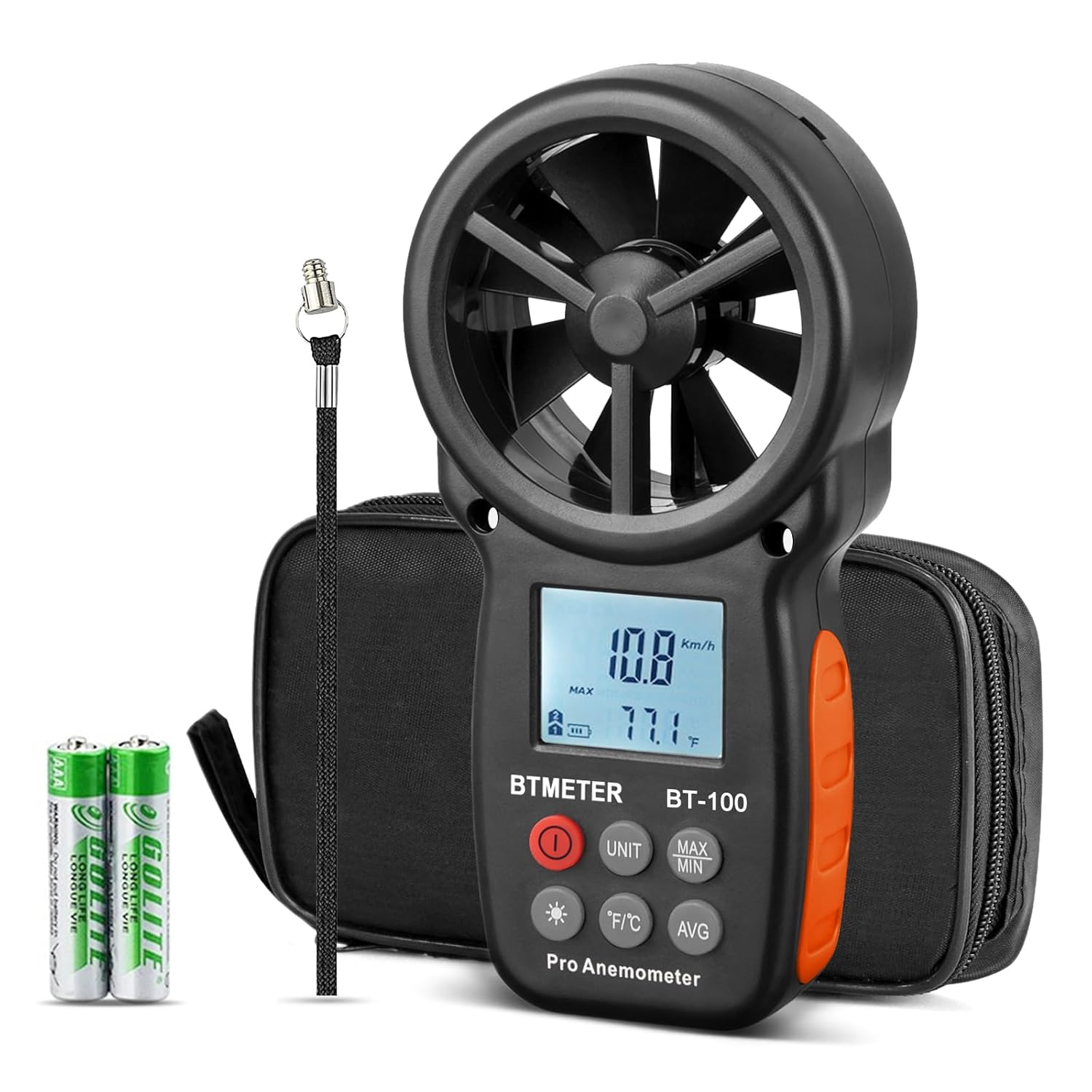
BTMETER BT-100 Handheld Anemometer
- Face velocity in fpm at the louver or the fan
- Velocity × free area is the CFM you really have
- The one reading that proves a fan is starved
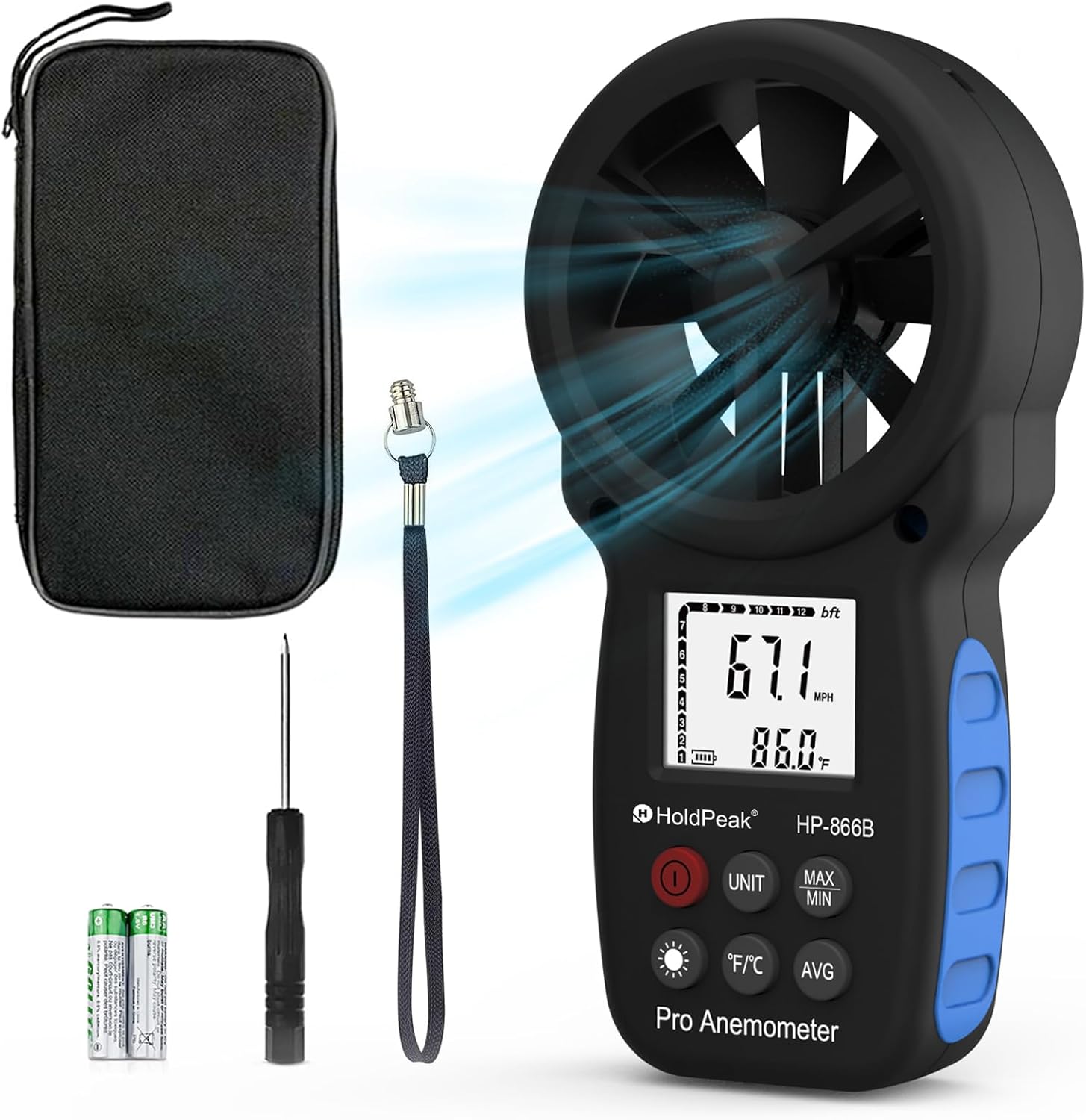
HoldPeak 866B Thermo-Anemometer
- Velocity and air temperature from one probe
- Intake and exhaust readings give you the real rise
- Cheap enough to leave in the plant room
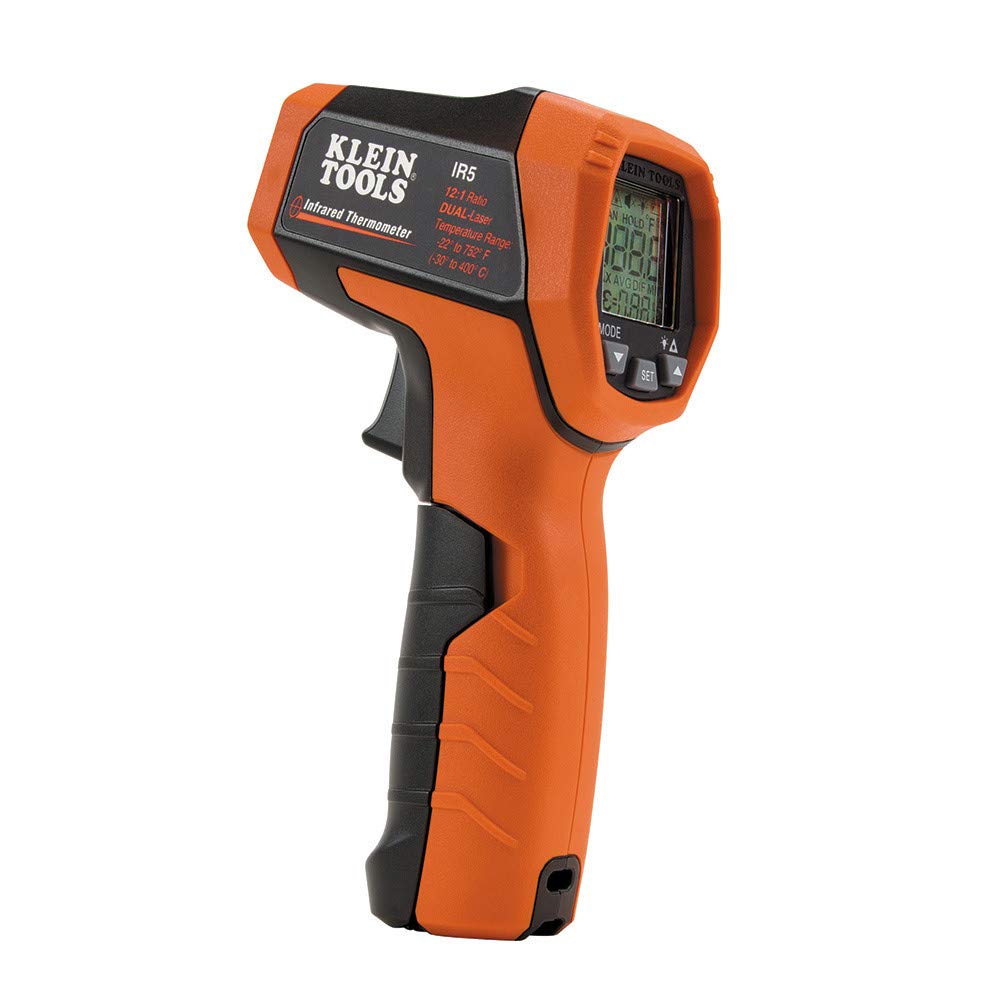
Klein Tools IR5 Infrared Thermometer
- Reads the cooler face and the enclosure without contact
- Traces a recirculation path around a packaged machine
- Dual laser keeps the spot where you aimed it
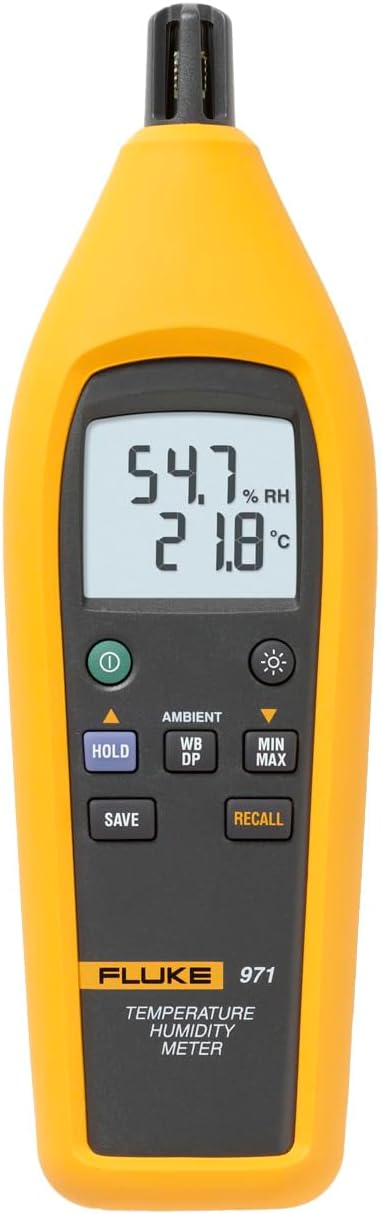
Fluke 971 Temperature / Humidity Meter
- Air temperature rather than surface temperature
- Log intake and room on the hottest afternoon of the year
- Humidity matters to the dryer sharing the room

Klein Tools CL800 Clamp Meter
- Loaded current beats a grossed-up nameplate every time
- Input power is the largest term in the heat balance
- Also settles arguments about real load factor
As an Amazon Associate, TestTalkHQ earns from qualifying purchases. Prices and availability can change.
Fault 3 — the fan is starved
Signature: the fan is running, the room is hot, and the measured louver velocity times free area is well below the fan’s rating. Sometimes the fan motor current is lower than expected rather than higher, which surprises people.
A fan rating is a point on a curve at a stated static pressure. Restrict the path and the fan does not strain — it slides back up its curve, moves much less air, and in many cases draws less power doing it. So “the fan is running and it is not tripping its overload” is not evidence that the fan is working.
Pressure drop through an opening goes with the square of velocity. Force the design flow through an opening two-thirds the size it should be and the velocity is 1.5×, so the drop is 2.25×. Halve the effective opening and the drop is 4×. That is how a small obstruction turns into a large problem.
| Restriction | How it hides | Check |
|---|---|---|
| Insect or bird screen over the intake | Looks like nothing. A fine mesh can be a bigger resistance than the louver behind it, and it blinds with dust in summer. | Hold a tissue to it, then measure velocity before and after cleaning. |
| Louver free area much lower than assumed | Somebody sized the hole, not the free area. A 50%-free louver halves the opening you thought you had. | Catalogue free-area percentage for that model, or count and measure the blades. |
| Stock, pallets or a workbench against the louver | Seasonal and invisible on a drawing | Walk the room. This is the single most common cause in a working shop. |
| Backdraft damper stuck or stiff | Gravity dampers seize with dust and paint | Watch the blades with the fan running. |
| Long or crushed discharge duct | The fan was selected for free air and then ducted | Fan curve at the real system static pressure, not the free-air rating. |
| Fan running backwards | Three-phase rotation reversed at some point. It still moves some air, badly. | Rotation arrow, and a velocity reading at the discharge. |
Fix the restriction before changing the fan. A fan that is being starved and a fan that is too small look identical from the outside and have completely different repairs.
Fault 4 — it is not the room
If measurements 1 to 4 all come back clean — intake within a couple of degrees of outdoors, room comfortably below the data plate limit, louver delivering its duty — then the room is doing its job and the fault is inside the machine. At that point stop and go to the manufacturer’s manual, because the remaining causes are machine-specific and several of them are not user-serviceable. In rough order of how often they turn up:
- A fouled cooler. The package’s own aftercooler and oil cooler are air-to-air matrices living in a shop, and they block with dust, oil mist and lint from the outside in. A cooler that looks clean at the face can be packed solid a quarter of an inch deep. This is maintenance, it is on a schedule in the manual, and it is the most common genuine machine-side cause of high discharge temperature.
- Low lubricant, or the wrong lubricant. On an oil-injected screw the oil is the coolant, and level and grade both matter more than people expect.
- A thermal or thermostatic valve not opening. It exists to keep the machine warm at start-up and it fails in the position that keeps it warm forever.
- A failed or slipping package cooling fan. Belt-driven package fans slip; electric ones fail quietly on one phase.
- A blocked intake filter. Different symptom, same season. DOE’s tip sheet on intake air notes that a new inlet filter’s pressure drop should not exceed 3 psi and that a dirty one can cut compressor efficiency by 1–3%.
- A genuinely faulty temperature sensor or switch. Last on the list, not first, and confirmed with an independent thermometer rather than assumed.
The seasonal pattern is half the diagnosis
When the fault appears tells you almost as much as any measurement, because ventilation faults are driven by outdoor air temperature and machine faults usually are not.
| Pattern | Most likely | Next step |
|---|---|---|
| Hot afternoons only, fine in the morning | Room sized for average conditions, not design day | Heat balance against measured louver CFM |
| Summer only, all day | Undersized ventilation, or an intake in the sun | Measurements 1–3, then the guide |
| All year, worse in summer | Recirculation plus marginal capacity | Intake vs outdoor temperature first |
| All year, no seasonal pattern at all | Machine side — cooler, lubricant, thermal valve, fan | Fault 4, and the manual |
| Started suddenly, no weather change | Something moved or blocked — pallets at the louver, a seized damper, reversed rotation after electrical work | Walk the room and measure the louver |
| Started after a second machine arrived | Heat load doubled, ventilation did not | Recalculate with both machines in the balance |
| Fine on the compressor, water downstream in summer | The dryer, defeated by room ambient | Next section |
The symptom that is not a compressor fault at all
A large share of “the compressor room got hot” problems are reported as moisture, not as temperature, and never generate a single trip. The mechanism is a double hit that both goes the wrong way at once:
- Warmer intake air carries far more water vapour, so the compressor takes in more moisture per cubic foot and the condensate load rises.
- A refrigerated dryer in the same hot room is outside — or near the top of — its own ambient rating, so its capacity falls at exactly the moment the load rises.
The result is water at the tools in July and a dry system in October, with no fault code anywhere. Check the dryer’s ambient against its rating rather than the compressor’s, quantify the load with the condensate calculator, and work the removal chain with the moisture removal guide. If the dryer is genuinely inside its ratings and still not holding dew point, that is a dryer fault and it belongs in dryer troubleshooting.
The cost that never trips anything
Even when nothing shuts down, a hot room is charging you continuously. DOE’s Compressed Air Tip Sheet #14 puts it directly: as intake air temperature rises, air density falls and “mass flow and pressure capability decrease”, with the result that “the resulting reduction in capacity is often addressed by operating additional compressors, thus increasing energy consumption.” The density arithmetic is unforgiving: air at 100 °F is about 5.4% thinner than air at 70 °F, and at 110 °F about 7.0% thinner. That is delivered CFM you have already paid for, quietly disappearing on the busiest days of the year.
Frequently asked questions
Why does my air compressor overheat only in summer?
Because ventilation is a temperature balance, not a fixed capability. The room settles wherever heat in equals heat out, and the temperature it settles at is roughly the outdoor temperature plus a fixed rise set by your airflow. If that rise is 15 °F, a 70 °F day gives you an 85 °F room and a 95 °F day gives you a 110 °F room. The ventilation did not change; the starting point did. This is also why commissioning a compressor room in spring proves nothing.
What temperature is too hot for an air compressor?
Above the maximum ambient on its own data plate, which is commonly 104 °F (40 °C) on packaged machines but must be read rather than assumed. In practice something else in the room usually has a lower limit — a refrigerated dryer especially — so the binding constraint is often not the compressor at all.
Will a bigger exhaust fan fix my hot compressor room?
Only if the fault is capacity. It will not fix recirculation, because a bigger fan moves more air around the same short circuit; and it will not fix a starved intake, because the new fan will be starved too. Take measurement 2 (intake versus outdoor temperature) and measurement 4 (louver velocity times free area) before buying anything — between them they tell you which of the three faults you have.
My fan is running but the room is still hot. What now?
Measure what it is actually moving rather than trusting the rating: anemometer at the louver, velocity times free area. A starved fan runs quietly, does not trip its overload, and often draws less current than nameplate while delivering a fraction of its rated flow. Then look for the restriction — screen, undersized free area, something stacked against the louver, a stuck backdraft damper, or reversed rotation.
Is it normal for compressed air to come out hot?
Air leaving the airend is very hot; air leaving a working aftercooler should be close to ambient, typically within a modest approach of the cooling air temperature. If your discharge air is hot at the receiver, the aftercooler is not doing its job — which is either a fouled cooler or cooling air that is already hot because the room is. That approach-temperature test is worked through in dryer troubleshooting.
Can I put the compressor outside instead?
It solves the heat problem and introduces several others: weather protection, freezing condensate and drains, lubricant viscosity at cold start, security, and noise for the neighbours. Manufacturers make outdoor-rated enclosures for exactly this reason. Moving a standard indoor package outdoors under a sheet of plywood is not the same thing and usually ends in a rusted machine.